U937 Xenograft Model Overview
The U937 xenograft model is derived from a human histiocytic lymphoma cell line that exhibits monocyte-like morphology and behavior. Originally isolated from the pleural effusion of a patient with histiocytic lymphoma, U937 cells differentiate into macrophage-like cells under stimulation and are widely used as a representative model for myeloid lineage malignancies, including monocytic leukemia. The U937 xenograft model provides a unique platform for studying tumor progression, immune modulation, and the tumor microenvironment in hematologic malignancies with monocytic features. Its adaptability to drug testing, immunologic profiling, and gene regulation studies makes it a valuable tool in preclinical oncology research focused on monocytic and macrophage-driven cancer pathologies.
Request a Custom Quote for U937 Xenograft ModelBiological and Molecular Characteristics
U937 cells possess characteristics of early-stage monocyte precursors, including the expression of CD33, CD13, CD14 (upon induction), and HLA-DR. They are negative for lymphoid markers such as CD3, CD19, and CD20. The cells harbor mutations and gene expression profiles consistent with disrupted myeloid differentiation and are responsive to various stimuli such as phorbol esters, vitamin D3, and interferons, which induce differentiation into mature macrophages. U937 cells express moderate levels of anti-apoptotic proteins such as BCL2 and MCL1, as well as transcription factors including C/EBPβ and PU.1, involved in myeloid lineage specification. Their cytokine and chemokine expression profile makes them suitable for immunological studies, particularly those exploring tumor-immune cell crosstalk.
| Characteristic | Description |
|---|---|
| Tissue Origin | Human histiocytic lymphoma / monocytic leukemia |
| Differentiation Potential | Monocyte to macrophage (under induction) |
| Immunophenotype | CD33+, CD13+, CD14+ (inducible), HLA-DR+, CD3–, CD20– |
| Key Pathways | BCL2 family, MAPK, cytokine signaling, differentiation axes |
| Research Applications | Monocytic leukemia, immune-oncology, myeloid differentiation |
In Vivo Model Development and Tumorigenicity
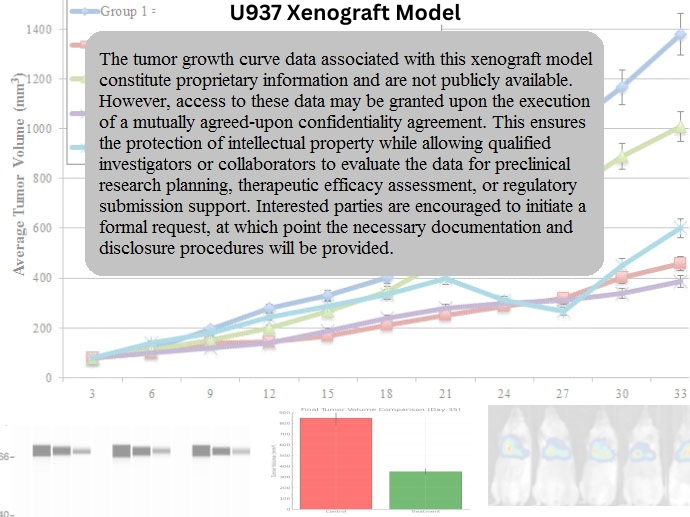
The U937 xenograft model is established through subcutaneous injection of cells into immunocompromised mice, typically NOD/SCID or NSG strains. Tumor formation is moderately fast, with visible tumors developing within 3 to 4 weeks post-inoculation. U937 tumors exhibit consistent growth kinetics and can reach volumes of 400–700 mm³ within 6 to 8 weeks. The model’s moderate tumorigenicity allows for a flexible treatment window suitable for single-agent or combination therapy evaluation. Importantly, the U937 xenograft reflects features of myeloid malignancies, offering a translational platform for targeting monocytic pathways, differentiation blockade, and inflammation-related mechanisms in leukemia models.
Request a Custom Quote for U937 Xenograft ModelHistopathology and Immunohistochemical Profile
Histologically, U937 xenograft tumors present as sheets of large, mononuclear cells with abundant cytoplasm and round to oval nuclei. Hematoxylin and eosin staining reveals a monoblastic or promonocytic morphology, with moderate mitotic activity and occasional apoptotic bodies. Immunohistochemistry typically shows cytoplasmic CD68 expression, inducible CD14, and moderate to strong HLA-DR staining, indicating myeloid lineage and MHC class II expression. Proliferation indices vary but commonly reach 50–70% as measured by Ki-67. Additionally, the model demonstrates modest vascularity and infiltration of mouse stromal cells, permitting studies on myeloid–stromal interactions.
Preclinical Applications and Drug Response
The U937 xenograft model is employed in preclinical testing of therapies directed at monocytic leukemia, particularly those targeting differentiation, survival, and inflammation-related signaling. It has been used extensively to assess agents that modulate apoptosis (e.g., BCL2 inhibitors), induce differentiation (e.g., ATRA, vitamin D analogs), or suppress pro-inflammatory cytokine pathways (e.g., JAK/STAT and NF-κB inhibitors). The model is well-suited for immune-oncology approaches that investigate macrophage polarization, tumor-associated macrophage depletion, and checkpoint blockade. Due to its inducible differentiation and immunologic plasticity, U937 is uniquely positioned to bridge basic leukemia biology and translational therapeutic development.
Request This Model
To request the U937 xenograft model for your preclinical studies, please use the form below. A customized quote and additional model specifications will be provided upon inquiry.
Request a Custom Quote for U937 Xenograft Model