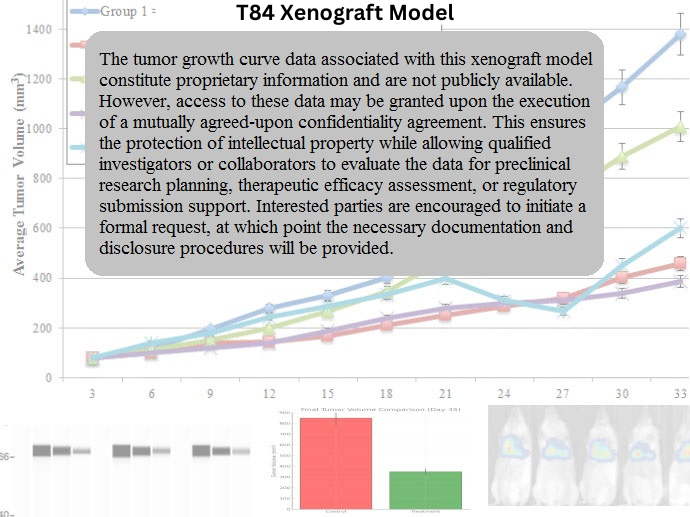
T84 Xenograft Model Overview
The T84 xenograft model is derived from a human colorectal carcinoma cell line established from a lung metastasis of a primary colon adenocarcinoma in a 72-year-old female patient. This model is particularly recognized for its high transepithelial resistance and tight junction integrity, traits that are preserved in vivo and contribute to its unique utility in both oncology and gastrointestinal research. T84 xenografts are valued for their ability to form well-differentiated, mucin-secreting tumors that recapitulate key histological and functional characteristics of human colorectal epithelium. With their pronounced epithelial polarity and barrier-forming properties, T84 xenografts offer a distinctive platform for studying tumor progression, barrier dysfunction, and treatment response in colorectal cancer, particularly in models that mimic metastatic disease.
Request a Custom Quote for T84 Xenograft ModelBiological and Molecular Characteristics
T84 cells display a columnar epithelial morphology with high levels of E-cadherin, tight junction proteins (e.g., claudin-1, occludin, and ZO-1), and mucin production. The cell line is microsatellite stable and harbors wild-type KRAS and BRAF, though TP53 is mutated. These characteristics allow for mechanistic studies focused on tight junction integrity, epithelial barrier signaling, and mucin-associated drug resistance. T84 cells express low to moderate levels of carcinoembryonic antigen (CEA), cytokeratin 20 (CK20), and mucin 2 (MUC2), further confirming their lineage fidelity. Their slow proliferation rate and high differentiation status distinguish them from more aggressive colorectal models and make them suitable for evaluating drugs requiring prolonged exposure or testing in epithelial-stabilized tumor environments.
| Characteristic | T84 Cell Line Profile |
|---|---|
| Tissue of Origin | Colorectal carcinoma (lung metastasis) |
| KRAS/BRAF Status | Wild-type |
| TP53 Status | Mutated |
| MSI Status | Microsatellite stable (MSS) |
| Differentiation Markers | MUC2, CK20, CEA |
| Junctional Proteins | Claudin-1, Occludin, ZO-1, E-cadherin |
In Vivo Model Development and Tumorigenicity
T84 xenografts are established by subcutaneous injection of cultured cells into immunodeficient mouse strains such as athymic nude or NOD/SCID mice. Tumor take rate is moderate due to the cell line’s slow proliferation, but once established, tumor growth is stable and reproducible. Tumor volumes typically reach 700–900 mm³ within 5 to 7 weeks. The model exhibits cohesive tumor architecture with minimal necrosis and limited inflammatory infiltration, reflecting the epithelial characteristics of the original tumor. The slow but steady growth kinetics allow for detailed longitudinal evaluation of treatment response and facilitate pharmacodynamic studies over extended dosing periods. The model is also compatible with mucosal barrier-focused investigations and transporter analysis due to preserved junctional protein expression.
Request a Custom Quote for T84 Xenograft ModelHistopathology and Immunohistochemical Profile
T84 xenografts form well-differentiated glandular tumors with prominent luminal spaces and abundant mucin secretion. Histologically, the tumors mimic intestinal architecture, including columnar epithelial cells with basally oriented nuclei and mucin-filled apical cytoplasm. Periodic acid–Schiff (PAS) staining highlights intracellular mucin pools, while hematoxylin and eosin staining reveals low mitotic index and intact structural organization. Immunohistochemistry confirms expression of CK20 and MUC2, validating colorectal epithelial identity. Strong membranous staining for tight junction markers such as claudin-1 and ZO-1 is retained in vivo, indicating preserved barrier integrity. These features enable histopathological fidelity that is uncommon in more proliferative and less differentiated CRC xenograft models.
Preclinical Applications and Drug Response
The T84 xenograft model is ideally suited for evaluating therapeutic responses in mucinous and well-differentiated colorectal cancers. Its KRAS/BRAF wild-type status allows for sensitivity testing to EGFR-targeted therapies, while the presence of tight junction proteins and mucin secretion makes it valuable for exploring epithelial barrier modulation and mucin-associated drug resistance. T84 tumors respond variably to DNA-damaging agents, and their low proliferation rate may reduce sensitivity to cell cycle-specific drugs, which must be considered when designing dosing regimens. Additionally, the model’s retention of polarized membrane structures and efflux transporter expression allows for integration into drug absorption and permeability studies. The T84 xenograft is particularly useful for researchers examining long-term drug effects, epithelial barrier dynamics, and mucin-mediated pharmacological resistance in colorectal carcinoma.
Request This Model
For preclinical research focused on epithelial differentiation, mucin production, and colorectal tumor barrier properties, the T84 xenograft model offers a uniquely informative platform. Contact our team to initiate access to this model and discuss study design options tailored to your research objectives.
Request a Custom Quote for T84 Xenograft Model