T24/83 Xenograft Model Overview
The T24/83 xenograft model is derived from a human transitional cell carcinoma of the urinary bladder and represents a well-characterized system for studying invasive urothelial carcinoma in vivo. Originating from the T24 parental cell line, the T24/83 variant retains the hallmark features of bladder carcinoma, including high proliferative potential, tumorigenic competence, and responsiveness to mitogenic stimuli. The T24 line was originally established from a grade III carcinoma in a male patient and has been extensively used in cancer biology to investigate oncogene activation, cell cycle deregulation, and chemotherapeutic responses. The T24/83 derivative maintains the aggressive phenotype of its parent line but demonstrates enhanced reproducibility in tumor formation and growth when implanted into immunodeficient murine hosts.
This model is particularly relevant to the study of muscle-invasive bladder cancer (MIBC), which accounts for a significant proportion of advanced bladder cancer cases and is associated with high morbidity and mortality. T24/83 xenografts exhibit consistent tumor engraftment, measurable tumor volumes, and a robust response to pharmacological modulation, making them well suited for drug screening, resistance mechanism studies, and biomarker discovery. The model is frequently used for evaluating PI3K/AKT/mTOR pathway inhibitors, DNA-damaging agents, and therapies targeting RAS-driven malignancies.
Request a Custom Quote for T24/83 Xenograft ModelBiological and Molecular Characteristics
The T24/83 cell line carries a homozygous activating mutation in the HRAS gene (codon 12, G12V), a defining feature that drives downstream MAPK and PI3K signaling cascades, contributing to uncontrolled proliferation and survival. In addition to the RAS mutation, T24/83 exhibits high expression of cyclin D1, CDK4, and EGFR, reflecting the mitogenic dysregulation commonly observed in advanced urothelial carcinoma. The line is p53-deficient due to a nonsense mutation leading to truncated, non-functional protein, impairing DNA damage responses and promoting genomic instability.
Cytogenetically, T24/83 cells display complex karyotypic abnormalities, including multiple chromosomal rearrangements and aneuploidy. They express epithelial markers such as E-cadherin and cytokeratin 18, though at reduced levels, suggestive of a partial epithelial-to-mesenchymal transition (EMT) phenotype. The cells are negative for uroplakin, distinguishing them from more differentiated urothelial cell lines and indicating a high-grade, invasive phenotype.
The table below summarizes key molecular characteristics of the T24/83 cell line:
| Characteristic | T24/83 Profile |
|---|---|
| Species/Origin | Human urinary bladder carcinoma |
| Mutation Profile | HRAS (G12V), TP53 (nonsense), RB1 loss |
| p53 Status | Non-functional (truncated protein) |
| EGFR Expression | High (membranous localization) |
| Cell Cycle Regulators | Overexpression of cyclin D1, CDK4 |
| EMT Markers | Reduced E-cadherin; partial EMT phenotype |
| Differentiation Marker (Uroplakin) | Negative |
| MMP Expression | MMP-2 and MMP-9 positive |
| Growth Factor Receptors | EGFR+, weak FGFR3, VEGF-A expression present |
| Cytogenetics | Aneuploid, complex chromosomal rearrangements |
The cell line lacks functional RB1 and shows dysregulated p16^INK4a expression, further contributing to unchecked cell cycle progression. T24/83 cells also exhibit enhanced migratory capacity in vitro and express matrix metalloproteinases (MMP-2 and MMP-9), which are associated with invasive behavior and metastasis potential, although distant dissemination in vivo remains limited under standard subcutaneous implantation conditions.
In Vivo Model Development and Tumorigenicity
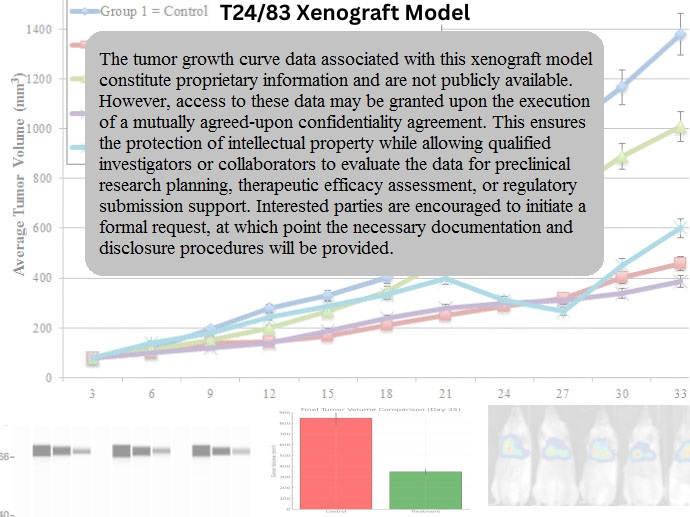
The T24/83 xenograft model demonstrates consistent tumorigenicity when injected subcutaneously into immunocompromised mice, including athymic nude and NOD-SCID strains. Tumor take rates exceed 90% in optimized conditions using Matrigel or serum-enriched matrices, with palpable tumor formation typically occurring within 10–14 days post-injection. Tumor volumes increase in a linear-to-logarithmic phase over a 3–4 week window, permitting robust evaluation of therapeutic agents in short-to-mid-term studies.
Optimal implantation involves subcutaneous injection of 5 × 10^6 to 1 × 10^7 cells suspended in 1:1 Matrigel:PBS into the flank region. Tumor growth kinetics are reproducible, with endpoint volumes of 1,000–1,500 mm³ generally reached within 28–35 days post-implantation. Orthotopic bladder implantation of T24/83 has been reported in specialized surgical protocols, enabling assessment of local tumor growth, stromal interaction, and bladder wall invasion, although such procedures require microsurgical precision and bladder instillation techniques.
The T24/83 xenograft model supports longitudinal tumor measurement, bioluminescent imaging (when transduced), and analysis of serum or tumor tissue for pharmacodynamic endpoints. It is considered an aggressive and rapidly progressing model suitable for short-course drug efficacy screening and mechanistic studies of oncogenic RAS signaling.
Request a Custom Quote for T24/83 Xenograft ModelHistopathology and Immunohistochemical Profile
Histologically, T24/83 xenografts exhibit a poorly differentiated carcinoma phenotype, characterized by densely packed tumor cells with scant cytoplasm, prominent nucleoli, and frequent mitotic figures. The tumors lack glandular differentiation and do not form papillary structures, mirroring the histopathology of high-grade muscle-invasive urothelial carcinoma.
Immunohistochemical analysis typically reveals strong nuclear staining for Ki-67, indicative of high proliferative activity (>70% labeling index). The tumors stain positively for cytokeratin 7 (CK7) and pan-cytokeratin, confirming epithelial origin. Expression of EGFR is diffusely membranous, and phospho-ERK1/2 and phospho-AKT are present at high levels, consistent with active RAS and PI3K pathway signaling.
Staining for MMP-9 and VEGF-A is often positive, reflecting the model’s angiogenic and invasive properties. Loss of p53 and RB1 expression is confirmed by absent or weak staining in IHC, corroborating known molecular defects. CD31 staining of endothelial cells indicates moderate-to-high tumor vascularization, supporting adequate drug delivery and diffusion during in vivo studies.
Preclinical Applications and Drug Response
The T24/83 xenograft model is widely used for preclinical evaluation of compounds targeting the RAS/RAF/MEK/ERK and PI3K/AKT/mTOR pathways. Its HRAS-driven oncogenicity makes it particularly suitable for testing farnesyltransferase inhibitors, MEK inhibitors, and downstream kinase modulators. The model has demonstrated partial sensitivity to cisplatin and gemcitabine, both of which are used in clinical management of bladder cancer, although resistance tends to develop rapidly, reflecting real-world therapeutic limitations.
Combination regimens incorporating cisplatin with PI3K inhibitors or PARP inhibitors have shown enhanced efficacy in vivo, likely due to the model’s impaired DNA damage response. The T24/83 system is also valuable in studying acquired resistance mechanisms, particularly in the context of EGFR-targeted therapies, where feedback activation of alternate signaling pathways often undermines treatment efficacy.
Beyond cytotoxic and targeted agents, the model is used in evaluating drug-induced modulation of EMT, MMP activity, and angiogenesis. Its rapid growth kinetics allow for efficient screening of multiple agents in parallel, with clear readouts in tumor volume reduction, proliferation index changes, and biomarker expression modulation. Given its poor differentiation and genetic instability, the T24/83 model approximates the aggressive and treatment-resistant nature of advanced bladder carcinoma, enhancing its translational relevance in preclinical oncology.
Request This Model
To obtain the T24/83 xenograft model or inquire about customization options, including orthotopic transplantation, bioluminescent tagging, or tailored therapeutic studies, please submit a request through the button below. Our team will assist with study design, quotation, and integration into your research pipeline.
Request a Custom Quote for T24/83 Xenograft Model