SW756 Xenograft Model Overview
The SW756 xenograft model is derived from a human cervical carcinoma classified as squamous cell carcinoma (SCC). The parent cell line, SW756, originates from a 56-year-old female patient and retains many of the hallmarks associated with HPV-driven cervical neoplasia, including high expression of p16^INK4a^ and deregulation of cell cycle checkpoints. This xenograft system serves as a valuable preclinical tool for studying cervical cancer pathophysiology, tumor proliferation, and therapeutic response in an in vivo context.
As a moderately to poorly differentiated squamous carcinoma model, SW756 provides relevant histological and molecular features for evaluating cytotoxic agents, targeted therapies, and immunomodulatory strategies. The model is particularly useful for investigating treatments targeting the p53 and Rb pathways, which are frequently disrupted in HPV-associated malignancies. It also supports exploration of EGFR and PI3K/AKT pathway inhibitors due to partial activation of these signaling axes.
Request a Custom Quote for SW756 Xenograft ModelBiological and Molecular Characteristics
SW756 cells display epithelial morphology and maintain a keratinizing squamous phenotype. Despite being derived from a cervical tumor, the cell line is HPV-negative, distinguishing it from many cervical cancer models and providing a unique system to evaluate HPV-independent carcinogenesis. It exhibits functional p53 mutations, reduced Rb expression, and constitutive overexpression of p16^INK4a^, along with modest PI3K/AKT pathway activation and detectable EGFR signaling.
| Characteristic | SW756 Profile |
|---|---|
| Tissue of Origin | Cervix (squamous cell carcinoma) |
| HPV Status | Negative |
| Histological Subtype | Moderately to poorly differentiated squamous carcinoma |
| p53 Status | Mutant |
| p16^INK4a^ Expression | Overexpressed |
| Rb Status | Downregulated |
| EGFR Status | Low to moderate expression |
| PI3K/AKT Pathway | Modestly activated |
| EMT Markers | Low |
| Proliferation Rate | Moderate (Ki-67 ~40–50%) |
This combination of molecular markers makes SW756 ideal for comparative studies involving HPV-negative cervical cancer and non-viral squamous tumors.
In Vivo Model Development and Tumorigenicity
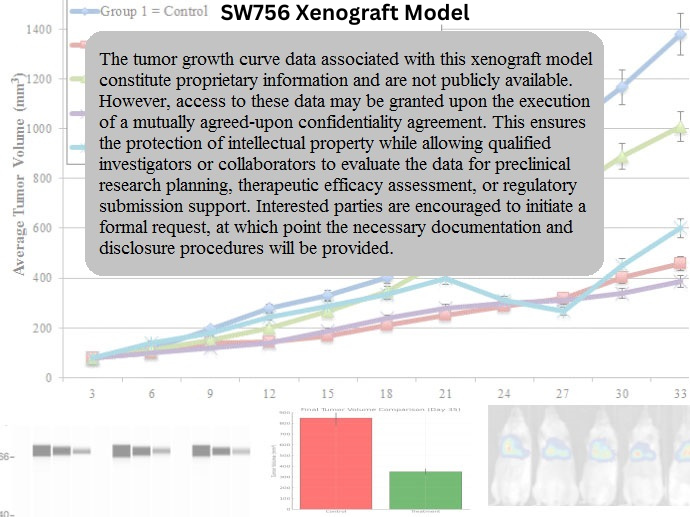
The SW756 xenograft model is typically established by subcutaneous injection of 5 × 10⁶ cells suspended in serum-free medium, often supplemented with Matrigel to improve tumor take. The model is compatible with both athymic nude and NOD/SCID mice. Tumor take rates range from 80% to 90%, and tumors reach measurable volumes (100–150 mm³) within 10–14 days post-implantation.
Tumor growth is generally linear, with xenografts reaching 1,000–1,200 mm³ in approximately 5–6 weeks. The model demonstrates low ulceration frequency and good histological fidelity to human squamous cell carcinoma. SW756 can also be adapted for orthotopic implantation in the vaginal-cervical region in advanced research protocols.
The model is highly responsive to platinum-based chemotherapies, including cisplatin and carboplatin, and it also supports longitudinal imaging using fluorescent or luciferase-tagged variants of the cell line.
Request a Custom Quote for SW756 Xenograft ModelHistopathology and Immunohistochemical Profile
SW756 xenografts recapitulate key morphological features of human cervical squamous cell carcinoma. Tumors display solid nests of polygonal epithelial cells with eosinophilic cytoplasm, intercellular bridges, and focal keratin pearl formation. Mitotic figures and nuclear atypia are prominent, reflecting high proliferative activity.
Immunohistochemically, tumors are positive for cytokeratin 5/6, p16^INK4a^, and pan-cytokeratin. Nuclear accumulation of mutant p53 is detectable, along with reduced Rb staining. Ki-67 labeling indexes typically exceed 40%, confirming moderate proliferative potential. E-cadherin expression is preserved, while EGFR expression is variable but measurable, particularly in peripheral tumor zones. In treated tumors, markers such as cleaved caspase-3 and γH2AX provide insight into therapeutic effect and DNA damage response.
These histologic and immunohistochemical features enhance the model’s utility for drug response profiling and mechanistic validation.
Preclinical Applications and Drug Response
SW756 xenografts are used extensively in preclinical trials focused on cervical cancer treatment, especially in the context of HPV-independent tumor biology. The model is particularly useful for:
- Cisplatin and carboplatin sensitivity testing in squamous cervical tumors
- EGFR pathway modulation using tyrosine kinase inhibitors or monoclonal antibodies
- p16^INK4a^–Rb axis studies involving CDK4/6 inhibitors or agents targeting senescence pathways
- PI3K/AKT and mTOR inhibitors, alone or in combination with standard therapies
- Radiotherapy adjunct studies, due to the model’s partial radioresistance and replicable tumor microarchitecture
Additionally, SW756 offers a unique platform to evaluate immunomodulatory agents or checkpoint inhibitors in models of squamous tumors that do not express viral antigens, allowing discrimination between viral and host-derived immune evasion mechanisms.
Request This Model
To incorporate the SW756 xenograft model into your cervical cancer research program or preclinical therapeutic pipeline, request a custom xenograft services package below. Services include tumor engraftment, therapeutic response studies, histopathology, and molecular biomarker profiling.
Request a Custom Quote for SW756 Xenograft Model