SW1573 Xenograft Model Overview
The SW1573 xenograft model is derived from a human non-small cell lung cancer (NSCLC) squamous cell carcinoma and serves as a valuable tool for investigating therapeutic responses in tumors lacking actionable EGFR or KRAS mutations. Originating from a male patient’s primary lung tumor, the SW1573 cell line reflects a treatment-resistant NSCLC subtype with mesenchymal-like features and high basal levels of drug efflux and apoptotic resistance. When implanted into immunodeficient mice, SW1573 cells generate moderately aggressive tumors with stable growth kinetics and well-defined squamous histology. This model is particularly useful for evaluating chemotherapeutics, multidrug resistance modulators, pro-apoptotic agents, and novel delivery platforms aimed at poorly differentiated, non-oncogene-addicted lung tumors.
Request a Custom Quote for SW1573 Xenograft ModelBiological and Molecular Characteristics
The SW1573 cell line exhibits a KRAS and EGFR wild-type genotype and harbors a functionally inactive TP53 mutation, resulting in impaired apoptotic response and poor checkpoint control. Unlike many lung adenocarcinoma models, SW1573 demonstrates molecular and phenotypic markers consistent with squamous cell carcinoma and displays upregulated expression of drug resistance transporters such as MDR1 and MRP1. The cell line also expresses mesenchymal markers, including vimentin, and demonstrates low levels of epithelial adhesion proteins like E-cadherin, suggesting partial epithelial-mesenchymal transition (EMT). PD-L1 is expressed at low levels but can be induced under inflammatory stimuli, making the model compatible with combination immunotherapy investigations. Elevated levels of BCL-XL and survivin further reinforce its resistance phenotype and support testing of apoptotic sensitizers.
| Characteristic | Description |
|---|---|
| Tissue Origin | Human NSCLC (squamous cell carcinoma) |
| Key Genetic Features | EGFR wild-type, KRAS wild-type, TP53 mutant |
| Resistance Features | MDR1+, MRP1+, BCL-XL+, survivin+ |
| EMT/Phenotype Markers | Vimentin+, low E-cadherin, partial EMT |
| Immunophenotype | Low PD-L1, MHC class I intact |
In Vivo Model Development and Tumorigenicity
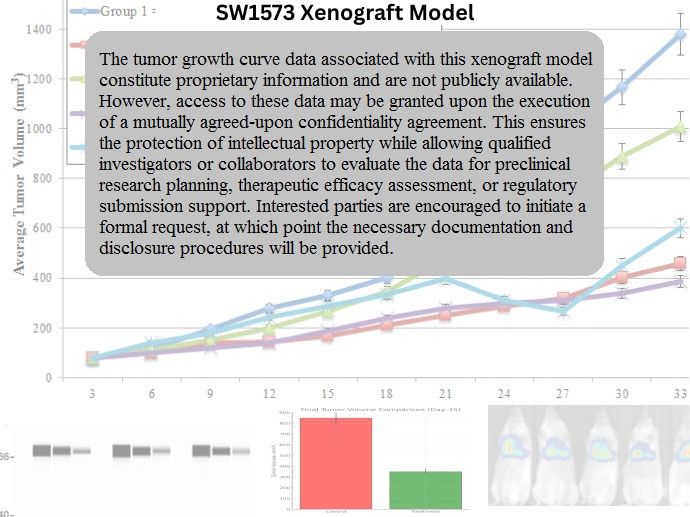
SW1573 xenografts are established via subcutaneous injection into immunodeficient mouse models, including athymic nude or NOD/SCID strains. Tumor nodules become palpable within 12–16 days, and measurable volumes of 300–600 mm³ are typically achieved within five to six weeks post-implantation. The model exhibits moderate take rates and a consistent growth trajectory, allowing for repeatable experimental timelines and therapeutic response assessments. Its well-vascularized architecture supports compound delivery, pharmacokinetic studies, and repeated systemic dosing. The moderate growth rate also accommodates long-term treatment schedules, including dose fractionation and dual-agent combination protocols.
Request a Custom Quote for SW1573 Xenograft ModelHistopathology and Immunohistochemical Profile
Tumors derived from SW1573 xenografts exhibit features of moderately to poorly differentiated squamous cell carcinoma. Hematoxylin and eosin staining reveals irregular epithelial clusters, keratin pearls in some regions, and intercellular bridges characteristic of squamous histology. The Ki-67 proliferation index ranges from 45% to 60%, supporting its classification as a moderately proliferative tumor. Immunohistochemistry confirms expression of cytokeratin 5/6 and p63, with weak or absent E-cadherin staining and positive vimentin expression, consistent with partial EMT. PD-L1 expression is generally low but focal, and p53 accumulation in tumor nuclei reflects underlying mutational inactivation. These histopathological traits support its use in research targeting differentiation, cell adhesion, and apoptosis evasion.
Preclinical Applications and Drug Response
The SW1573 xenograft model is frequently used to assess therapies targeting non-oncogene-driven NSCLC, particularly in the context of chemoresistance and EMT. It has shown modest sensitivity to platinum-based agents and taxanes, and greater resistance to EGFR or MEK inhibition, making it ideal for studying drug resistance mechanisms and compensatory pathway activation. The model is well-suited for evaluating BCL-2 family inhibitors, CHK1/ATR pathway modulators, and efflux pump inhibitors aimed at reversing MDR phenotypes. Its partial EMT status also makes it applicable for testing agents that suppress tumor plasticity or restore epithelial differentiation. In immunotherapy studies, the model supports investigation of combination regimens that elevate PD-L1 expression or enhance immune infiltration via cytokine or epigenetic priming.
Request This Model
To request the SW1573 xenograft model for your preclinical studies, please use the form below. A customized quote and additional model specifications will be provided upon inquiry.
Request a Custom Quote for SW1573 Xenograft Model