SW1463 Xenograft Model Overview
The SW1463 xenograft model is derived from a human colorectal adenocarcinoma cell line established from the primary tumor of a 65-year-old female patient. This model is recognized for its epithelial features, moderate differentiation, and consistent in vivo growth, making it a valuable tool in preclinical colorectal cancer research. SW1463 xenografts are frequently employed in studies that focus on chemoresistance, targeted therapy efficacy, and molecular signaling pathways in microsatellite-stable (MSS), KRAS-wild-type colorectal cancer. Given its established molecular and histological characteristics, this model is suitable for drug screening, biomarker validation, and combination therapy studies, particularly in contexts where tumor progression is driven by canonical signaling pathways like EGFR, PI3K, and Wnt/β-catenin.
Request a Custom Quote for SW1463 Xenograft ModelBiological and Molecular Characteristics
SW1463 cells maintain an epithelial monolayer growth pattern and exhibit strong expression of E-cadherin, making them suitable for studies of cell–cell adhesion and epithelial integrity. The cell line is microsatellite stable (MSS) and carries a wild-type KRAS and BRAF, making it sensitive to EGFR-targeted therapies. TP53 is mutated in this model, contributing to reduced apoptotic signaling and an altered DNA damage response. SW1463 cells express moderate to high levels of carcinoembryonic antigen (CEA) and cytokeratin 20 (CK20), consistent with their colorectal origin. β-catenin signaling is active in the cytoplasm and at the membrane, indicating intact Wnt pathway regulation. These molecular traits make the SW1463 model a strong candidate for studies evaluating EGFR inhibitors, DNA-damaging agents, and targeted therapies aimed at the PI3K/AKT or Wnt/β-catenin signaling pathways.
| Characteristic | SW1463 Cell Line Profile |
|---|---|
| Tissue of Origin | Colorectal adenocarcinoma (primary) |
| KRAS/BRAF Status | Wild-type |
| TP53 Status | Mutated |
| MSI Status | Microsatellite stable (MSS) |
| Differentiation Markers | CK20, CEA, E-cadherin |
| Wnt Signaling | Active, β-catenin cytoplasmic/membranous |
In Vivo Model Development and Tumorigenicity
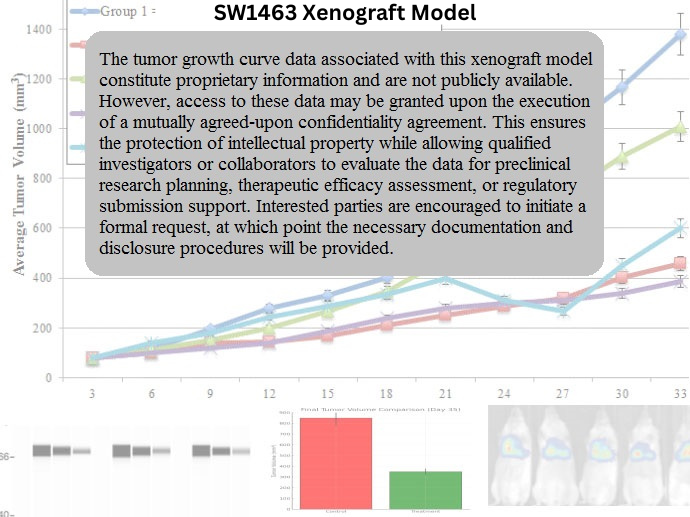
SW1463 xenografts are generated by subcutaneous injection of cultured SW1463 cells into immunodeficient mice, such as athymic nude or NOD/SCID strains. Tumor formation occurs reliably within 7 to 10 days, and tumors generally reach volumes of 700–900 mm³ by day 28–35. The growth rate is moderate, with consistent tumor size across cohorts, making the model ideal for long-term studies and longitudinal treatment regimens. The model’s KRAS/BRAF wild-type status makes it an optimal system for evaluating EGFR inhibitors and therapies targeting the PI3K/AKT/mTOR pathway, while its TP53 mutation offers an opportunity to study therapies targeting DNA repair and apoptotic resistance. SW1463 tumors retain key epithelial features, allowing for in-depth molecular and histological analyses over extended periods.
Request a Custom Quote for SW1463 Xenograft ModelHistopathology and Immunohistochemical Profile
Histopathologically, SW1463 xenograft tumors exhibit moderately differentiated adenocarcinomas with well-formed glandular structures and some mucin production. The tumors retain epithelial polarity and organization, with columnar cells exhibiting basally oriented nuclei. Hematoxylin and eosin (H&E) staining highlights moderate mitotic activity and minimal stromal infiltration. Immunohistochemical staining confirms expression of epithelial markers, including CK20, CEA, and E-cadherin, which are crucial for verifying colorectal lineage and differentiation. β-catenin shows membranous and cytoplasmic localization, consistent with active Wnt signaling. Mutant p53 protein is detected in the tumor nuclei, reflecting its functional inactivation. These histological characteristics reinforce the model’s utility for colorectal cancer research and therapeutic evaluation.
Preclinical Applications and Drug Response
The SW1463 xenograft model is well-suited for evaluating therapies targeting the EGFR pathway, particularly in KRAS/BRAF wild-type colorectal cancer. Due to its intact EGFR signaling, the model is responsive to EGFR inhibitors such as cetuximab and panitumumab, making it ideal for testing these agents in a preclinical context. SW1463 is also employed in combination therapy studies, particularly those targeting the PI3K/AKT/mTOR axis or Wnt/β-catenin signaling. The TP53 mutation provides additional value in testing DNA-damaging agents and synthetic lethality strategies that exploit apoptotic defects. Given its moderate growth rate, stable histology, and molecular fidelity, SW1463 serves as an important model for assessing drug efficacy, resistance mechanisms, and biomarker development in colorectal cancer.
Request This Model
To incorporate the SW1463 xenograft model into your research program, contact our scientific team to request access, discuss study objectives, and design a customized preclinical evaluation plan.
Request a Custom Quote for SW1463 Xenograft Model