SUPT1 Xenograft Model Overview
The SUPT1 xenograft model is established from the SUPT1 cell line, a human T-lymphoblastic cell line originally derived from a patient with non-Hodgkin’s lymphoma. It is widely used as a model for peripheral T-cell lymphomas (PTCL) and T-lymphoblastic malignancies due to its consistent tumorigenic behavior and defined molecular characteristics. This model enables mechanistic studies of T-cell receptor (TCR) signaling, cell cycle regulation, and apoptotic pathways, and serves as a robust in vivo platform for evaluating novel small molecules, targeted immunotherapies, and antimetabolite drug classes that impact T-cell proliferation and survival.
Request a Custom Quote for SUPT1 Xenograft ModelBiological and Molecular Characteristics
SUPT1 cells possess an immature T-cell immunophenotype, expressing CD3, CD7, CD2, and surface TCR α/β complexes. They are also positive for CD1a, CD4, and CD8, indicative of cortical thymocyte-like differentiation. The cell line is p53 wild-type and shows functional Fas expression, which is relevant in studies involving apoptotic regulation. SUPT1 cells are known for their susceptibility to HIV-1 infection, which has also enabled their use in retroviral vector studies. However, in oncology-focused applications, the SUPT1 line is predominantly employed in preclinical screening of cytotoxic and immunomodulatory drugs targeting lymphoblastic T-cell malignancies.
| Characteristic | Description |
|---|---|
| Disease Origin | Human non-Hodgkin’s lymphoma (T-lymphoblastic) |
| Immunophenotype | CD2+, CD3+, CD4+, CD8+, CD1a+, TCR α/β+ |
| p53 Status | Wild-type |
| Apoptotic Regulation | Fas pathway functional |
| Therapeutic Relevance | HDAC inhibitors, antimetabolites, apoptosis modulators |
In Vivo Model Development and Tumorigenicity
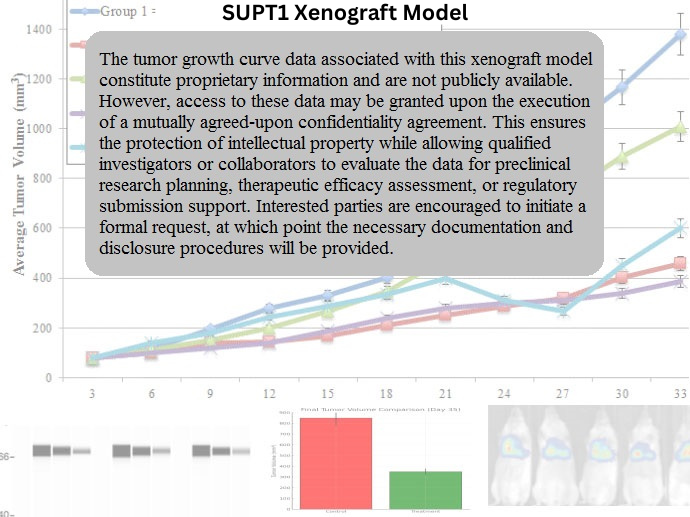
The SUPT1 xenograft model is typically generated by subcutaneous implantation of tumor cells into immunodeficient mice, such as NSG or NOD/SCID strains. Tumor take is efficient, with formation of solid tumors generally observed within three weeks. Tumor progression is moderately rapid, reaching experimental endpoints between five to seven weeks post-inoculation. Due to the cell line’s aggressive T-cell phenotype, this model is particularly well-suited for evaluating early-stage responses to treatment, as well as resistance development under therapeutic pressure. SUPT1 xenografts also allow for monitoring of circulating tumor cells in systemic dissemination models when implanted intravenously.
Request a Custom Quote for SUPT1 Xenograft ModelHistopathology and Immunohistochemical Profile
Histologically, SUPT1 xenograft tumors are composed of dense sheets of small to intermediate-sized blastoid cells with high nuclear-to-cytoplasmic ratios, fine chromatin, and inconspicuous nucleoli. The proliferation index, as determined by Ki-67 staining, typically exceeds 80%, confirming the highly proliferative nature of this T-lymphoblastic tumor. Immunohistochemical staining consistently shows positivity for CD3, CD7, and TCRα/β, along with variable expression of CD4 and CD8, aligning with the cortical thymocyte-like lineage. These findings validate the fidelity of the SUPT1 model in replicating the aggressive histopathology observed in precursor T-cell neoplasms.
Preclinical Applications and Drug Response
The SUPT1 xenograft model has been employed in studies evaluating nucleoside analogs, histone deacetylase (HDAC) inhibitors, and agents that activate intrinsic apoptotic pathways. Its high expression of Fas and intact p53 pathway makes it a favorable model for testing pro-apoptotic agents and cell-cycle checkpoint inhibitors. Moreover, SUPT1 xenografts are useful for preclinical testing of novel T-cell targeted agents, including monoclonal antibodies, CD3 bispecifics, and immune checkpoint inhibitors in T-cell contexts. The model’s responsiveness to antimetabolites such as methotrexate and cytarabine underscores its utility in mimicking treatment scenarios in acute lymphoblastic T-cell leukemia and lymphoblastic lymphoma.
Request This Model
To request the SUPT1 xenograft model for your preclinical studies, please use the form below. A customized quote and additional model specifications will be provided upon inquiry.
Request a Custom Quote for SUPT1 Xenograft Model