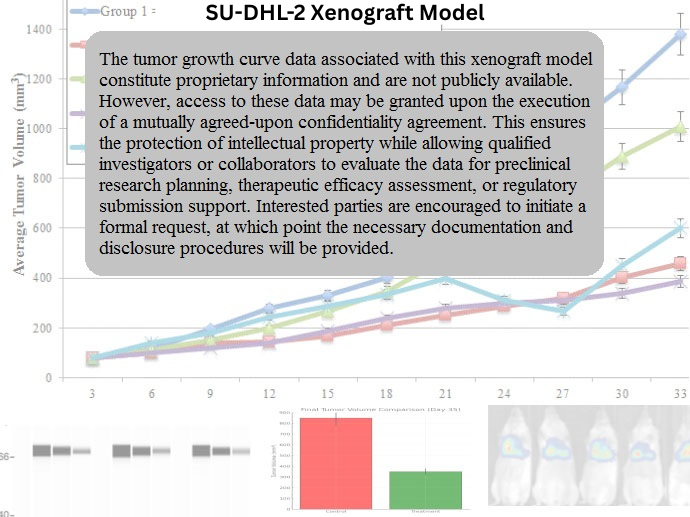
SU-DHL-2 Xenograft Model Overview
The SU-DHL-2 xenograft model is derived from a diffuse large B-cell lymphoma (DLBCL) of the activated B-cell–like (ABC) subtype, offering a highly relevant in vivo platform for studying aggressive non-Hodgkin lymphomas with poor prognoses. This cell line was originally established from a patient with relapsed DLBCL and carries defining genetic alterations including MYD88 L265P and CD79B mutations, both of which contribute to constitutive B-cell receptor (BCR) and NF-κB signaling. The SU-DHL-2 xenograft model demonstrates robust tumor formation in immunocompromised mice, enabling detailed evaluation of targeted inhibitors, immunotherapeutics, and combination regimens that exploit vulnerabilities in the ABC-DLBCL pathway.
Request a Custom Quote for SU‑DHL‑2 Xenograft ModelBiological and Molecular Characteristics
SU-DHL-2 cells exhibit hallmark features of the ABC subtype of DLBCL, including chronic active BCR signaling, NF-κB pathway activation, and impaired apoptosis. These cells harbor the MYD88 L265P mutation, which leads to constitutive Toll-like receptor signaling, and mutations in CD79B, which promote BCR complex stabilization. Expression of BCL2 is elevated, and TP53 is functionally compromised. The immunophenotype is consistent with mature B cells, including strong expression of CD19, CD20, and MHC class II molecules. PD-L1 expression is variable but often detectable, supporting immunotherapeutic investigation. This profile enables use of the model in testing BTK inhibitors, IRAK4 antagonists, BCL2 modulators, and emerging bispecific antibodies.
| Characteristic | Description |
|---|---|
| Tissue Origin | Human diffuse large B-cell lymphoma (ABC subtype) |
| Key Alterations | MYD88 L265P, CD79B mutation, BCL2 overexpression |
| Immunophenotype | CD19+, CD20+, MHC II+, PD-L1 (variable) |
| Pathway Activation | Chronic BCR/NF-κB signaling |
| Therapeutic Relevance | ABC-DLBCL, BTK/BCL2-targeted therapy, immunotherapy |
In Vivo Model Development and Tumorigenicity
The SU-DHL-2 xenograft model is typically generated by subcutaneous injection of cultured cells into immunodeficient mice, such as NOD/SCID or NSG strains. Tumor formation is reliable, with nodules becoming palpable within two to three weeks post-injection. Tumors grow progressively, reaching experimental volumes of 400–600 mm³ within five to seven weeks. The model demonstrates a high degree of consistency in growth kinetics, enabling robust pharmacodynamic and therapeutic evaluations. It is especially well suited for studies exploring resistance mechanisms to BTK inhibitors (e.g., ibrutinib), testing dual inhibition of BCR and BCL2 signaling, and assessing adaptive immune evasion strategies.
Request a Custom Quote for SU‑DHL‑2 Xenograft ModelHistopathology and Immunohistochemical Profile
Histologically, SU-DHL-2 xenografts resemble human DLBCL with diffuse infiltration of large atypical lymphoid cells, prominent nucleoli, and brisk mitotic activity. Hematoxylin and eosin staining highlights dense sheets of tumor cells with minimal stromal components and focal areas of necrosis. Immunohistochemical analysis reveals strong CD20 and CD79a expression, nuclear positivity for NF-κB p65, and cytoplasmic BCL2 staining. Ki-67 proliferation indices often exceed 70%, underscoring the high proliferative activity typical of aggressive lymphoma. PD-L1 expression may be focal and inducible, allowing for experimental modulation with checkpoint inhibitors or epigenetic drugs in combinatorial settings.
Preclinical Applications and Drug Response
The SU-DHL-2 xenograft model plays a critical role in evaluating targeted therapies for genetically defined ABC-DLBCL. It responds to Bruton’s tyrosine kinase (BTK) inhibitors such as ibrutinib and acalabrutinib but may develop resistance, allowing for evaluation of second-generation agents and combinatorial regimens. The model has also demonstrated sensitivity to BCL2 inhibitors like venetoclax and is used in studies involving dual inhibition strategies targeting BCR signaling and apoptotic pathways. Ongoing research also leverages SU-DHL-2 for bispecific antibody testing (e.g., CD20/CD3) and chimeric antigen receptor (CAR) T-cell therapy development, particularly when paired with immune priming or TME-modulating agents.
Request This Model
To request the SU-DHL-2 xenograft model for your preclinical studies, please use the form below. A customized quote and additional model specifications will be provided upon inquiry.
Request a Custom Quote for SU‑DHL‑2 Xenograft Model