SNU-1 Xenograft Model Overview
The SNU-1 xenograft model is derived from a poorly differentiated human gastric carcinoma resected from a Korean patient with advanced-stage gastric cancer. This model is classified as belonging to the diffuse type under the Lauren classification and aligns with the genomically stable (GS) molecular subtype of The Cancer Genome Atlas (TCGA) classification. SNU-1 xenografts are highly tumorigenic in immunodeficient mice and represent a clinically relevant model for studying aggressive, HER2-negative gastric adenocarcinoma with limited glandular differentiation. With a high degree of cellular plasticity and evidence of epithelial–mesenchymal transition (EMT), the SNU-1 model supports translational research targeting drug resistance, cell adhesion disruption, and gastric cancer progression in genomically stable tumors.
Request a Custom Quote for SNU-1 Xenograft ModelBiological and Molecular Characteristics
SNU-1 cells exhibit morphological features of undifferentiated carcinoma, including polygonal cell shape and loss of glandular polarity. Molecularly, the model lacks HER2 amplification and is characterized by TP53 mutation and CDH1 deficiency, the latter being responsible for reduced E-cadherin expression, a hallmark of diffuse-type gastric cancer. It is wild-type for KRAS and BRAF and is microsatellite stable (MSS), placing it among gastric cancers without mismatch repair deficiency. The cell line demonstrates low expression of tight junction proteins and elevated expression of mesenchymal markers such as vimentin, ZEB1, and N-cadherin, supporting its utility in EMT-related investigations. Aberrant activation of PI3K/AKT and TGF-β signaling pathways is also evident, contributing to oncogenic survival and motility.
| Characteristic | SNU-1 Cell Line Profile |
|---|---|
| Tissue of Origin | Gastric adenocarcinoma (diffuse type) |
| HER2 Status | Negative |
| TP53/CDH1 Status | Mutated/Deficient |
| KRAS/BRAF Status | Wild-type |
| MSI Status | Microsatellite stable (MSS) |
| EMT Markers | ↑Vimentin, ↑ZEB1, ↓E-cadherin |
In Vivo Model Development and Tumorigenicity
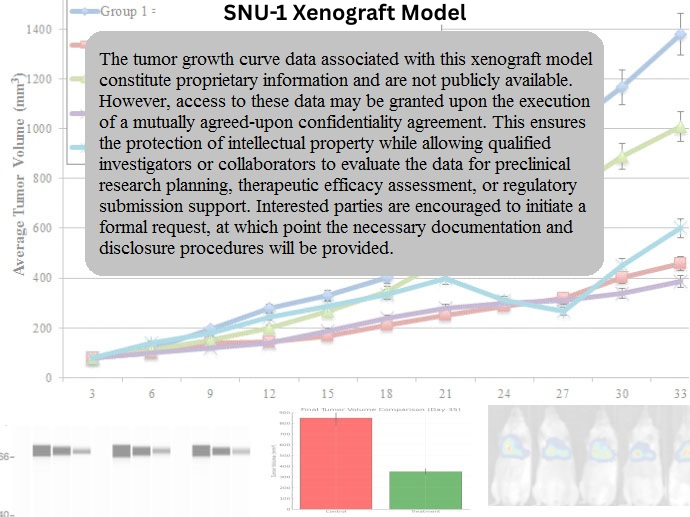
SNU-1 xenografts are generated via subcutaneous implantation of tumor cells into immunodeficient mouse strains such as athymic nude or NOD/SCID mice. Tumors become palpable within 7 to 10 days and progress rapidly, achieving sizes of 700–900 mm³ within 3 to 4 weeks. The model demonstrates high tumor take rates and consistent growth kinetics, supporting reliable drug efficacy studies. Due to its diffuse histopathological nature, SNU-1 tumors are characterized by poorly demarcated margins and limited structural organization, making this model particularly appropriate for studying therapeutic penetration, invasive behavior, and metastasis in poorly differentiated gastric cancers. It is widely used in preclinical trials of EMT inhibitors, PI3K/AKT pathway modulators, and cytotoxic agents.
Request a Custom Quote for SNU-1 Xenograft ModelHistopathology and Immunohistochemical Profile
SNU-1 xenograft tumors display histological features of poorly differentiated adenocarcinoma with scant glandular formation and diffuse cellular architecture. Hematoxylin and eosin (H&E) staining reveals pleomorphic nuclei, high mitotic activity, and frequent apoptotic bodies. Immunohistochemistry indicates absent or reduced E-cadherin staining, increased vimentin expression, and nuclear ZEB1 localization—confirming EMT progression. p53 is strongly expressed in a nuclear pattern due to stabilizing mutations, and HER2 staining is consistently negative. These features mirror aggressive diffuse-type gastric cancer in clinical pathology, validating SNU-1 as a histologically and molecularly accurate xenograft system for drug testing and mechanistic studies.
Preclinical Applications and Drug Response
The SNU-1 xenograft model is widely used in preclinical screening of therapeutics targeting EMT, cell adhesion molecules, and survival signaling pathways. Its HER2-negative and CDH1-deficient phenotype make it ideal for evaluating non-HER2-targeted regimens and therapies aimed at reversing epithelial–mesenchymal plasticity. The model supports testing of PI3K/AKT inhibitors, TGF-β antagonists, DNA damage response modulators, and standard chemotherapies such as cisplatin and 5-FU. SNU-1 is also utilized in combinatorial approaches investigating synergy between cytotoxic and targeted therapies in EMT-positive gastric cancers. Its rapid growth and well-defined molecular alterations enable reproducible and clinically meaningful evaluations in the context of high-grade gastric adenocarcinoma.
Request This Model
To incorporate the SNU-1 xenograft model into your gastric cancer research program or drug development initiative, contact our scientific team to obtain full model specifications and receive guidance on customized study design for diffuse-type gastric adenocarcinoma.
Request a Custom Quote for SNU-1 Xenograft Model