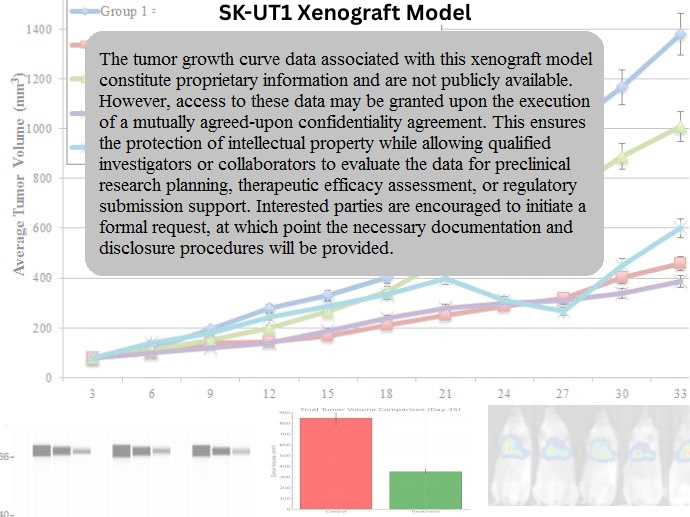
SK-UT1 Xenograft Model Overview
The SK-UT1 xenograft model is derived from a human uterine tumor cell line, SK-UT1, which was established from a primary tumor in a patient with uterine sarcoma, specifically an undifferentiated uterine sarcoma. Uterine sarcomas are rare and aggressive malignancies that arise in the smooth muscle or connective tissue of the uterus. These tumors are often diagnosed at advanced stages, and they present challenges in terms of treatment due to their aggressive growth, high metastatic potential, and resistance to conventional therapies. The SK-UT1 xenograft model is highly valuable for studying the biology of uterine sarcomas, particularly the mechanisms driving tumor progression, metastasis, and therapeutic resistance. This model provides an essential platform for evaluating novel therapeutic strategies, including chemotherapy, targeted therapies, and immunotherapies aimed at improving the treatment and survival outcomes for patients with uterine sarcomas.
Request a Custom Quote for SK-UT1 Xenograft ModelBiological and Molecular Characteristics
SK-UT1 cells are characterized by their undifferentiated nature and exhibit markers associated with smooth muscle and connective tissue differentiation, such as vimentin, smooth muscle actin (SMA), and desmin. The model is particularly relevant for studying uterine sarcomas due to its aggressive growth pattern and potential for metastasis to distant organs, including the lungs, liver, and lymph nodes. Although the model does not harbor specific genetic mutations like those seen in endometrial carcinomas, SK-UT1 cells exhibit dysregulated signaling in key pathways such as PI3K/AKT, MAPK/ERK, and mTOR, all of which contribute to tumor growth, survival, and invasion. Additionally, SK-UT1 xenografts demonstrate elevated levels of vascular endothelial growth factor (VEGF), contributing to tumor angiogenesis. These molecular features make the SK-UT1 xenograft model useful for testing therapies that target angiogenesis, cell survival, and proliferation.
| Marker | Expression Level | Function |
|---|---|---|
| Vimentin | High | Mesenchymal marker involved in tumor invasion |
| Smooth Muscle Actin (SMA) | Elevated | Muscle differentiation marker |
| Desmin | High | Muscle differentiation marker |
| VEGF | Elevated | Angiogenesis factor promoting tumor growth |
In Vivo Model Development and Tumorigenicity
The SK-UT1 xenograft model is typically developed by implanting SK-UT1 cells into immunocompromised mice, such as NOD/SCID or NSG mice, which lack functional T and B cells. Upon implantation, the cells form solid tumors that closely resemble human uterine sarcomas, including high cellularity, significant vascularization, and areas of necrosis. These tumors demonstrate rapid growth and frequent local invasion into surrounding tissues, making the model ideal for studying tumor progression, metastasis, and the effects of treatment on the tumor microenvironment. The SK-UT1 xenograft model is particularly useful for evaluating chemotherapy agents, such as doxorubicin and ifosfamide, which are standard treatments for uterine sarcomas, and for testing new targeted therapies and combination regimens.
In addition to subcutaneous implantation, orthotopic models of SK-UT1 can be established by implanting the cells into the uterine cavity or surrounding tissue of immunocompromised mice. This orthotopic model provides a more clinically relevant setting by mimicking the natural site of tumor growth, allowing for the study of local invasion, metastatic spread, and the effects of treatment on the tumor microenvironment. The ability of SK-UT1 tumors to metastasize to distant organs, including the lungs, liver, and lymph nodes, makes this model highly relevant for studying metastatic disease and evaluating therapies aimed at preventing or treating metastasis in uterine sarcoma.
Request a Custom Quote for SK-UT1 Xenograft ModelHistopathology and Immunohistochemical Profile
Histopathological analysis of SK-UT1 xenografts reveals the characteristic features of undifferentiated uterine sarcoma, including pleomorphic cells, mitotic figures, and areas of necrosis due to rapid tumor growth. The tumors exhibit a mix of spindle-shaped and pleomorphic cells, a hallmark of undifferentiated sarcoma. Immunohistochemical staining of SK-UT1 xenografts shows strong expression of mesenchymal markers such as vimentin, smooth muscle actin (SMA), and desmin, confirming the tumor’s differentiation profile. Elevated levels of VEGF are observed in SK-UT1 xenografts, reflecting the importance of angiogenesis in sustaining tumor growth. Additionally, high levels of phosphorylated AKT and ERK are detected, indicating activation of the PI3K/AKT and MAPK/ERK pathways, which promote tumor cell survival, proliferation, and resistance to apoptosis. CD31 staining reveals significant vascularization, further supporting the role of angiogenesis in tumor progression.
Preclinical Applications and Drug Response
The SK-UT1 xenograft model is widely used to evaluate the efficacy of various therapeutic agents for uterine sarcomas. The model is particularly useful for testing chemotherapy agents such as doxorubicin and ifosfamide, which are standard treatments for uterine sarcomas, and for investigating new drugs aimed at overcoming resistance to chemotherapy. The model is also valuable for evaluating targeted therapies that inhibit key signaling pathways involved in tumor progression, such as the PI3K/AKT, MAPK/ERK, and mTOR pathways.
In addition to chemotherapy and targeted therapies, the SK-UT1 xenograft model is increasingly used to evaluate the potential of immunotherapies, including immune checkpoint inhibitors and monoclonal antibodies targeting tumor-specific antigens. The model’s ability to replicate key features of uterine sarcoma, including its aggressive growth, metastasis, and resistance to therapy, makes it an ideal platform for studying new treatment strategies. Furthermore, the ability of SK-UT1 xenografts to metastasize to distant organs provides an excellent opportunity to evaluate therapies aimed at preventing or treating metastatic disease, which is a critical challenge in uterine sarcoma treatment.
Request This Model
To request the SK-UT1 xenograft model for your preclinical studies, please use the form below. A customized quote and additional model specifications will be provided upon inquiry.
Request a Custom Quote for SK-UT1 Xenograft Model