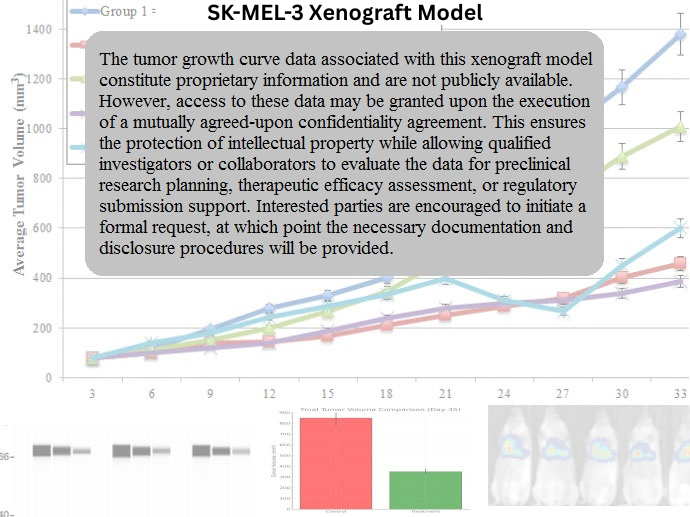
SK-MEL-3 Xenograft Model Overview
The SK-MEL-3 xenograft model is derived from human melanoma cells, specifically originating from a metastatic site in a patient with melanoma. This cell line is widely used for preclinical studies investigating melanoma biology, metastasis, and potential therapeutic strategies. Known for its aggressive growth pattern and resistance to conventional therapies, the SK-MEL-3 model serves as an ideal system for testing novel anti-cancer agents, including immune checkpoint inhibitors, targeted therapies, and combination treatments. The SK-MEL-3 xenograft is often employed in both subcutaneous and orthotopic implantation models, depending on the research focus, enabling a comprehensive exploration of tumor growth and metastasis.
Request a Custom Quote for SK-MEL-3 Xenograft ModelBiological and Molecular Characteristics
SK-MEL-3 cells express key markers indicative of melanoma, such as the melanoma-specific surface antigen gp100, and exhibit high expression of melanocyte-specific proteins like tyrosinase. These cells possess a mutated BRAF gene, which plays a central role in their oncogenesis and makes the model suitable for testing BRAF inhibitors and other targeted therapies aimed at signaling pathways frequently dysregulated in melanoma. The cells are known to harbor mutations in the PTEN gene, contributing to their resistance to apoptosis and further promoting tumor progression. In terms of growth, SK-MEL-3 cells demonstrate rapid proliferation in vivo, leading to robust tumor formation and metastasis when transplanted into immunocompromised mice.
| Marker | Expression Level | Function |
|---|---|---|
| BRAF (V600E) | High | Drives melanoma cell proliferation |
| PTEN | Low | Contributes to resistance to apoptosis |
| gp100 | High | Melanoma-specific antigen |
| Tyrosinase | Moderate | Melanocyte differentiation marker |
In Vivo Model Development and Tumorigenicity
The SK-MEL-3 xenograft model is typically developed by subcutaneously implanting SK-MEL-3 cells into immunocompromised mice, such as nude or SCID mice. Upon implantation, the cells exhibit rapid tumor growth, with tumors generally detectable within 1-2 weeks post-inoculation. The model can also be established through orthotopic implantation, where the tumor is placed in the skin to mimic more closely the natural metastatic pattern of melanoma. SK-MEL-3 tumors are highly vascularized and exhibit significant intra-tumoral heterogeneity, making them a robust model for studying tumor microenvironment interactions, drug resistance, and metastatic spread.
Request a Custom Quote for SK-MEL-3 Xenograft ModelHistopathology and Immunohistochemical Profile
Histopathologically, SK-MEL-3 xenografts resemble human melanoma with the formation of atypical, pleomorphic cells. Tumors are highly cellular, with a prominent presence of melanin pigment in certain regions, although not uniformly distributed throughout the tumor. Immunohistochemical analysis often reveals high expression of melanocytic markers, including tyrosinase, gp100, and MART-1, confirming the melanoma origin of the xenograft. Additionally, SK-MEL-3 tumors exhibit a high degree of vascularization, often assessed through endothelial markers such as CD31, indicative of the aggressive and rapidly growing nature of the model. The model also displays an immune-suppressive microenvironment, with evidence of low infiltration of T cells, making it particularly useful for studying immunotherapy responses.
Preclinical Applications and Drug Response
The SK-MEL-3 xenograft model has been extensively used to evaluate the efficacy of targeted therapies, chemotherapy agents, and immunotherapies. Given the BRAF V600E mutation, the model is particularly relevant for testing BRAF inhibitors, such as vemurafenib, and MEK inhibitors, which are commonly used in clinical settings for melanoma treatment. Additionally, the SK-MEL-3 model is employed to investigate combination therapies, including immune checkpoint inhibitors, such as anti-PD-1 and anti-CTLA-4 antibodies, due to the model’s immunosuppressive tumor microenvironment. Furthermore, this xenograft model is crucial for testing novel agents aimed at overcoming drug resistance in melanoma, a hallmark of the disease.
Request This Model
To request the SK-MEL-3 xenograft model for your preclinical studies, please use the form below. A customized quote and additional model specifications will be provided upon inquiry.
Request a Custom Quote for SK-MEL-3 Xenograft Model