SET-2 Xenograft Model Overview
The SET-2 xenograft model is derived from a human megakaryoblastic leukemia cell line established from the peripheral blood of a 72-year-old male patient diagnosed with essential thrombocythemia that transformed into acute megakaryoblastic leukemia (AMKL). This cell line harbors the JAK2 V617F mutation, a key molecular hallmark of myeloproliferative neoplasms (MPNs), particularly polycythemia vera, essential thrombocythemia, and primary myelofibrosis. The SET-2 xenograft model offers a valuable in vivo system for investigating JAK-STAT pathway–driven leukemogenesis, megakaryocyte maturation, and the efficacy of targeted kinase inhibitors in MPN progression and transformation to acute leukemia. Its well-characterized molecular and phenotypic profile makes it a preferred model for JAK2-targeted drug discovery and translational MPN research.
Request a Custom Quote for SET-2 Xenograft ModelBiological and Molecular Characteristics
SET-2 cells exhibit characteristics of the megakaryocytic lineage, including expression of CD41 (GPIIb), CD61 (GPIIIa), and CD42b (GPIbα). The cells also express HLA-DR and CD34, indicative of their hematopoietic progenitor status. The most prominent molecular feature is the presence of the JAK2 V617F point mutation, which leads to constitutive activation of the JAK-STAT signaling cascade, promoting unchecked proliferation and resistance to cytokine withdrawal. SET-2 cells display sensitivity to JAK2 inhibitors such as ruxolitinib, fedratinib, and momelotinib, and serve as an important tool for preclinical evaluation of therapeutic strategies targeting downstream STAT activation, cytokine signaling, and hematopoietic stem cell dynamics.
| Characteristic | SET-2 Cell Line Profile |
|---|---|
| Disease Origin | Transformed essential thrombocythemia (AMKL) |
| Lineage | Megakaryoblastic |
| Key Mutation | JAK2 V617F |
| Immunophenotype | CD41⁺, CD61⁺, CD42b⁺, HLA-DR⁺, CD34⁺ |
| Signaling Pathways | JAK-STAT, cytokine receptor–mediated proliferation |
| Therapeutic Sensitivity | JAK2 inhibitors, STAT3/5 blockers |
In Vivo Model Development and Tumorigenicity
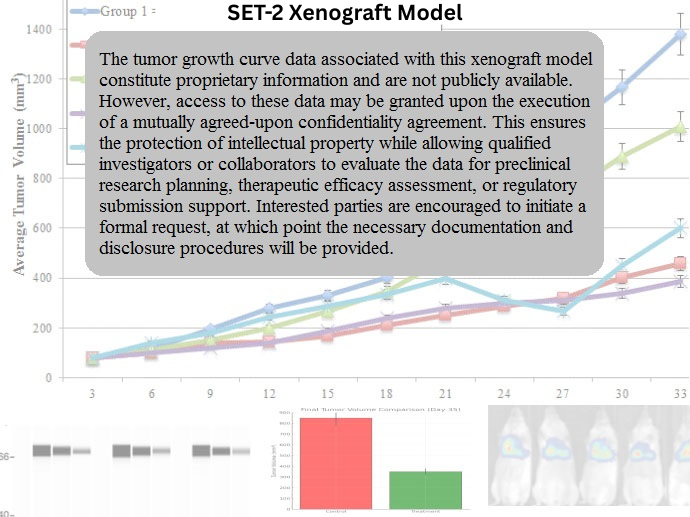
SET-2 xenografts are established by subcutaneous injection into immunodeficient mice such as NSG or NOD/SCID strains. Tumor take rates are consistently high, and nodules typically reach a target volume of 700–900 mm³ within 4–5 weeks. The model displays moderate growth kinetics and a well-circumscribed tumor morphology. While dissemination models via intravenous injection have limited efficiency, the subcutaneous system is reliable for drug efficacy evaluation, pharmacodynamic studies, and biomarker validation. The SET-2 model is particularly suited for longitudinal studies investigating the response to JAK2 inhibition, hematopoietic stem/progenitor cell targeting, and reversal of MPN blast transformation.
Request a Custom Quote for SET-2 Xenograft ModelHistopathology and Immunohistochemical Profile
Histological analysis of SET-2 xenografts reveals densely packed neoplastic cells with round to irregular nuclei, open chromatin, and moderate cytoplasm. Cells display features consistent with megakaryocytic precursors, including lobulated nuclei in differentiated subsets. Hematoxylin and eosin staining highlights homogeneous architecture with low necrosis and limited stromal invasion. Immunohistochemical staining confirms strong positivity for megakaryocytic lineage markers such as CD41 and CD61, while Ki-67 expression demonstrates active proliferation. Nuclear phosphorylated STAT5 is readily detectable and serves as a readout of JAK2 signaling activity, particularly under therapeutic intervention.
Preclinical Applications and Drug Response
The SET-2 xenograft model is extensively employed to evaluate JAK2-targeted therapies and compounds interfering with STAT phosphorylation, cytokine receptor activation, or epigenetic regulators involved in MPN pathogenesis. Ruxolitinib and other JAK2 inhibitors have shown marked efficacy in this model, validating its use in pharmacologic screening. In addition to JAK inhibition, SET-2 supports studies of combination therapies targeting Bcl-2 family proteins, histone deacetylases, and DNA methylation. The model is also suitable for studying drug resistance mechanisms and compensatory signaling in JAK2-driven malignancies. As an in vivo system modeling post-MPN AML transformation, SET-2 provides a critical translational bridge between chronic MPNs and leukemic evolution.
Request This Model
To integrate the SET-2 xenograft model into your preclinical research program focused on JAK2-driven leukemias or myeloproliferative neoplasms, contact our team to receive detailed model specifications and assistance in designing custom efficacy, resistance, or pharmacodynamic studies.
Request a Custom Quote for SET-2 Xenograft Model