RL95-2 Xenograft Model Overview
The RL95-2 xenograft model is derived from a well-differentiated endometrial adenocarcinoma established from the primary tumor of a 64-year-old female patient. This cell line represents estrogen receptor (ER)-positive, hormone-responsive endometrial carcinoma, making it an optimal in vivo platform for studying hormone-dependent tumor growth, endocrine therapy mechanisms, and signaling pathways associated with type I endometrial cancers. RL95-2 xenografts demonstrate consistent tumor formation, epithelial morphology, and molecular features indicative of low-grade, hormone-sensitive disease. Due to its relevance to early-stage endometrioid tumors, the model is widely used in evaluating selective estrogen receptor modulators (SERMs), anti-progestins, PI3K/mTOR pathway inhibitors, and agents targeting epithelial differentiation.
Request a Custom Quote for RL95-2 Xenograft ModelBiological and Molecular Characteristics
RL95-2 cells exhibit cobblestone epithelial morphology and retain key features of differentiated endometrial epithelium, including strong ER and progesterone receptor (PR) expression. The cell line is PTEN-deficient, leading to upregulation of the PI3K/AKT/mTOR pathway, a hallmark of type I endometrial tumors. RL95-2 is microsatellite stable (MSS) and wild-type for TP53, KRAS, and BRAF, consistent with the genomic landscape of hormone-responsive tumors. The cells express E-cadherin and cytokeratin 8/18 (CK8/18), confirming epithelial identity, and are responsive to estrogen and progesterone in vitro. This hormone receptor-positive profile enables mechanistic studies of hormone-driven tumorigenesis and therapeutic response modulation in well-differentiated endometrial carcinoma.
| Characteristic | RL95-2 Cell Line Profile |
|---|---|
| Tissue of Origin | Endometrial adenocarcinoma (primary) |
| Hormone Receptor Status | ER-positive, PR-positive |
| TP53/KRAS/BRAF Status | Wild-type |
| PTEN Status | Loss-of-function mutation |
| MSI Status | Microsatellite stable (MSS) |
| Differentiation Markers | CK8/18, E-cadherin |
In Vivo Model Development and Tumorigenicity
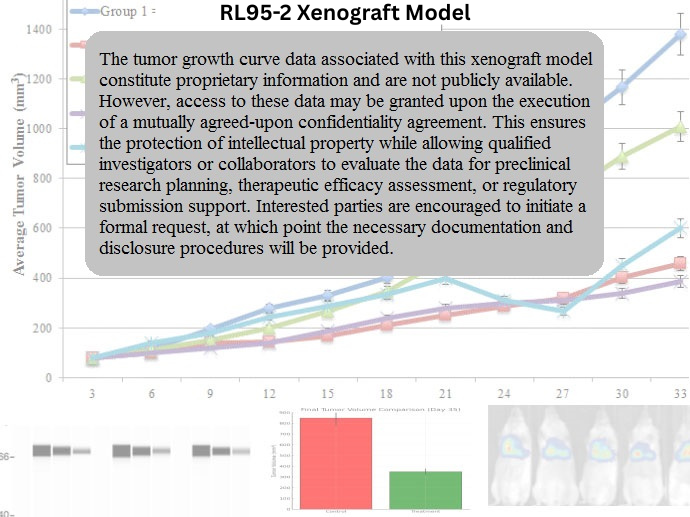
RL95-2 xenografts are established through subcutaneous injection of cultured tumor cells into immunodeficient mice, typically using athymic nude or NOD/SCID strains. Tumor formation is estrogen-dependent; therefore, host mice are usually supplemented with exogenous estradiol via subcutaneous pellets to ensure robust and sustained tumor growth. Tumors form within 10–14 days and reach experimental volumes (700–900 mm³) in approximately 4–5 weeks. The growth kinetics are moderate and highly reproducible, facilitating the controlled evaluation of hormonal therapies and pathway-specific inhibitors. The model is especially suited for studies examining endocrine responsiveness, PI3K/mTOR modulation, and resistance mechanisms arising in hormone-receptor-positive endometrial cancer.
Request a Custom Quote for RL95-2 Xenograft ModelHistopathology and Immunohistochemical Profile
Histological analysis of RL95-2 xenograft tumors reveals well-differentiated glandular structures with pseudostratified columnar epithelium, uniform nuclei, and moderate cytoplasm. Hematoxylin and eosin (H&E) staining demonstrates clear gland formation, consistent with early-stage endometrioid histology. Immunohistochemistry confirms strong nuclear staining for estrogen and progesterone receptors, supporting its classification as a hormone-dependent model. Cytokeratin 8/18 and E-cadherin expression highlight the preserved epithelial architecture, while PTEN expression is absent or markedly reduced, reflecting pathway activation. These features validate the model’s relevance to human low-grade endometrial carcinoma and its suitability for therapeutic studies involving endocrine modulation and mTOR signaling inhibition.
Preclinical Applications and Drug Response
The RL95-2 xenograft model is a cornerstone in the evaluation of hormone-responsive endometrial cancer therapies. It is particularly useful for testing SERMs, aromatase inhibitors, anti-progestins, and estrogen receptor degraders. The model is also responsive to PI3K and mTOR inhibitors due to PTEN loss, supporting combination strategies that target hormonal and growth factor pathways simultaneously. Additionally, RL95-2 xenografts are employed in resistance mechanism studies, especially those involving chronic hormone exposure or targeted pathway feedback. Their defined hormone-receptor status, epithelial differentiation, and moderate growth kinetics make RL95-2 an essential preclinical model for type I endometrial carcinoma.
Request This Model
To integrate the RL95-2 xenograft model into your endometrial cancer research or therapeutic development pipeline, contact our scientific team to request comprehensive model details and initiate customized study design tailored to hormone-responsive disease.
Request a Custom Quote for RL95-2 Xenograft Model