REC-1 Xenograft Model Overview
The REC-1 xenograft model is derived from a human mantle cell lymphoma (MCL) cell line originally isolated from the peripheral blood of a patient in leukemic phase. REC-1 cells are widely recognized for their cyclin D1 overexpression driven by the hallmark t(11;14)(q13;q32) translocation, which characterizes classical MCL. This model exhibits typical features of MCL, including mature B-cell immunophenotype and aggressive in vivo proliferation. The REC-1 xenograft offers a clinically relevant system for evaluating therapeutic agents targeting cell cycle progression, B-cell receptor signaling, and apoptosis in MCL, while also enabling investigation of treatment resistance and combination therapy strategies in a translational context.
Request a Custom Quote for REC‑1 Xenograft ModelBiological and Molecular Characteristics
REC-1 cells express surface markers consistent with mature B lymphocytes, including CD19, CD20, CD5, and surface immunoglobulin. The t(11;14) translocation results in upregulated CCND1, driving constitutive cyclin D1 expression and G1/S cell cycle progression. Unlike some other MCL cell lines, REC-1 lacks secondary mutations in TP53, making it suitable for assessing early-stage MCL interventions. These cells also exhibit active BCR and NF-κB signaling pathways and elevated expression of anti-apoptotic proteins such as BCL2 and MCL1. This molecular profile supports the model’s responsiveness to pathway-specific inhibitors and highlights its utility for screening agents aimed at disrupting proliferative and survival mechanisms.
| Characteristic | Description |
|---|---|
| Tissue Origin | Human mantle cell lymphoma (leukemic phase) |
| Key Genetic Feature | t(11;14)(q13;q32) with cyclin D1 overexpression |
| Immunophenotype | CD19+, CD20+, CD5+, sIg+, HLA-DR+ |
| Mutation Status | TP53 wild-type, active NF-κB and BCR signaling |
| Therapeutic Relevance | CDK4/6 inhibition, BTK inhibition, BCL2-targeted therapies |
In Vivo Model Development and Tumorigenicity
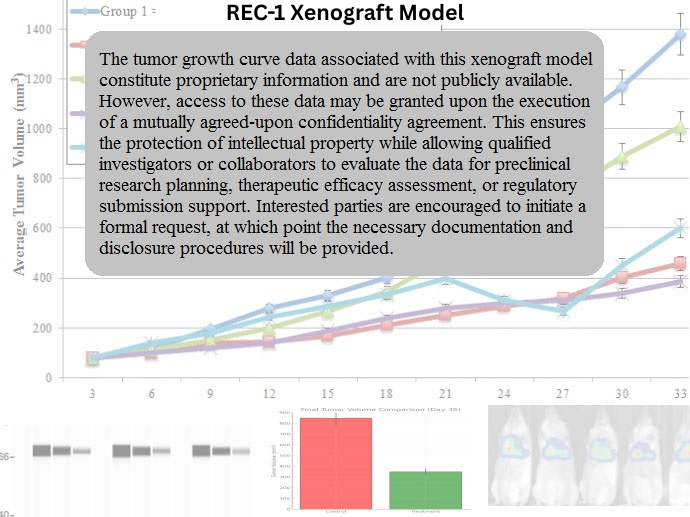
The REC-1 xenograft model is developed through subcutaneous injection into immunodeficient mice such as NOD/SCID or NSG. Tumor formation is typically observed within 3–4 weeks, with volumes reaching 500–800 mm³ by weeks 6–8, depending on cell dose and host strain. The model exhibits high tumor take rates and relatively uniform growth across experimental replicates. Tumors are moderately vascularized and retain histological features consistent with the parental disease. The model allows for accurate assessment of drug efficacy across a range of modalities, including kinase inhibitors, monoclonal antibodies, and emerging small-molecule therapeutics targeting key oncogenic drivers in MCL.
Request a Custom Quote for REC‑1 Xenograft ModelHistopathology and Immunohistochemical Profile
Histologic sections of REC-1 xenografts reveal sheets of small to intermediate-sized lymphoid cells with irregular nuclear contours, dispersed chromatin, and scant cytoplasm. Hematoxylin and eosin staining shows a diffuse infiltrative growth pattern with frequent mitotic figures. Immunohistochemical analysis demonstrates strong nuclear staining for cyclin D1, consistent with the t(11;14) translocation. CD20 and BCL2 are prominently expressed on the membrane and in the cytoplasm, respectively. MHC class II (HLA-DR) expression is retained, and Ki-67 proliferation indices typically range from 50% to 70%, supporting the model’s use in assessing proliferation-targeted treatments.
Preclinical Applications and Drug Response
The REC-1 xenograft model has been widely adopted in preclinical studies evaluating novel agents targeting cyclin D1–CDK4/6, BCR signaling (e.g., BTK inhibitors such as ibrutinib), and apoptosis regulators including BCL2 inhibitors like venetoclax. It has also been used in combination therapy research to overcome drug resistance, particularly through dual targeting of survival and proliferation pathways. Its consistent growth and well-defined molecular features make it suitable for pharmacokinetic and pharmacodynamic studies, dose optimization, and biomarker discovery. The REC-1 model is especially valuable for translational programs aimed at addressing unmet needs in mantle cell lymphoma.
Request This Model
To request the REC-1 xenograft model for your preclinical studies, please use the form below. A customized quote and additional model specifications will be provided upon inquiry.
Request a Custom Quote for REC‑1 Xenograft Model