PL-21 Xenograft Model Overview
The PL-21 xenograft model is derived from a human acute myeloid leukemia (AML) cell line established from the peripheral blood of a 14-year-old male patient with AML M3, which corresponds to the promyelocytic subtype. Although originally classified as M3, PL-21 cells do not carry the PML-RARA translocation typical of classical acute promyelocytic leukemia, and instead represent a model of myelomonocytic AML with unique transcriptional and signaling features. The PL-21 cell line harbors activating mutations in NRAS and displays dysregulated PI3K/AKT signaling, making it an effective system for evaluating the efficacy of small molecules targeting RAS-driven AML. Its moderate proliferation rate and human-specific immunophenotype allow consistent engraftment in immunodeficient murine models.
Request a Custom Quote for PL‑21 Xenograft ModelBiological and Molecular Characteristics
PL-21 cells exhibit suspension growth with a blast-like morphology and high nuclear-to-cytoplasmic ratio. The immunophenotype is consistent with a myelomonocytic profile, with cells expressing CD13, CD33, CD34, CD38, and HLA-DR, and low or negative expression of CD14. The NRAS Q61L mutation present in PL-21 promotes constitutive activation of MAPK and PI3K signaling, contributing to enhanced cell survival, resistance to apoptosis, and proliferative capacity. PL-21 cells are also characterized by upregulated expression of anti-apoptotic genes such as BCL2 and MCL1, and modest expression of myeloid transcription factors including PU.1 and CEBPα. Their genetic and molecular background supports utility in targeted therapy development for RAS-mutant AML.
| Characteristic | PL-21 Cell Line Profile |
|---|---|
| Disease Origin | Acute myeloid leukemia (AML, myelomonocytic subtype) |
| Key Mutation | NRAS Q61L |
| Immunophenotype | CD13⁺, CD33⁺, CD34⁺, HLA-DR⁺, CD38⁺ |
| Oncogenic Pathways | MAPK/ERK, PI3K/AKT, anti-apoptotic signaling |
| Differentiation Status | Myelomonocytic, blast-like |
| Therapeutic Relevance | RAS pathway inhibitors, BCL2 antagonists |
In Vivo Model Development and Tumorigenicity
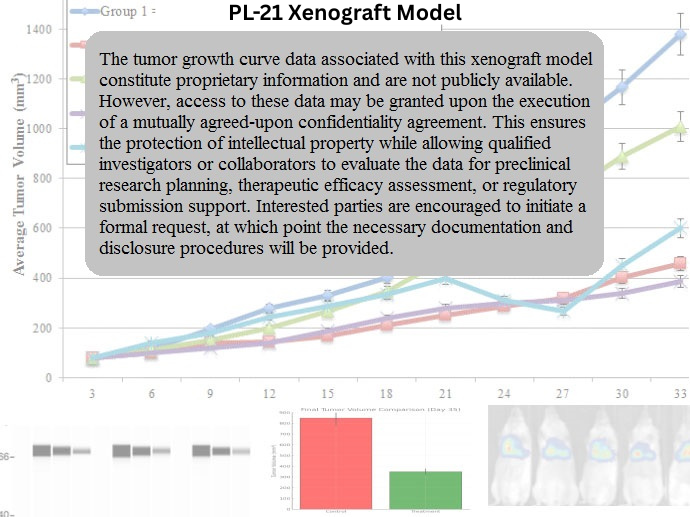
The PL-21 xenograft model is established through intravenous or subcutaneous injection of cells into immunocompromised mice, most commonly NOD/SCID or NSG strains. Subcutaneous implantation leads to solid tumor formation with moderate growth kinetics, typically reaching volumes of 700–900 mm³ over the course of 5 weeks. In systemic models, intravenous injection results in hematopoietic infiltration, especially in the bone marrow, spleen, and liver. Preconditioning of recipient mice via sublethal irradiation improves engraftment and disease burden. The model is suitable for longitudinal therapeutic testing, pharmacokinetic-pharmacodynamic (PK-PD) studies, and evaluation of survival endpoints in RAS-mutant AML.
Request a Custom Quote for PL‑21 Xenograft ModelHistopathology and Immunohistochemical Profile
Histological examination of PL-21 xenografts shows diffuse infiltration of medium-sized leukemic blasts with irregular nuclear contours, fine chromatin, and scant cytoplasm. Hematoxylin and eosin staining reveals a homogeneous tumor mass with little stromal involvement. Immunohistochemically, PL-21 xenografts are positive for CD33, CD34, and CD38, confirming their immature myeloid phenotype. Proliferative activity is marked by widespread Ki-67 nuclear staining, while downstream signaling markers such as phosphorylated ERK and AKT are readily detectable and modifiable upon pathway-targeted intervention. These features support use of the PL-21 model for mechanistic studies and treatment response evaluation in AML.
Preclinical Applications and Drug Response
The PL-21 xenograft model is highly relevant for testing inhibitors targeting RAS signaling, including MEK and PI3K inhibitors, as well as agents directed at BCL2 and MCL1. It is also used in studies evaluating epigenetic regulators, pro-apoptotic compounds, and agents that overcome resistance in NRAS-mutant AML. The model supports evaluation of both monotherapy and combination therapy approaches aimed at synthetic lethality in RAS-driven leukemias. Its sensitivity to oxidative stress and pathway inhibition makes it a valuable platform for dissecting resistance mechanisms and identifying predictive biomarkers in the context of aberrant MAPK pathway activation.
Request This Model
To incorporate the PL-21 xenograft model into your AML drug development pipeline or mechanistic RAS-pathway studies, reach out to our scientific team to obtain full technical specifications, recommended protocols, and tailored in vivo study design support.
Request a Custom Quote for PL‑21 Xenograft Model