OE21 Xenograft Model Overview
The OE21 xenograft model is derived from a human esophageal squamous cell carcinoma (ESCC) cell line established from a poorly differentiated primary tumor in a 73-year-old male patient. Although not of colorectal origin, OE21 is widely utilized in preclinical oncology for the study of squamous cell carcinomas of the upper gastrointestinal tract, particularly in esophageal cancer research. This model provides a highly tumorigenic and reproducible system for evaluating the efficacy of radiation therapy, chemotherapeutic agents, and targeted molecular therapies in esophageal squamous histology. OE21 xenografts recapitulate the aggressive clinical behavior of ESCC, including rapid growth, keratinization, and resistance to standard cytotoxic agents, making them an essential tool for translational studies focused on therapeutic resistance, epithelial-mesenchymal transition (EMT), and epithelial differentiation.
Request a Custom Quote for OE21 Xenograft ModelBiological and Molecular Characteristics
OE21 cells exhibit a squamous epithelial morphology and display features consistent with poorly differentiated ESCC. The cell line is characterized by TP53 mutation, a common aberration in ESCC, which impairs cell cycle regulation and apoptotic response. It is wild-type for KRAS and BRAF but often harbors amplification of genes such as EGFR and SOX2, which contribute to enhanced proliferative capacity and stemness. OE21 cells are negative for markers associated with intestinal differentiation (e.g., CK20), but strongly express squamous markers such as cytokeratin 5/6 (CK5/6), p63, and involucrin. These molecular and phenotypic features enable OE21 to serve as a representative model for investigating squamous-specific signaling pathways, EGFR inhibitor sensitivity, and radiation responsiveness in esophageal cancers.
| Characteristic | OE21 Cell Line Profile |
|---|---|
| Tissue of Origin | Esophageal squamous cell carcinoma (ESCC) |
| KRAS/BRAF Status | Wild-type |
| TP53 Status | Mutated |
| MSI Status | Not applicable (non-colorectal origin) |
| Differentiation Markers | CK5/6, p63, involucrin |
| Oncogenic Pathways | EGFR amplification, SOX2 overexpression |
In Vivo Model Development and Tumorigenicity
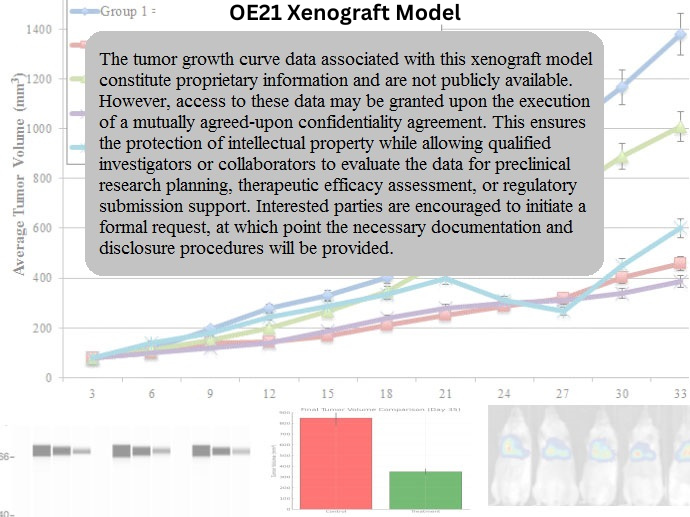
OE21 xenografts are typically established by subcutaneous injection of cultured cells into immunodeficient mice, including athymic nude or NOD/SCID strains. Tumor engraftment occurs rapidly, usually within 7 to 10 days, and tumors reach volumes of 700–900 mm³ in approximately 3 to 4 weeks. The model exhibits aggressive growth with high proliferative index and limited necrosis, making it suitable for evaluating radiation sensitivity, chemotherapeutic efficacy, and targeted therapy mechanisms. OE21 xenografts are often used in studies of fractionated radiation, EGFR inhibition, and combinations involving apoptosis-sensitizing agents or immune modulators. Its aggressive yet histologically stable nature supports longitudinal analyses of tumor progression and response.
Request a Custom Quote for OE21 Xenograft ModelHistopathology and Immunohistochemical Profile
Histopathologic analysis of OE21 xenografts reveals poorly differentiated squamous cell carcinomas with solid architecture, frequent keratin pearl formation, and intercellular bridges. Hematoxylin and eosin (H&E) staining demonstrates high nuclear-to-cytoplasmic ratios, prominent nucleoli, and occasional tumor necrosis. Immunohistochemical staining confirms high expression of squamous markers CK5/6 and p63, while CEA and CK20 are absent, consistent with a non-intestinal phenotype. EGFR overexpression is commonly detected, with membrane-localized staining, reflecting receptor amplification and therapeutic relevance. Mutant p53 protein accumulation is observed in tumor nuclei, consistent with its dysfunctional tumor suppressor role. The model’s histological and molecular consistency makes it particularly suitable for studying ESCC tumor biology and therapeutic interventions.
Preclinical Applications and Drug Response
The OE21 xenograft model is especially relevant for studies evaluating treatments in esophageal squamous cell carcinoma, including radiation therapy, EGFR-targeted agents, and apoptosis-inducing compounds. Given its wild-type KRAS status and EGFR overexpression, OE21 responds to EGFR inhibitors, although resistance may develop, making it suitable for resistance mechanism and combination therapy research. Its TP53 mutation allows exploration of DNA-damage-based treatments, including cisplatin and radiation, in the context of impaired apoptotic signaling. OE21 xenografts are also employed in evaluating EMT inhibitors, stemness modulators, and immunotherapeutic strategies targeting squamous carcinoma antigens. The model’s consistent growth and histological fidelity render it a powerful tool for preclinical screening and biomarker validation in ESCC.
Request This Model
To integrate the OE21 xenograft model into your esophageal cancer research or drug development workflow, contact our scientific team to request detailed model specifications and design a custom preclinical study tailored to your therapeutic targets.
Request a Custom Quote for OE21 Xenograft Model