OCI-LY7 Xenograft Model Overview
The OCI-LY7 xenograft model is established from the OCI-LY7 cell line, which originates from a patient with diffuse large B-cell lymphoma (DLBCL) and represents the germinal center B-cell-like (GCB) subtype. This subtype is generally associated with a more favorable prognosis and distinct molecular signaling compared to the activated B-cell-like (ABC) subtype. The OCI-LY7 model offers a valuable platform for evaluating therapeutic agents that target pathways specific to GCB-DLBCL, including regulators of B-cell maturation, epigenetic modulators, and components of the PI3K/AKT and BCL6 axes. The model’s reproducibility, molecular stability, and alignment with clinical GCB-DLBCL phenotypes make it an indispensable tool in preclinical research aimed at improving outcomes in this subtype of lymphoma.
Request a Custom Quote for OCI‑LY7 Xenograft ModelBiological and Molecular Characteristics
OCI-LY7 cells demonstrate a prototypical GCB-DLBCL immunophenotype, expressing surface markers such as CD19, CD20, CD22, CD79a, and high levels of BCL6 and LMO2, while lacking IRF4 and other ABC-associated markers. The cell line exhibits wild-type MYD88 and constitutive PI3K signaling, and is BCL2-positive but lacks rearrangements involving the MYC gene. These features support studies that focus on epigenetic dysregulation, B-cell development checkpoints, and therapies aimed at restoring germinal center differentiation. OCI-LY7 is also highly responsive to changes in the tumor microenvironment, allowing its use in stromal co-engraftment and immune-modulation models.
| Characteristic | Description |
|---|---|
| Disease Origin | Human diffuse large B-cell lymphoma (GCB subtype) |
| Immunophenotype | CD19+, CD20+, CD79a+, BCL6+, LMO2+, IRF4– |
| Molecular Features | Wild-type MYD88, BCL2 overexpression, active PI3K/AKT signaling |
| Subtype Classification | Germinal center B-cell-like (GCB) DLBCL |
| Therapeutic Relevance | BCL6 inhibitors, epigenetic therapies, PI3K/AKT pathway drugs |
In Vivo Model Development and Tumorigenicity
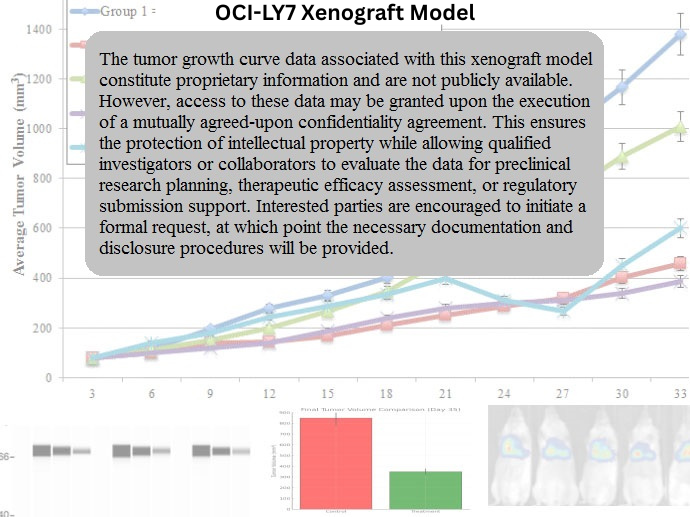
The OCI-LY7 xenograft model is typically established by subcutaneous injection into immunodeficient mice, such as NOD/SCID or NSG. Tumor development is moderately paced but highly reproducible, with palpable nodules forming within 3–4 weeks and volumes reaching 600–900 mm³ within six to eight weeks post-implantation. The model demonstrates consistent tumor take rates and predictable growth kinetics across cohorts, supporting both short- and long-term therapeutic evaluations. Its germinal center origin and relatively indolent biology make it suitable for evaluating therapeutic efficacy under both steady-state and combinatorial treatment protocols.
Request a Custom Quote for OCI‑LY7 Xenograft ModelHistopathology and Immunohistochemical Profile
Histologic sections of OCI-LY7 xenografts reveal diffuse infiltrates of large atypical lymphoid cells with round nuclei, fine chromatin, and visible nucleoli, reflecting a histomorphology consistent with GCB-DLBCL. Immunohistochemical staining confirms strong CD20 and BCL6 expression, with LMO2 positivity and low levels of IRF4, validating its germinal center origin. Proliferative activity, as measured by Ki-67, typically ranges from 60–75%, suggesting intermediate tumor aggressiveness. These pathologic features support its fidelity as a preclinical analog of human GCB-type DLBCL and enable targeted analyses of subtype-specific therapeutic responses.
Preclinical Applications and Drug Response
The OCI-LY7 xenograft model has been used extensively to test novel agents directed at BCL6, EZH2, and histone deacetylases, making it especially valuable for studies involving epigenetic modulation and transcriptional reprogramming. The model’s PI3K/AKT signaling activity also supports its use in preclinical trials of PI3K and AKT inhibitors. Given its responsiveness to CD20-targeted monoclonal antibodies, it is frequently employed in testing rituximab-based regimens and CD20-directed antibody-drug conjugates. In addition, the OCI-LY7 model is utilized for studying resistance mechanisms and for evaluating dual-targeting therapies that combine B-cell signaling inhibition with apoptotic sensitization.
Request This Model
To request the OCI‑LY7 xenograft model for your preclinical studies, please use the form below. A customized quote and additional model specifications will be provided upon inquiry.
Request a Custom Quote for OCI‑LY7 Xenograft Model