OCI-LY3 Xenograft Model Overview
The OCI-LY3 xenograft model is derived from a diffuse large B-cell lymphoma (DLBCL) cell line classified within the activated B-cell-like (ABC) molecular subtype, which is associated with poor prognosis and inferior response to standard chemotherapy. Originating from a patient with transformed non-Hodgkin lymphoma, OCI-LY3 cells retain the hallmark features of aggressive ABC-DLBCL, including chronic active B-cell receptor (BCR) signaling and constitutive NF-κB activation. The xenograft model provides a reproducible and clinically relevant platform for investigating novel therapeutics targeting refractory DLBCL, particularly agents aimed at disrupting signaling cascades that sustain survival and proliferation in the ABC subtype.
Request a Custom Quote for OCI‑LY3 Xenograft ModelBiological and Molecular Characteristics
OCI-LY3 cells express a mature B-cell immunophenotype including CD19, CD20, CD22, and surface immunoglobulin M. They lack germinal center markers such as BCL6 and CD10, but express IRF4/MUM1, consistent with ABC-DLBCL classification. The cell line is characterized by mutations and constitutive activation in the NF-κB pathway, involving upstream components such as CARD11 and MYD88. High levels of anti-apoptotic proteins including BCL2 and MCL1 contribute to drug resistance. This molecular configuration reflects treatment-resistant ABC-DLBCL seen in patients and supports the use of the OCI-LY3 model for evaluating precision therapies targeting this subtype.
| Characteristic | Description |
|---|---|
| Disease Origin | Human diffuse large B-cell lymphoma, ABC subtype |
| Immunophenotype | CD19+, CD20+, CD22+, sIgM+, BCL6–, IRF4/MUM1+ |
| Genetic Features | NF-κB pathway activation, MYD88 mutations, BCL2 overexpression |
| Molecular Subtype | Activated B-cell-like (ABC) DLBCL |
| Therapeutic Relevance | NF-κB inhibitors, BCL2 antagonists, BTK inhibitors |
In Vivo Model Development and Tumorigenicity
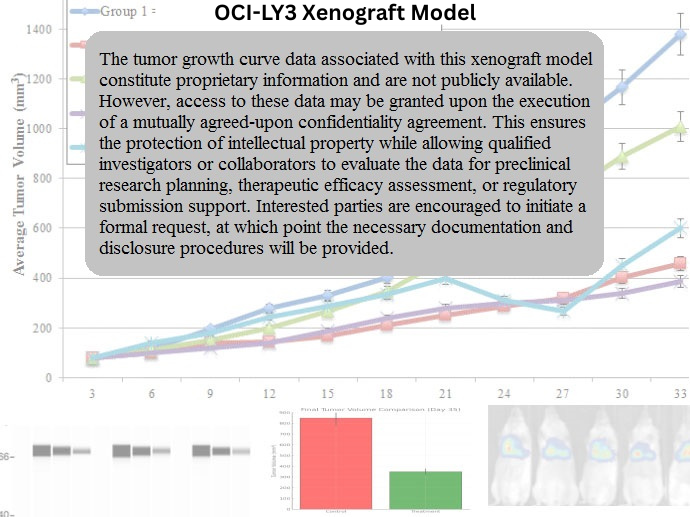
The OCI-LY3 xenograft is typically generated via subcutaneous implantation of tumor cells into immunodeficient mice such as NOD/SCID or NSG. Tumor take rates are high, and growth kinetics are moderate to rapid, with tumor volumes reaching 400–800 mm³ within 5–7 weeks post-engraftment. The model supports robust, reproducible tumor development, facilitating longitudinal assessment of therapeutic efficacy and biomarker evolution. Due to its activation of innate immune signaling and BCR dependency, the OCI-LY3 xenograft is frequently used in studies testing combinations of small molecule inhibitors, monoclonal antibodies, and immune-modulating therapies.
Request a Custom Quote for OCI‑LY3 Xenograft ModelHistopathology and Immunohistochemical Profile
Histologic analysis of OCI-LY3 xenografts reveals dense sheets of large neoplastic B cells with irregular nuclei, dispersed chromatin, and prominent nucleoli. The tumors lack follicular architecture and display a diffuse pattern typical of aggressive DLBCL. Immunohistochemical staining shows strong expression of CD20 and CD79a, along with nuclear positivity for IRF4 and cytoplasmic BCL2. A Ki-67 index often exceeds 70%, indicative of the highly proliferative nature of the tumor. These histopathological and immunophenotypic features align closely with human ABC-DLBCL, validating the model’s relevance for translational oncology research.
Preclinical Applications and Drug Response
The OCI-LY3 xenograft model has been instrumental in evaluating targeted therapies for ABC-DLBCL, including ibrutinib (a BTK inhibitor), lenalidomide (an immunomodulator), and inhibitors of MALT1, IRAK4, and NF-κB signaling. Its resistance to standard chemotherapeutics underscores its value in screening novel combination regimens and identifying agents that overcome apoptotic blockade. The model is also used for testing monoclonal antibodies against CD20, bispecific T-cell engagers, and checkpoint inhibitors. Because of its alignment with treatment-refractory DLBCL, the OCI-LY3 xenograft is a preferred in vivo system for advancing drug discovery efforts in high-risk lymphomas.
Request This Model
To request the OCI‑LY3 xenograft model for your preclinical studies, please use the form below. A customized quote and additional model specifications will be provided upon inquiry.
Request a Custom Quote for OCI‑LY3 Xenograft Model