NUGC4 Xenograft Model Overview
The NUGC4 xenograft model is derived from a poorly differentiated gastric adenocarcinoma originating in a 48-year-old Japanese male. It represents a diffuse-type gastric carcinoma, consistent with Lauren classification, and is distinguished by its high tumorigenicity, aggressive growth profile, and relevance to advanced-stage gastric cancer. NUGC4 xenografts serve as a preclinical platform for studying chemotherapeutic resistance, epithelial–mesenchymal transition (EMT), and targeted inhibition of receptor tyrosine kinases implicated in gastric tumor progression. This model is particularly valuable for assessing drug efficacy in HER2-negative, microsatellite stable, and diffuse gastric cancer subtypes, which remain difficult to treat in clinical settings.
Request a Custom Quote for NUGC4 Xenograft ModelBiological and Molecular Characteristics
NUGC4 cells display morphological and molecular features of undifferentiated gastric adenocarcinoma, including loss of cell polarity and diffuse growth characteristics. The line is negative for HER2 amplification, aligning it with HER2-nonresponsive gastric tumors. It is microsatellite stable (MSS) and exhibits wild-type KRAS and BRAF, offering a clean background for evaluating EGFR and downstream MAPK/PI3K pathway inhibitors. NUGC4 expresses E-cadherin at reduced levels and demonstrates increased vimentin and Snail expression, consistent with partial EMT. TP53 is mutated, contributing to impaired DNA damage response, while PI3K/AKT and STAT3 signaling pathways are upregulated, supporting oncogenic proliferation and survival.
| Characteristic | NUGC4 Cell Line Profile |
|---|---|
| Tissue of Origin | Gastric adenocarcinoma (diffuse type) |
| HER2 Status | Negative |
| KRAS/BRAF Status | Wild-type |
| TP53 Status | Mutated |
| MSI Status | Microsatellite stable (MSS) |
| EMT Markers | ↓E-cadherin, ↑Vimentin, ↑Snail |
In Vivo Model Development and Tumorigenicity
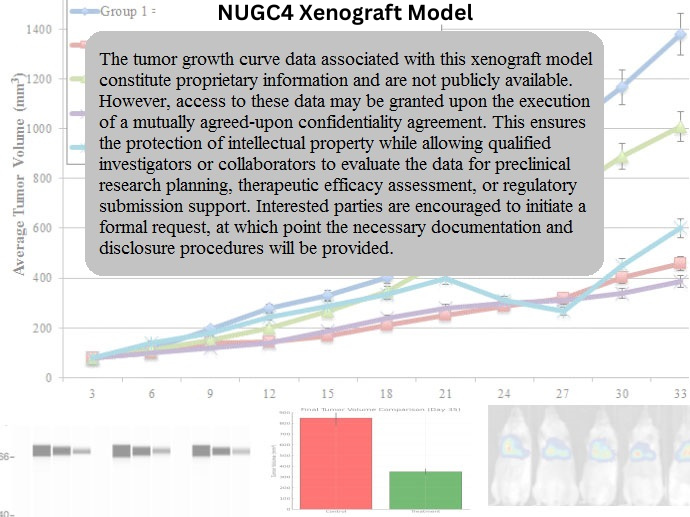
NUGC4 xenografts are established by subcutaneous injection of tumor cells into immunodeficient mice, typically athymic nude or NOD/SCID strains. Tumors typically form within 7–10 days post-injection and reach volumes of 700–900 mm³ within 3–4 weeks. The model exhibits a high engraftment rate and aggressive tumor expansion, making it ideal for studies requiring fast tumor development and robust readouts. Due to the diffuse-type histology, tumors often lack glandular structure and exhibit invasive margins, offering a histologically accurate platform for evaluating antitumor agents in aggressive gastric cancer phenotypes. NUGC4 xenografts are used to assess chemotherapeutic cytotoxicity, TGF-β inhibitors, EMT-reversing agents, and anti-angiogenic drugs.
Request a Custom Quote for NUGC4 Xenograft ModelHistopathology and Immunohistochemical Profile
Histological evaluation of NUGC4 xenografts reveals poorly differentiated carcinoma with a diffuse, sheet-like growth pattern lacking clear glandular architecture. Tumor cells exhibit high nuclear-to-cytoplasmic ratios, frequent mitotic activity, and regions of necrosis. Hematoxylin and eosin (H&E) staining demonstrates loss of cell adhesion and invasive front formation, mirroring clinical features of diffuse gastric adenocarcinoma. Immunohistochemistry shows reduced or absent E-cadherin expression, increased vimentin, and cytoplasmic Snail staining—hallmarks of EMT. p53 is overexpressed in a diffuse nuclear pattern due to mutation, and HER2 staining is consistently negative. These features validate the model’s relevance to high-grade, HER2-negative, EMT-positive gastric cancer.
Preclinical Applications and Drug Response
The NUGC4 xenograft model is instrumental for evaluating therapeutics in HER2-negative, microsatellite-stable, and aggressive gastric cancers. It supports screening of fluoropyrimidine–platinum combinations, irinotecan-based regimens, and agents targeting EMT, STAT3, or PI3K/AKT signaling. Given its EMT phenotype, the model is suitable for testing compounds that reverse mesenchymal transition or sensitize tumors to chemotherapy. The lack of HER2 amplification also enables evaluation of HER2-independent resistance mechanisms and immune checkpoint blockade strategies in tumors with high oncogenic plasticity. With rapid in vivo growth and molecular complexity, NUGC4 xenografts provide a robust platform for translational research and anti-gastric cancer drug development.
Request This Model
To incorporate the NUGC4 xenograft model into your gastric cancer studies or preclinical therapeutic programs, contact our team to obtain complete model specifications and initiate a custom-designed research plan tailored to diffuse-type gastric adenocarcinoma.
Request a Custom Quote for NUGC4 Xenograft Model