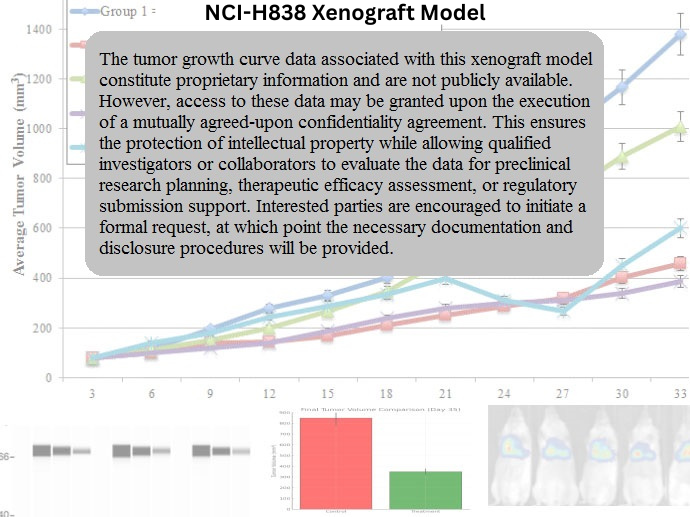
NCI-H838 Xenograft Model Overview
The NCI-H838 xenograft model is derived from a human non-small cell lung cancer (NSCLC) adenocarcinoma and serves as a robust in vivo system for preclinical testing of cytotoxic agents and molecularly targeted therapies. Originating from a male patient, the NCI-H838 cell line lacks activating mutations in KRAS and EGFR, providing a wild-type background that reflects a subset of NSCLC cases often excluded from mutation-specific treatment approaches. This makes the model highly valuable for assessing agents that exert their effects independent of classical oncogenic drivers. When implanted subcutaneously into immunodeficient mice, the NCI-H838 line exhibits reliable tumor formation, moderate to rapid growth kinetics, and consistent histological features, making it suitable for efficacy evaluations, biomarker studies, and combinatorial therapy testing.
Request a Custom Quote for NCI-H838 Xenograft ModelBiological and Molecular Characteristics
The NCI-H838 cell line features an epithelial phenotype and is wild-type for both KRAS and EGFR, distinguishing it from more commonly studied driver mutation-positive models. However, the cell line harbors alterations in other tumor suppressor pathways, including TP53 mutations, and demonstrates upregulated expression of anti-apoptotic proteins such as BCL-XL. This genetic composition makes it well-suited for preclinical evaluation of DNA-damaging agents, apoptosis inducers, and cell cycle checkpoint inhibitors. Immunophenotypic analysis confirms expression of epithelial markers including cytokeratin 7 and E-cadherin, and the cell line expresses functional MHC class I molecules. Basal PD-L1 expression is generally low, but inducible under immune-activating conditions, making it a candidate for studies evaluating immunogenicity modulation.
| Characteristic | Description |
|---|---|
| Tissue Origin | Human lung (adenocarcinoma) |
| Key Genetic Features | KRAS wild-type, EGFR wild-type, TP53 mutant |
| Cell Morphology | Epithelial, adherent |
| Immunomarkers | CK7+, E-cadherin+, PD-L1 (low, inducible) |
| Therapeutic Pathways | Apoptosis, cell cycle regulation, immune modulation |
In Vivo Model Development and Tumorigenicity
Subcutaneous xenografts of NCI-H838 are routinely developed in immunodeficient mice such as athymic nude or NOD/SCID strains. The tumors typically become measurable within 10–14 days post-injection and progress to target volumes of 300–600 mm³ within five weeks, depending on experimental parameters. The model exhibits high take rates and predictable growth behavior, making it suitable for dose-response studies and repeated dosing schedules. Its histological uniformity and moderate proliferation rate facilitate precise pharmacodynamic sampling and therapeutic window assessments. In addition, the tumor microenvironment supports vascularized tissue architecture, allowing for pharmacokinetic analyses and compound distribution studies. NCI-H838 xenografts are compatible with in vivo imaging approaches and can be modified for bioluminescent or fluorescent tracking when required.
Request a Custom Quote for NCI-H838 Xenograft ModelHistopathology and Immunohistochemical Profile
Histological examination of NCI-H838-derived tumors reveals moderately differentiated adenocarcinoma with cohesive epithelial structures, glandular architecture, and a fibrous interstitial framework. Hematoxylin and eosin staining shows polygonal tumor cells with vesicular nuclei and mitotic figures scattered throughout the tumor mass. The Ki-67 proliferation index ranges from 50% to 65%, indicating an intermediate growth rate suitable for therapeutic efficacy assessments. Immunohistochemistry confirms cytoplasmic cytokeratin 7 expression and membranous localization of E-cadherin, confirming epithelial lineage. p53 protein accumulation is evident due to underlying mutation, while PD-L1 staining remains limited to focal areas, enabling investigation into immune checkpoint pathway modulation through therapeutic induction.
Preclinical Applications and Drug Response
The NCI-H838 xenograft model is frequently used to evaluate the efficacy of non-targeted chemotherapeutics, such as platinum-based agents and microtubule inhibitors, as well as targeted treatments directed at apoptosis and cell cycle dysregulation. Due to its KRAS and EGFR wild-type status, the model is well suited for testing agents intended for mutation-agnostic indications. BCL-2/BCL-XL inhibitors and checkpoint kinase inhibitors have shown efficacy in this system, particularly when combined with DNA-damaging compounds. Its baseline immune profile makes it amenable to studies exploring the induction of tumor immunogenicity, as well as the synergistic effects of immune checkpoint inhibitors with sensitizing agents. NCI-H838 is also utilized in the validation of drug delivery systems and formulations requiring consistent tumor morphology and predictable kinetics.
Request This Model
To request the NCI-H838 xenograft model for your preclinical studies, please use the form below. A customized quote and additional model specifications will be provided upon inquiry.
Request a Custom Quote for NCI-H838 Xenograft Model