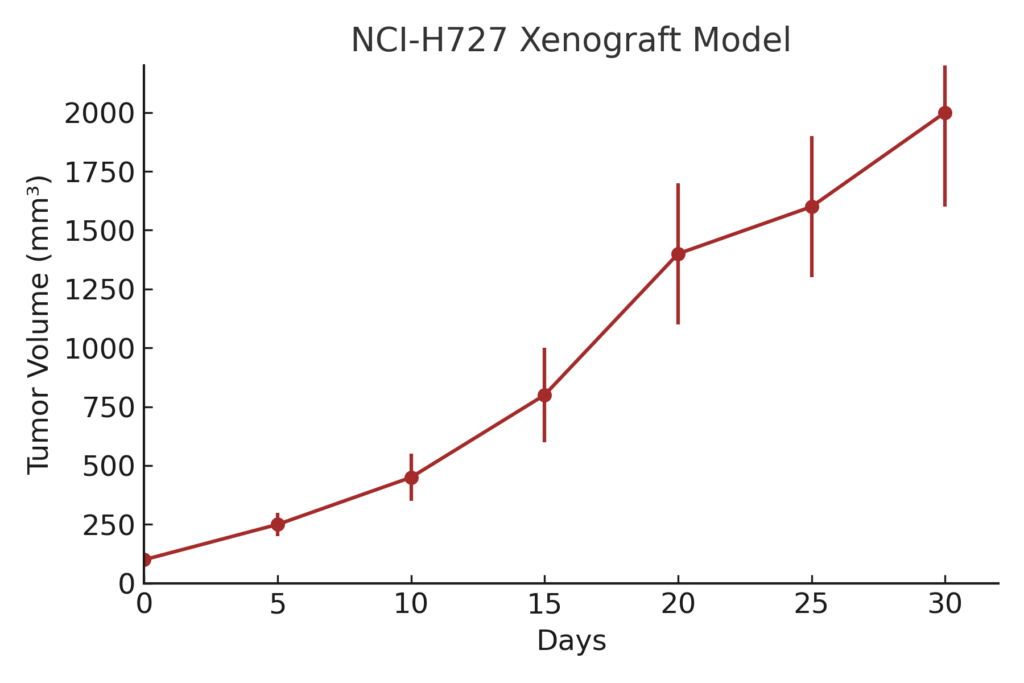
NCI-H727 Xenograft Model Overview
The NCI-H727 xenograft model is derived from a human lung carcinoid tumor and represents a key tool for preclinical investigation of well-differentiated neuroendocrine tumors (NETs) of pulmonary origin. Established from a metastatic lymph node lesion, this cell line reflects the slow-growing, hormonally active phenotype associated with typical carcinoid tumors. NCI-H727 xenografts are widely used to study somatostatin receptor–positive lung cancers, and serve as a validated platform for evaluating cytostatic agents, peptide receptor radionuclide therapies (PRRT), and somatostatin analogs. Its low proliferation rate and sustained neuroendocrine differentiation make it a physiologically relevant model for translational studies in NET biology.
Request a Custom Quote for NCI‑H727 Xenograft ModelBiological and Molecular Characteristics
NCI-H727 cells retain key neuroendocrine markers and exhibit moderate growth in vitro. The cell line expresses somatostatin receptor 2 (SSTR2), chromogranin A, and synaptophysin, making it highly suitable for therapies targeting neuroendocrine differentiation. Genetically, the model harbors a wild-type TP53 gene and shows low mutational burden, in line with the genomic stability typically associated with well-differentiated NETs. NCI-H727 cells are non-invasive and non-metastatic, enabling focused evaluation of tumor-specific drug effects without confounding metastatic behavior. The epithelial phenotype is preserved through cytokeratin expression, and the cells form tightly adherent monolayers in vitro.
| Characteristic | NCI-H727 Cell Line Profile |
|---|---|
| Tumor Origin | Lung carcinoid (typical neuroendocrine tumor) |
| Somatostatin Receptor Status | SSTR2⁺ |
| Neuroendocrine Markers | Chromogranin A⁺, Synaptophysin⁺ |
| TP53 Status | Wild-type |
| Proliferation Rate | Low |
| Growth Behavior | Non-metastatic, well-differentiated |
In Vivo Model Development and Tumorigenicity
NCI-H727 xenografts are developed through subcutaneous injection into immunodeficient mice, including nude or NOD/SCID strains. Tumor take rates are moderate and may require Matrigel supplementation to enhance engraftment efficiency. Tumors typically appear within 2–3 weeks and grow slowly, often reaching endpoint volumes between 6–8 weeks post-implantation. This model’s indolent growth profile reflects the clinical behavior of pulmonary carcinoids and provides an extended window for therapeutic evaluation. Because of its slower kinetics, the model is well-suited for long-term dosing regimens and pharmacodynamic assessments of cytostatic therapies.
Request a Custom Quote for NCI‑H727 Xenograft ModelHistopathology and Immunohistochemical Profile
Histologically, NCI-H727 xenograft tumors display nests of uniform cells with finely granular chromatin, a hallmark of carcinoid tumors. These nests are separated by delicate fibrovascular stroma and exhibit low mitotic indices and minimal necrosis. Immunohistochemical staining reveals strong positivity for neuroendocrine markers such as chromogranin A and synaptophysin, as well as robust expression of SSTR2, confirming the model’s suitability for receptor-targeted approaches. Ki-67 indices generally remain below 10%, consistent with a well-differentiated phenotype and low proliferative potential.
Preclinical Applications and Drug Response
The NCI-H727 xenograft model is extensively used in evaluating somatostatin analogs, mTOR inhibitors, and radionuclide therapies such as 177Lu-DOTATATE. Its stable SSTR2 expression enables consistent in vivo imaging and drug delivery via receptor-mediated mechanisms. The model supports investigations into hormone secretion, long-term tumor control, and resistance mechanisms to PRRT and other cytostatic treatments. Furthermore, its neuroendocrine profile allows exploration of combination regimens with anti-angiogenic agents, epigenetic modulators, or immune checkpoint inhibitors in NETs with low immunogenicity. Due to its predictable and sustained tumor growth, the NCI-H727 model is favored for chronic dosing and therapeutic response studies in neuroendocrine lung cancers.
Request This Model
To integrate the NCI-H727 xenograft model into your preclinical development pipeline for neuroendocrine or somatostatin receptor–positive lung cancers, reach out for study protocols, validation data, and expert guidance tailored to your experimental goals.
Request a Custom Quote for NCI‑H727 Xenograft Model