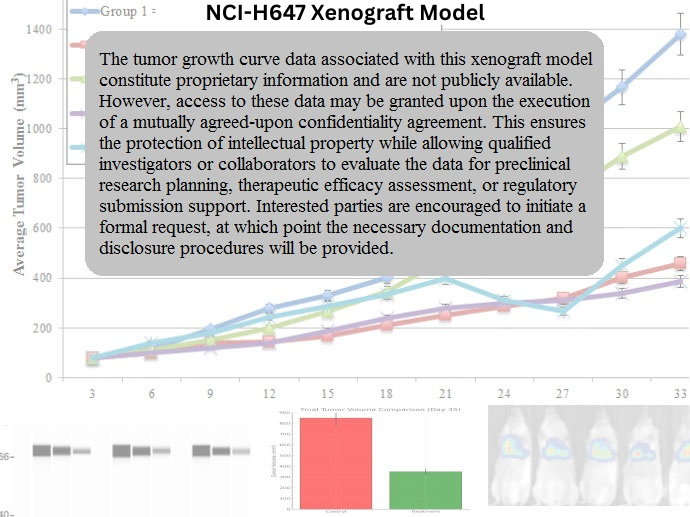
NCI-H647 Xenograft Model Overview
The NCI-H647 xenograft model is derived from a human non-small cell lung carcinoma (NSCLC) cell line originating from a metastatic lymph node biopsy of a 65-year-old male patient. Classified as a large cell carcinoma, NCI-H647 represents a rare and histologically distinct NSCLC subtype that lacks glandular or squamous differentiation. This xenograft model is particularly valuable for studying atypical NSCLC pathologies and for testing therapeutic agents targeting tumors with neuroendocrine characteristics and KRAS mutation-driven signaling. Due to its unique molecular profile and differentiation status, the NCI-H647 model is frequently employed in preclinical studies investigating resistance mechanisms, oncogenic plasticity, and alternative treatment strategies.
Request a Custom Quote for NCI‑H647 Xenograft ModelBiological and Molecular Characteristics
NCI-H647 cells exhibit loosely adherent epithelial morphology and grow as aggregates in culture. They are defined by a KRAS G13D mutation, leading to constitutive activation of the RAS/RAF/MEK/ERK and PI3K/AKT pathways. Unlike more common adenocarcinoma-derived NSCLC models, NCI-H647 expresses low levels of epithelial markers and shows variable expression of neuroendocrine markers such as chromogranin A and synaptophysin, positioning it within a transitional phenotype. The cell line is wild-type for EGFR and ALK, and retains partial p53 activity. These characteristics allow for the investigation of KRAS-driven oncogenesis in the absence of classical epithelial or squamous markers.
| Characteristic | NCI-H647 Cell Line Profile |
|---|---|
| Cancer Type | Non-small cell lung carcinoma (large cell) |
| KRAS Status | Mutant (G13D) |
| EGFR/ALK Status | Wild-type |
| p53 Status | Functionally active |
| Marker Expression | Variable; low cytokeratin, occasional neuroendocrine⁺ |
| Morphology | Loosely adherent aggregates |
In Vivo Model Development and Tumorigenicity
The NCI-H647 xenograft model is generated via subcutaneous implantation of cultured cells into immunodeficient mouse strains such as athymic nude or NOD/SCID mice. Tumor formation is typically observed within 12–16 days post-injection, with volumetric expansion reaching 600–800 mm³ by 5–6 weeks. Engraftment rates are moderate but reproducible, and tumors demonstrate a cohesive but histologically undifferentiated architecture. The model is particularly well-suited for long-term treatment studies and pharmacodynamic evaluations, especially in drug development pipelines focusing on KRAS G13D-selective inhibitors or agents modulating cell fate transitions in NSCLC.
Request a Custom Quote for NCI‑H647 Xenograft ModelHistopathology and Immunohistochemical Profile
Histologic analysis of NCI-H647 xenografts reveals undifferentiated tumor morphology with large polygonal cells, prominent nucleoli, and minimal keratinization. The tumors are poorly differentiated and lack glandular or squamous structures, consistent with large cell carcinoma classification. Immunohistochemical staining typically shows variable expression of pan-cytokeratin, low to moderate Ki-67 indices, and patchy positivity for neuroendocrine markers such as synaptophysin. KRAS pathway activity is evidenced by phosphorylated ERK and AKT staining. The overall histological and immunohistochemical profile reflects a poorly differentiated NSCLC tumor with KRAS-driven oncogenic signaling and minimal lineage commitment.
Preclinical Applications and Drug Response
The NCI-H647 xenograft model is a valuable preclinical system for evaluating novel therapeutics targeting KRAS G13D, a less common but clinically significant mutation. Its intermediate epithelial-neuroendocrine phenotype makes it applicable in studies focused on cell fate reprogramming, drug resistance development, and lineage plasticity. It has been used to assess efficacy of MEK and ERK inhibitors, DNA damage response modulators, and agents targeting tumor heterogeneity. The model also supports investigations into therapeutic vulnerability associated with large cell carcinoma, a historically understudied NSCLC subtype.
Request This Model
To incorporate the NCI-H647 xenograft model into your NSCLC research portfolio or therapeutic evaluation strategy, contact our team for detailed tumor growth data, IHC profiles, and study design support tailored to large cell carcinoma and KRAS G13D-mutant lung cancer.
Request a Custom Quote for NCI‑H647 Xenograft Model