NCI-H596 Xenograft Model Overview
The NCI-H596 xenograft model is derived from a human large cell carcinoma of the lung and serves as a critical tool for studying non-small cell lung cancer (NSCLC) subtypes that diverge from the more commonly represented adenocarcinoma and squamous cell carcinoma lineages. Isolated from the lymph node metastasis of a male patient, the NCI-H596 cell line exhibits a poorly differentiated phenotype and supports the evaluation of therapies targeting non-oncogene-addicted tumors, particularly those driven by PI3K/AKT/mTOR signaling. This model is especially relevant in studies focused on metabolic regulation, epithelial-mesenchymal transition (EMT), and apoptosis evasion. When implanted into immunodeficient mice, NCI-H596 cells produce aggressive tumors with consistent morphology and rapid proliferation, enabling rigorous assessment of anti-cancer agents and combination strategies in a clinically relevant NSCLC subset.
Request a Custom Quote for NCI-H596 Xenograft ModelBiological and Molecular Characteristics
The NCI-H596 cell line is defined by a wild-type KRAS and EGFR status, but exhibits amplification and overexpression of PIK3CA and deregulation of PTEN, contributing to constitutive activation of the PI3K/AKT pathway. This makes the model particularly suitable for evaluating inhibitors of PI3K, mTOR, and related intracellular kinases. TP53 is mutated, consistent with impaired DNA damage response and apoptotic control. Immunophenotypically, the cells express moderate levels of cytokeratin 7, while lacking strong epithelial markers such as E-cadherin, indicative of EMT-like properties. PD-L1 expression is low at baseline but can be induced under inflammatory conditions, and the cell line retains MHC class I functionality. The model’s molecular signature supports investigations into targeted therapies, synthetic lethality, and resistance modulation in aggressive NSCLC.
| Characteristic | Description |
|---|---|
| Tissue Origin | Human lung (large cell carcinoma, lymph node metastasis) |
| Key Genetic Features | PIK3CA amplification, TP53 mutant, KRAS/EGFR wild-type |
| EMT/Adhesion Profile | Low E-cadherin, CK7+, vimentin+ |
| Immunophenotype | Low PD-L1, MHC class I positive |
| Pathway Activation | PI3K/AKT/mTOR, apoptosis resistance |
In Vivo Model Development and Tumorigenicity
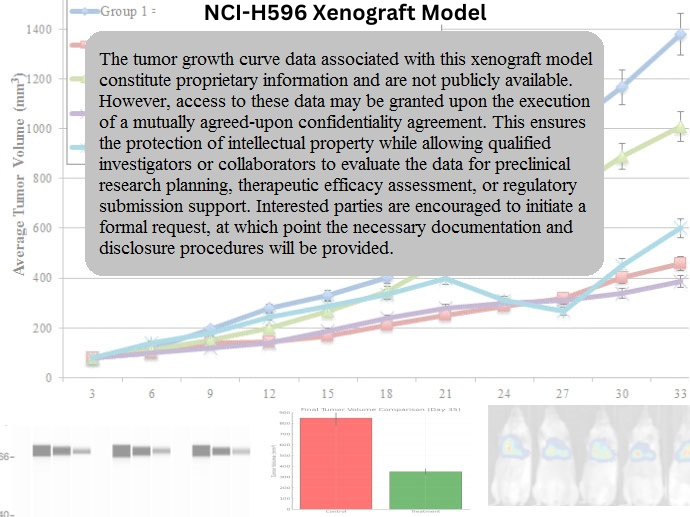
NCI-H596 xenografts are established through subcutaneous injection into immunocompromised mice, such as nude or NOD/SCID strains. Tumors typically appear within 10–14 days and grow rapidly to reach volumes of 400–600 mm³ by weeks four to five. The model exhibits high take rates, minimal necrosis, and stable morphology, making it ideal for longitudinal pharmacological studies and therapeutic efficacy evaluations. Its consistent tumor architecture and intermediate vascular density support analyses of drug distribution and intratumoral pharmacokinetics. The model also allows for repeat dosing and combination therapy protocols, including dual inhibition of PI3K and compensatory survival pathways such as MAPK or STAT3.
Request a Custom Quote for NCI-H596 Xenograft ModelHistopathology and Immunohistochemical Profile
Histological analysis of NCI-H596 xenograft tumors reveals poorly differentiated carcinoma with features consistent with large cell histology. Tumors appear as solid sheets of polygonal cells with high nuclear-to-cytoplasmic ratios, scattered mitotic figures, and areas of pseudoglandular formation. Hematoxylin and eosin staining highlights marked cellular pleomorphism and focal necrosis. Immunohistochemical staining confirms cytoplasmic cytokeratin 7 expression and reduced E-cadherin, consistent with EMT. Vimentin is frequently expressed, suggesting a mesenchymal shift. The Ki-67 proliferation index typically exceeds 60%, supporting its application in therapeutic efficacy and tumor growth inhibition studies. PD-L1 staining is focal and limited, although inducibility makes the model compatible with immune-modulatory exploration under appropriate conditions.
Preclinical Applications and Drug Response
The NCI-H596 xenograft model is extensively used in studies targeting the PI3K/AKT/mTOR axis, particularly in the context of PIK3CA amplification and PTEN dysregulation. It has demonstrated responsiveness to PI3K and mTOR inhibitors, both as monotherapies and in combination with DNA-damaging agents or anti-apoptotic pathway inhibitors. The model is also well-suited for testing anti-EMT compounds and evaluating synthetic lethality approaches involving dual kinase inhibition. Due to its low baseline immunogenicity and intact MHC class I expression, the model can support immunotherapy studies that incorporate agents designed to upregulate PD-L1 or enhance T-cell recruitment. Additionally, NCI-H596 has been employed in nanoparticle-based drug delivery evaluations, given its consistent tumor mass and predictable progression. Its molecular complexity and phenotypic aggressiveness make it a valuable model for studying hard-to-treat NSCLC subtypes.
Request This Model
To request the NCI-H596 xenograft model for your preclinical studies, please use the form below. A customized quote and additional model specifications will be provided upon inquiry.
Request a Custom Quote for NCI-H596 Xenograft Model