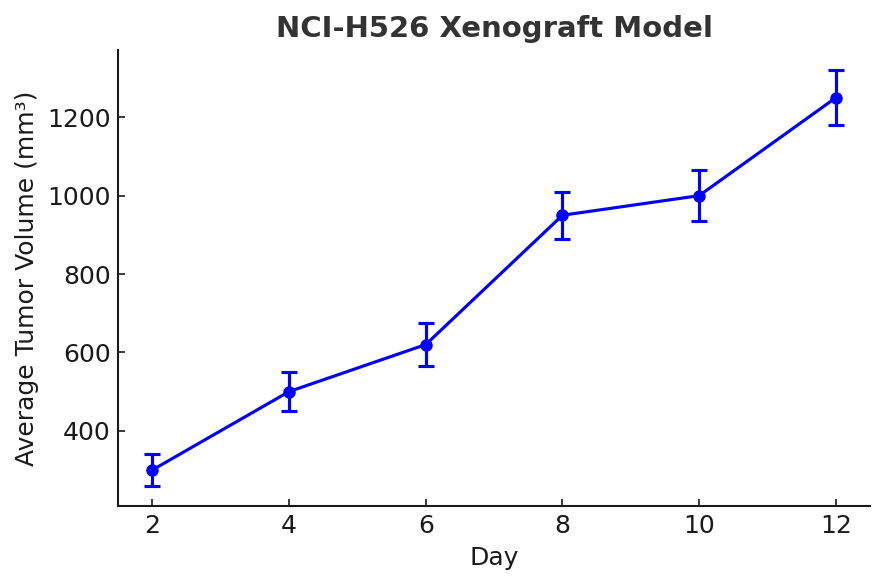
NCI-H526 Xenograft Model Overview
The NCI-H526 xenograft model is a preclinical in vivo system derived from a human small cell lung carcinoma (SCLC), one of the most aggressive and therapeutically challenging lung cancer subtypes. Established from a patient-derived tumor, the NCI-H526 cell line has been extensively utilized for modeling drug-resistant and chemosensitive forms of SCLC. This xenograft model recapitulates the histological, molecular, and growth dynamics of clinical small cell lung tumors, making it particularly well-suited for evaluating standard chemotherapeutics, epigenetic regulators, and experimental therapies targeting neuroendocrine differentiation and apoptotic resistance.
Request a Custom Quote for NCI‑H526 Xenograft ModelBiological and Molecular Characteristics
NCI-H526 cells exhibit features typical of SCLC, including neuroendocrine morphology and biomarker expression. These cells express high levels of neural and endocrine markers such as synaptophysin, neuron-specific enolase (NSE), and chromogranin A. Genomic analysis reveals loss-of-function mutations in both TP53 and RB1, the two most commonly inactivated tumor suppressors in SCLC. Additionally, MYC family gene dysregulation, particularly MYCL amplification, is often observed. The low expression of major histocompatibility complex (MHC) class I molecules contributes to the immune-evasive phenotype frequently seen in SCLC.
| Characteristic | NCI-H526 Cell Line Profile |
|---|---|
| Tumor Type | Small cell lung carcinoma (SCLC) |
| Neuroendocrine Markers | Synaptophysin⁺, Chromogranin A⁺, NSE⁺ |
| Common Genetic Alterations | TP53⁻/⁻, RB1⁻/⁻, MYCL⁺ |
| Proliferative Index | High (Ki-67 >80%) |
| MHC Class I Expression | Minimal |
In Vivo Model Development and Tumorigenicity
The NCI-H526 xenograft model is established via subcutaneous injection of cultured cells into immunocompromised mice, commonly using nude or NOD/SCID strains. Tumor formation occurs rapidly, with reliable engraftment and exponential growth kinetics. Tumors typically reach measurable size within two weeks, with consistent reproducibility across study cohorts. This model is particularly effective for high-throughput screening of drug efficacy and for evaluating resistance mechanisms in the context of rapid tumor proliferation and poor immune recognition. Its reliable growth and high-grade tumor characteristics make it an excellent platform for short-term efficacy trials.
Request a Custom Quote for NCI‑H526 Xenograft ModelHistopathology and Immunohistochemical Profile
Histologic examination of NCI-H526 xenograft tissue reveals dense sheets of small, round to oval cells with hyperchromatic nuclei, scant cytoplasm, and inconspicuous nucleoli, typical of high-grade neuroendocrine carcinomas. High mitotic activity and necrotic foci are frequently observed. Immunohistochemistry confirms strong expression of neuroendocrine lineage markers such as chromogranin A, synaptophysin, and NSE, along with an elevated Ki-67 index, often exceeding 80%. The consistent histopathologic profile closely mirrors clinical SCLC, allowing for relevant translational interpretation of drug efficacy and tumor biology.
Preclinical Applications and Drug Response
The NCI-H526 xenograft model has been used extensively to test the efficacy of standard chemotherapeutic agents such as etoposide and cisplatin, which are foundational in SCLC treatment. In addition, the model is suitable for testing BCL2 inhibitors, DNA-damaging agents, epigenetic modulators (e.g., EZH2 inhibitors), and novel therapeutics aimed at reactivating immune responses or inducing apoptosis in neuroendocrine cells. Its genetic stability and rapid tumor growth also make it valuable for evaluating the emergence of chemoresistance and for studying the biological consequences of specific gene perturbations using CRISPR or RNAi-based technologies.
Request This Model
For researchers focusing on small cell lung cancer, the NCI-H526 xenograft model provides a robust and clinically relevant system to test therapeutic interventions. Contact us to access tumor growth data, histological characterization, and expert guidance on customizing your preclinical study design.
Request a Custom Quote for NCI‑H526 Xenograft Model