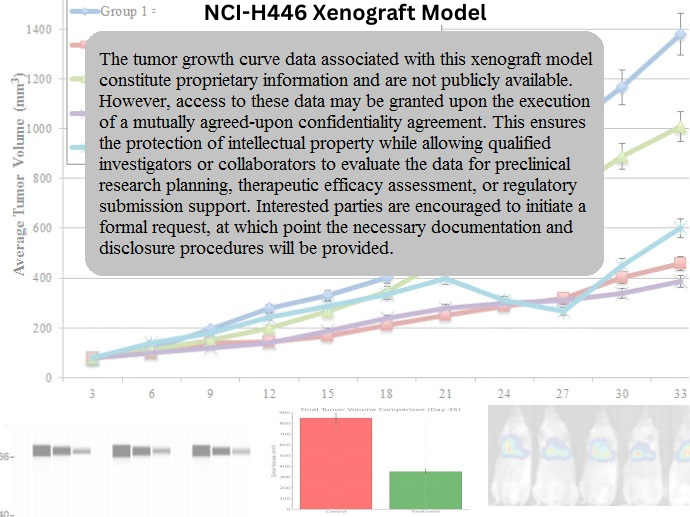
NCI-H446 Xenograft Model Overview
The NCI-H446 xenograft model is derived from a human small cell lung carcinoma (SCLC) and serves as a reliable platform for investigating aggressive neuroendocrine lung malignancies. Established from a metastatic site, this model reflects key pathological hallmarks of SCLC, including rapid growth, neuroendocrine marker expression, and frequent inactivation of tumor suppressor genes such as TP53 and RB1. The NCI-H446 cell line is widely utilized for evaluating cytotoxic agents, targeted therapies, and resistance mechanisms characteristic of high-grade pulmonary neuroendocrine tumors. Its consistent tumorigenicity in vivo, along with molecular resemblance to clinical SCLC, renders it valuable in preclinical drug discovery pipelines.
Request a Custom Quote for NCI‑H446 Xenograft ModelBiological and Molecular Characteristics
NCI-H446 cells display suspension growth and adopt a round-to-oval morphology with minimal cytoplasm. The cell line expresses canonical neuroendocrine markers including neuron-specific enolase (NSE), chromogranin A, and synaptophysin. Genomic profiling reveals biallelic loss of TP53 and RB1, typical of SCLC pathogenesis. Elevated expression of MYCN and BCL2, along with low MHC class I levels, further characterize its aggressive phenotype. These features recapitulate clinical SCLC biology, particularly in terms of immune evasion and apoptotic dysregulation.
| Characteristic | NCI-H446 Cell Line Profile |
|---|---|
| Cancer Type | Small cell lung carcinoma (SCLC) |
| Growth Pattern | Suspension culture |
| Key Genetic Alterations | TP53⁻/⁻, RB1⁻/⁻, MYCN⁺, BCL2⁺ |
| Neuroendocrine Markers | NSE⁺, Chromogranin A⁺, Synaptophysin⁺ |
| MHC Class I Expression | Low or absent |
In Vivo Model Development and Tumorigenicity
Subcutaneous implantation of NCI-H446 cells into immunodeficient mouse strains such as athymic nude or NOD/SCID mice leads to robust tumor formation. Tumors typically become palpable within 10–14 days and exhibit exponential growth, making the model ideal for early-phase efficacy studies. Due to the neuroendocrine origin and rapid proliferation, this xenograft is often selected for evaluating agents targeting mitotic checkpoints, anti-apoptotic signaling, or neuroendocrine differentiation. It provides consistent tumor establishment across cohorts, allowing for comparative drug response analyses and combinatorial regimens.
Request a Custom Quote for NCI‑H446 Xenograft ModelHistopathology and Immunohistochemical Profile
Tumors derived from NCI-H446 xenografts exhibit densely packed sheets of small round cells with hyperchromatic nuclei, scant cytoplasm, and finely granular chromatin. The mitotic index is high, and extensive regions of necrosis are often observed due to the model’s rapid growth. Immunohistochemical staining reveals strong expression of chromogranin A, synaptophysin, and NSE, with Ki-67 proliferation indices exceeding 80%. Absence of surface MHC class I expression contributes to reduced lymphocyte infiltration, mirroring the immune-cold phenotype of clinical SCLC.
Preclinical Applications and Drug Response
The NCI-H446 xenograft model is extensively used to evaluate chemotherapy agents such as cisplatin and etoposide, the current standard of care in SCLC. Its neuroendocrine differentiation and MYCN amplification make it especially suitable for testing PARP inhibitors, BCL2 antagonists, and emerging MYC-targeted therapies. Furthermore, its inherent immune evasiveness enables the investigation of immune reactivation strategies, including epigenetic modulation and antigen-presentation restoration. This model supports a wide range of translational research aimed at overcoming chemoresistance and improving therapeutic outcomes in patients with SCLC.
Request This Model
To incorporate the NCI-H446 xenograft model into your small cell lung cancer research project, contact us to receive validated tumor data, histological analysis, and expert consultation for customized preclinical study design.
Request a Custom Quote for NCI‑H446 Xenograft Model