NCI-H358 Xenograft Model Overview
The NCI-H358 xenograft model is derived from a human bronchioalveolar carcinoma, a histologic variant of non-small cell lung cancer (NSCLC) known for its glandular architecture and mucin production. Originating from a lung tumor resected from a 54-year-old male patient, the NCI-H358 cell line is defined by its KRAS G12C mutation and absence of TP53 expression, making it a critical platform for testing emerging KRAS G12C inhibitors and combination therapies. This model has become a cornerstone for evaluating targeted therapies in preclinical NSCLC research, especially for tumors lacking EGFR mutations or other actionable drivers.
Request a Custom Quote for NCI‑H358 Xenograft ModelBiological and Molecular Characteristics
NCI-H358 cells exhibit adherent, epithelial morphology and retain several features characteristic of alveolar type II pneumocytes. The KRAS G12C mutation confers persistent activation of downstream signaling cascades including the MAPK and PI3K pathways, resulting in enhanced cellular proliferation and survival. Notably, the cell line lacks functional p53 due to a deletion, making it useful for understanding therapeutic responses in TP53-deficient lung adenocarcinoma. It expresses epithelial markers such as E-cadherin and cytokeratin 7, while also exhibiting low baseline levels of MUC1. The wild-type status for EGFR, ALK, and BRAF further refines its utility in isolating KRAS-specific drug effects.
| Characteristic | NCI-H358 Cell Line Profile |
|---|---|
| Cancer Type | Non-small cell lung carcinoma (bronchioalveolar) |
| KRAS Status | Mutant (G12C) |
| TP53 Status | Null (gene deletion) |
| EGFR/ALK/BRAF Status | Wild-type |
| Marker Expression | Cytokeratin⁺, E-cadherin⁺, MUC1⁻/low |
| Differentiation Status | Well-differentiated, mucin-producing |
In Vivo Model Development and Tumorigenicity
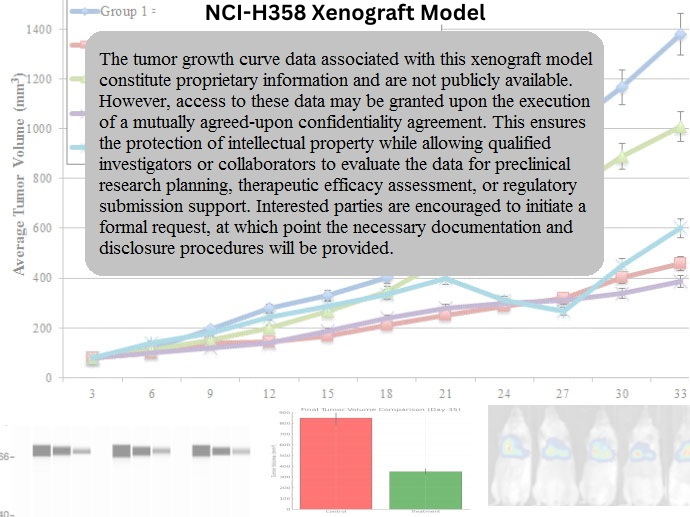
The NCI-H358 xenograft model is typically established via subcutaneous injection of cultured cells into immunodeficient mouse strains, including athymic nude or NOD/SCID mice. Tumors become palpable within 7–10 days, with consistent growth reaching volumes of 800–900 mm³ over a 4–6 week period. The model displays uniform growth kinetics and a moderate-to-high engraftment rate, facilitating reproducibility across cohorts. Its growth characteristics support standard efficacy studies, as well as combination therapy designs involving small molecules and biologics. The absence of TP53 function contributes to tumor progression and mimics an aggressive subset of human NSCLC.
Request a Custom Quote for NCI‑H358 Xenograft ModelHistopathology and Immunohistochemical Profile
Histological analysis of NCI-H358 xenograft tumors reveals well-differentiated adenocarcinomas composed of cuboidal epithelial cells arranged in glandular and alveolar-like structures. Tumor cells display eosinophilic cytoplasm, mucin vacuoles, and round-to-oval nuclei with minimal pleomorphism. Immunohistochemical staining demonstrates strong cytokeratin 7 and E-cadherin expression, confirming epithelial origin. Ki-67 proliferation indices are typically moderate to high, consistent with active cell cycling driven by KRAS mutation. Absence of nuclear p53 and high phospho-ERK staining reflect the functional gene deletion and ongoing RAS pathway activation.
Preclinical Applications and Drug Response
The NCI-H358 xenograft model is widely used for preclinical validation of KRAS G12C inhibitors and for evaluating combinatorial approaches involving MEK, ERK, or SHP2 inhibitors. Its TP53-null status provides an additional dimension for modeling tumor aggressiveness and chemotherapy resistance. The model is also employed to assess drug effects on signaling pathway modulation, tumor regression, and resistance evolution. It has proven responsive to pathway-specific interventions, while exhibiting limited sensitivity to EGFR inhibitors, reinforcing its role in KRAS-focused drug development. Additionally, its alveolar morphology makes it suitable for evaluating drug delivery strategies targeting the distal lung epithelium.
Request This Model
To request the NCI-H358 xenograft model for your preclinical NSCLC research or targeted therapy studies, please contact our team for tumor growth data, validated dosing protocols, and histological profiles specific to KRAS G12C-driven lung cancer.
Request a Custom Quote for NCI‑H358 Xenograft Model