NCI-H2347 Xenograft Model Overview
The NCI-H2347 xenograft model originates from a human non-small cell lung cancer (NSCLC) adenocarcinoma and provides a robust, well-characterized platform for investigating targeted therapies in tumors driven by oncogenic fusion events. Isolated from a male patient, the NCI-H2347 cell line harbors a CD74–NRG1 gene fusion, a rare but actionable alteration that activates ERBB signaling pathways. This model is particularly relevant for preclinical evaluation of HER2/HER3-targeted therapies, pan-ERBB inhibitors, and downstream PI3K/AKT pathway antagonists. When implanted subcutaneously into immunodeficient mice, NCI-H2347 tumors exhibit moderate-to-rapid growth and consistent tumorigenicity, making this model suitable for both efficacy and biomarker-guided therapeutic studies.
Request a Custom Quote for NCI‑H2347 Xenograft ModelBiological and Molecular Characteristics
NCI-H2347 cells possess several key molecular features, the most prominent of which is the CD74–NRG1 fusion, a driver alteration that leads to constitutive activation of ERBB3 signaling through paracrine or autocrine loops. The cell line expresses moderate levels of HER2 and high levels of HER3, while EGFR and ALK remain wild-type. TP53 is inactivated, further contributing to genomic instability and tumor progression. These cells exhibit epithelial morphology and express markers such as E-cadherin and cytokeratin 7. Importantly, PD-L1 expression is typically low, and MHC class I expression is retained, which enables studies that integrate immune sensitization approaches with anti-ERBB therapeutics.
| Characteristic | Description |
|---|---|
| Tissue Origin | Human lung adenocarcinoma |
| Key Alterations | CD74–NRG1 fusion; TP53 inactivation |
| Receptor Profile | HER2+, HER3+, EGFR wild-type, ALK wild-type |
| Immunophenotype | PD-L1 (low), MHC I (retained), CK7+, E-cadherin+ |
| Therapeutic Relevance | NRG1 fusion-positive NSCLC, pan-ERBB inhibition |
In Vivo Model Development and Tumorigenicity
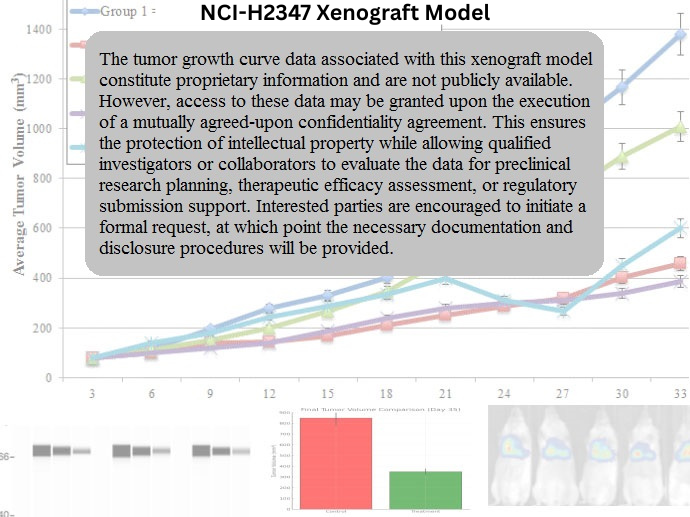
Subcutaneous xenograft development using NCI-H2347 cells is typically performed in immunodeficient mouse strains such as NOD/SCID or athymic nude mice. Tumor formation occurs within two weeks post-injection, with exponential growth leading to measurable volumes of 300–500 mm³ by week five or six. Tumor take rates are high, and growth kinetics are consistent, allowing for precise study design and longitudinal treatment assessment. This model is frequently used in dose-ranging and combination studies that target HER3 or pan-ERBB signaling, as well as in trials evaluating resistance mechanisms arising from ligand-mediated receptor activation or pathway reactivation.
Request a Custom Quote for NCI‑H2347 Xenograft ModelHistopathology and Immunohistochemical Profile
Histological sections of NCI-H2347 xenografts reveal moderately differentiated adenocarcinoma architecture with gland-like structures, dense cellularity, and focal necrosis. Hematoxylin and eosin staining demonstrates polygonal tumor cells with prominent nucleoli and high nuclear-to-cytoplasmic ratios. Immunohistochemistry confirms strong expression of cytokeratin 7 and E-cadherin, with moderate membranous HER2 and cytoplasmic HER3 staining. The Ki-67 proliferation index generally ranges from 50–70%, indicative of active cell division. PD-L1 expression is low across tumor fields, while MHC class I molecules are detectably expressed, enabling assessment of antigen presentation and immune reactivity in therapeutic contexts.
Preclinical Applications and Drug Response
The NCI-H2347 xenograft model is extensively used in preclinical research targeting ERBB pathway alterations, particularly those involving NRG1 fusions. It responds to HER2/HER3-directed monoclonal antibodies, pan-ERBB tyrosine kinase inhibitors, and agents that disrupt downstream PI3K/AKT signaling. Its relevance is especially high in combination therapy development, including co-treatment with MEK inhibitors, mTOR inhibitors, and apoptosis-sensitizing agents. The model also supports investigation of acquired resistance mechanisms to HER-targeted therapies and is being leveraged in immunotherapy studies where tumor priming or epigenetic modulation is required to enhance response in low-PD-L1 settings. This model is well suited for translational efforts aimed at advancing personalized therapies in rare genomic subtypes of NSCLC.
Request This Model
To request the NCI-H2347 xenograft model for your preclinical studies, please use the form below. A customized quote and additional model specifications will be provided upon inquiry.
Request a Custom Quote for NCI‑H2347 Xenograft Model