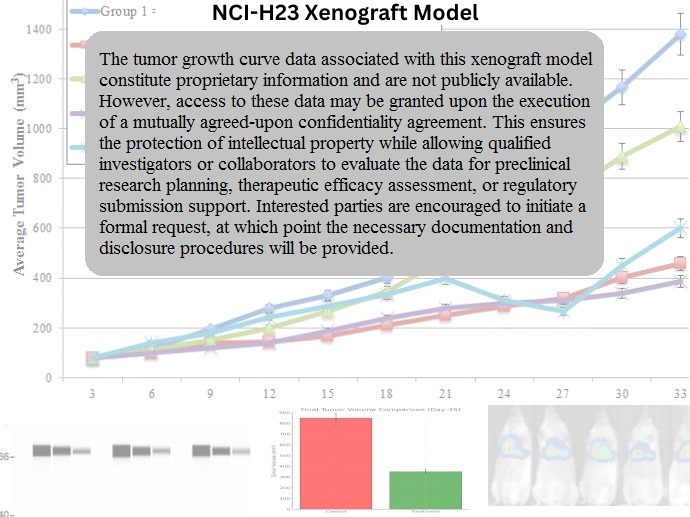
NCI-H23 Xenograft Model Overview
The NCI-H23 xenograft model is derived from a human non-small cell lung carcinoma (NSCLC) of adenocarcinoma origin. Originally established from a pleural effusion, this cell line represents a KRAS-mutant, EGFR-wild-type phenotype frequently encountered in clinical lung adenocarcinoma cases. It serves as a critical model for investigating resistance mechanisms to EGFR-targeted therapy and for evaluating direct KRAS-targeted inhibitors and downstream pathway modulators. With consistent tumor growth kinetics and reproducible histopathological features, the NCI-H23 xenograft is widely used in translational oncology for testing chemotherapeutics, immunotherapies, and signal transduction inhibitors.
Request a Custom Quote for NCI‑H23 Xenograft ModelBiological and Molecular Characteristics
The NCI-H23 cell line exhibits classic epithelial morphology and expresses adenocarcinoma-associated markers such as cytokeratin 7 (CK7) and TTF-1. Importantly, it harbors a KRAS G12C mutation, a key driver alteration that contributes to constitutive activation of the RAS/MAPK signaling cascade. The cells are wild-type for EGFR and ALK, which aligns with the typical mutational exclusivity observed in lung adenocarcinoma. Additionally, NCI-H23 exhibits p53 mutations and moderate expression of PD-L1, supporting its use in both targeted and immunotherapeutic drug development.
| Characteristic | NCI-H23 Cell Line Profile |
|---|---|
| Tumor Origin | Lung adenocarcinoma (NSCLC) |
| KRAS Status | Mutant (G12C) |
| EGFR/ALK Status | Wild-type |
| Marker Expression | CK7⁺, TTF-1⁺, PD-L1 moderate |
| Molecular Pathways | RAS/MAPK⁺, PI3K/AKT⁺ |
In Vivo Model Development and Tumorigenicity
NCI-H23 xenografts are generated by subcutaneous injection into immunodeficient murine hosts such as athymic nude or NOD/SCID mice. Tumor engraftment typically occurs within 10 to 14 days post-inoculation, with progressive and measurable tumor expansion over a 3–5 week period. The model demonstrates stable tumor formation and a high take rate under standard growth conditions. Its moderate growth kinetics and well-defined tumor architecture facilitate repeated dosing regimens and pharmacodynamic evaluations. This model is well-suited for in vivo validation of compounds targeting KRAS-mutant lung tumors.
Request a Custom Quote for NCI‑H23 Xenograft ModelHistopathology and Immunohistochemical Profile
Histological analysis of NCI-H23-derived tumors shows moderately differentiated glandular structures consistent with adenocarcinoma. Hematoxylin and eosin staining reveals prominent nucleoli, variable cytoplasmic mucin content, and occasional gland-like luminal structures. Immunohistochemistry demonstrates strong staining for TTF-1 and CK7, as well as nuclear p53 accumulation indicating loss of function. PD-L1 expression is heterogeneous but present in both tumor and peritumoral immune compartments, allowing for checkpoint blockade evaluation. The Ki-67 proliferation index is moderate, providing a suitable window for longitudinal therapeutic studies.
Preclinical Applications and Drug Response
Due to its KRAS G12C mutation and EGFR-wild-type status, the NCI-H23 xenograft model is especially relevant for preclinical testing of direct KRAS G12C inhibitors, such as sotorasib and adagrasib. It is also used in studies involving MEK inhibitors, mTOR blockers, and PI3K pathway modulators. The model has demonstrated responsiveness to cytotoxic agents such as docetaxel and carboplatin, but resistance to EGFR-targeted therapies. Additionally, its moderate PD-L1 expression supports its utility in immunotherapy research, particularly in studies assessing response variability and biomarker correlation.
Request This Model
The NCI-H23 xenograft model is a robust and translationally relevant system for investigating therapeutic strategies targeting KRAS-driven lung adenocarcinoma. To receive detailed study data, histological validation, or to initiate a custom xenograft study, please contact our team.
Request a Custom Quote for NCI‑H23 Xenograft Model