NCI-H2172 Xenograft Model Overview
The NCI-H2172 xenograft model is derived from a human large cell lung carcinoma and provides a robust preclinical system for studying non-small cell lung cancer (NSCLC) that lacks targetable oncogenic mutations. Originally established from a male patient, the NCI-H2172 cell line is characterized by poor differentiation, rapid proliferation, and a high degree of tumorigenicity when implanted subcutaneously in immunodeficient mice. This model is particularly useful for investigating cytotoxic drug responses, mitotic checkpoint disruption, and tumor progression in NSCLC subtypes that are not driven by EGFR, KRAS, or ALK alterations. Its reproducible growth characteristics and aggressive biological behavior make it an important tool in drug development pipelines focused on high-grade, treatment-refractory NSCLC.
Request a Custom Quote for NCI‑H2172 Xenograft ModelBiological and Molecular Characteristics
NCI-H2172 cells lack mutations in EGFR, KRAS, and ALK, classifying the model as a driver-negative NSCLC system. Instead, tumor progression is influenced by inactivation of tumor suppressor genes such as TP53 and by deregulated proliferation pathways. The cell line shows limited epithelial marker expression and a loss of cellular adhesion features, including reduced E-cadherin, contributing to a more mesenchymal phenotype. PD-L1 expression is low, and interferon response signaling is attenuated, making the model suitable for studying immune-cold tumors. Due to its undefined driver profile, NCI-H2172 enables broad-spectrum therapeutic testing, including DNA damage response agents, apoptosis-inducing compounds, and experimental cytotoxic platforms.
| Characteristic | Description |
|---|---|
| Tissue Origin | Human large cell lung carcinoma |
| Mutation Profile | Wild-type EGFR, KRAS, ALK; TP53 inactivated |
| Cell Morphology | Poorly differentiated, adherent |
| Immunomarkers | CK7 (low), E-cadherin (reduced), PD-L1 (low) |
| Therapeutic Relevance | Driver-negative NSCLC, chemotherapy and apoptosis studies |
In Vivo Model Development and Tumorigenicity
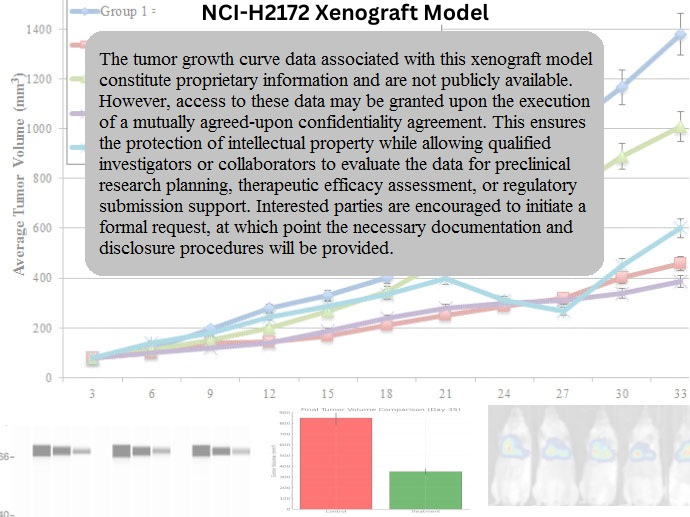
The NCI-H2172 xenograft model is established via subcutaneous injection into immunocompromised mouse strains such as NOD/SCID or athymic nude mice. Tumor formation typically occurs within 10–14 days, with consistent volumetric progression reaching 300–500 mm³ in 4–6 weeks. Tumor take rates are high and growth curves remain linear across cohorts, facilitating reproducibility and accurate therapeutic response evaluations. This model is especially appropriate for evaluating cytotoxic chemotherapies, microtubule-targeting agents, and emerging compounds that target mitotic progression, cell cycle control, or intrinsic apoptotic signaling in tumors unresponsive to targeted therapy.
Request a Custom Quote for NCI‑H2172 Xenograft ModelHistopathology and Immunohistochemical Profile
Histologic evaluation of NCI-H2172 xenograft tumors reveals poorly differentiated carcinoma with solid sheets of pleomorphic cells, high nuclear-to-cytoplasmic ratios, and frequent mitotic figures. Hematoxylin and eosin staining highlights a high degree of cellular atypia, with scattered necrotic regions and limited stromal support. Immunohistochemically, the tumors exhibit low-level cytokeratin expression and focal E-cadherin staining, reflecting a disrupted epithelial phenotype. TP53 nuclear accumulation is typically observed, indicating a dysfunctional tumor suppressor profile. Ki-67 labeling frequently exceeds 60%, confirming the aggressive proliferative nature of the tumors. PD-L1 staining is consistently low, limiting immune responsiveness but providing a baseline for immunostimulatory combination trials.
Preclinical Applications and Drug Response
The NCI-H2172 xenograft model has been employed in a wide range of preclinical studies focusing on drug discovery for NSCLC without identifiable oncogenic drivers. Due to its resistance to EGFR- and ALK-targeted therapies, it serves as a platform for evaluating cytotoxic drugs such as platinum-based agents, taxanes, and DNA-damaging compounds. Inhibitors targeting mitotic kinases (e.g., Aurora or PLK inhibitors), as well as pro-apoptotic agents like BCL-2 antagonists, have also been explored using this model. Its low immunogenicity supports its use in combination therapy studies aimed at enhancing immune responsiveness through epigenetic modulation or innate immune activation. The model’s consistent growth, aggressive biology, and absence of common driver mutations make it a key system for validating drug candidates in difficult-to-treat NSCLC.
Request This Model
To request the NCI-H2172 xenograft model for your preclinical studies, please use the form below. A customized quote and additional model specifications will be provided upon inquiry.
Request a Custom Quote for NCI‑H2172 Xenograft Model