NCI-H2135 Xenograft Model Overview
The NCI-H2135 xenograft model is established from a human large cell lung carcinoma and offers a robust in vivo platform for studying non-small cell lung cancer (NSCLC) subtypes lacking canonical oncogenic drivers. Derived from a male patient, the NCI-H2135 cell line demonstrates a poorly differentiated phenotype and supports consistent tumor formation in immunodeficient mice following subcutaneous implantation. This model is particularly suited for evaluating the efficacy of broad-spectrum chemotherapeutic agents, agents targeting cell cycle control, and combination regimens designed for tumors with limited molecular targetability. It is also valuable for investigating mechanisms of therapeutic resistance and tumor progression in histologically undifferentiated NSCLC.
Request a Custom Quote for NCI‑H2135 Xenograft ModelBiological and Molecular Characteristics
NCI-H2135 cells lack activating mutations in EGFR, KRAS, and ALK, making this model representative of oncogene-negative lung carcinomas. Instead, the cell line frequently exhibits inactivation of TP53 and alterations in genes regulating apoptosis and the mitotic checkpoint. It displays a high proliferative index and retains expression of certain epithelial markers such as cytokeratin 7, although E-cadherin expression is often reduced or aberrantly localized. PD-L1 levels are low, and interferon response pathways are downregulated, contributing to an immune-cold tumor microenvironment. These characteristics position the model as a clinically relevant system for studying poorly differentiated NSCLC and for developing therapies that do not depend on common oncogenic targets.
| Characteristic | Description |
|---|---|
| Tissue Origin | Human large cell lung carcinoma |
| Mutation Profile | Wild-type EGFR, KRAS, ALK; TP53 inactivated |
| Cell Morphology | Poorly differentiated, adherent |
| Immunomarkers | CK7+, reduced E-cadherin, PD-L1 (low) |
| Therapeutic Relevance | Driver-negative NSCLC, chemotherapy resistance studies |
In Vivo Model Development and Tumorigenicity
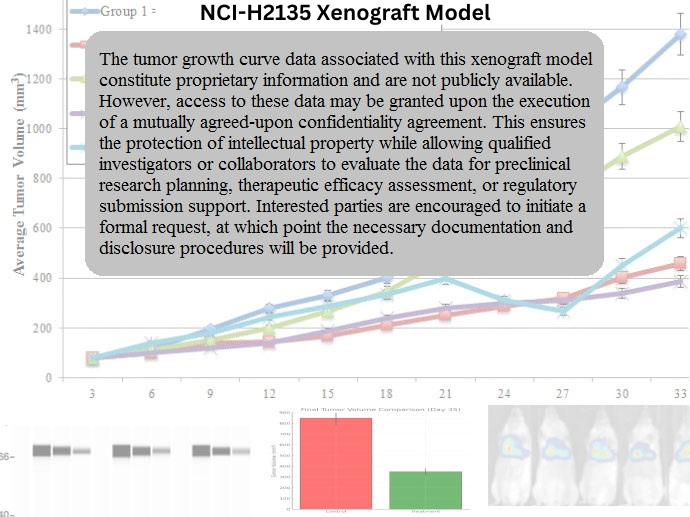
The NCI-H2135 xenograft model is developed by subcutaneous injection of cultured tumor cells into immunodeficient mice, including nude or NOD/SCID strains. Tumors typically become palpable within 12–14 days and reach experimental volumes of 300–500 mm³ over the course of 5–6 weeks. The model exhibits high tumor take rates and reproducible growth patterns, enabling standardized preclinical study designs and consistent evaluation of therapeutic response. Its rapid proliferation and histological characteristics support its use in evaluating cytotoxic compounds, anti-mitotic agents, and drug delivery platforms in lung cancers that are unresponsive to targeted therapies.
Request a Custom Quote for NCI‑H2135 Xenograft ModelHistopathology and Immunohistochemical Profile
Histological analysis of NCI-H2135-derived tumors reveals sheets of large pleomorphic tumor cells with prominent nucleoli, high nuclear-to-cytoplasmic ratios, and frequent mitoses. Hematoxylin and eosin staining confirms poorly differentiated morphology with minimal glandular or squamous differentiation. Immunohistochemistry reveals moderate cytokeratin 7 expression and diminished E-cadherin staining, consistent with a partially epithelial but poorly adherent phenotype. TP53 protein accumulation indicates underlying loss-of-function mutations. Ki-67 staining demonstrates a proliferation index exceeding 65%, highlighting the model’s suitability for evaluating antiproliferative therapies. PD-L1 staining is typically low or undetectable, limiting responsiveness to checkpoint blockade but enabling investigation into immune-resensitization strategies.
Preclinical Applications and Drug Response
The NCI-H2135 xenograft model is employed in preclinical testing of therapies for NSCLC subtypes without targetable oncogenic mutations. Due to its lack of EGFR and KRAS alterations, the model is used to evaluate broad-acting chemotherapeutics, including platinum agents and taxanes, as well as novel compounds targeting mitotic regulators, apoptotic pathways, and DNA damage responses. The model’s immune-cold phenotype supports investigation of immune adjuvants, epigenetic modulators, and combination therapies aimed at enhancing tumor immunogenicity. Its stable tumor growth and high proliferative capacity also make it well-suited for pharmacokinetic and pharmacodynamic studies, including those involving nanoparticle-encapsulated agents or intratumoral delivery systems.
Request This Model
To request the NCI-H2135 xenograft model for your preclinical studies, please use the form below. A customized quote and additional model specifications will be provided upon inquiry.
Request a Custom Quote for NCI‑H2135 Xenograft Model