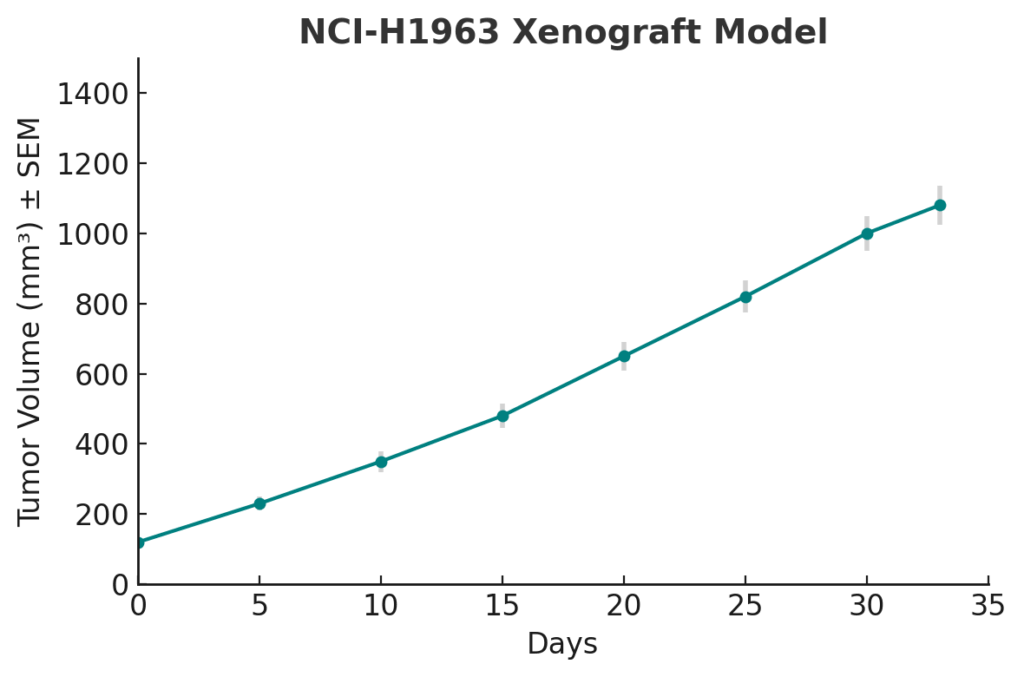
NCI-H1963 Xenograft Model Overview
The NCI-H1963 xenograft model is derived from a human non-small cell lung carcinoma (NSCLC), specifically adenocarcinoma, and is notable for harboring both KRAS and STK11 (LKB1) mutations. These co-occurring alterations define a molecular subtype of lung cancer characterized by aggressive behavior, metabolic dysregulation, and resistance to standard-of-care therapies, including immune checkpoint inhibitors. Originating from a male patient, the NCI-H1963 cell line demonstrates robust tumorigenicity in immunodeficient mice when implanted subcutaneously. This model is particularly suited for preclinical evaluation of metabolic inhibitors, synthetic lethality strategies, and combination regimens aimed at overcoming immune-refractory and KRAS-driven tumor biology.
Request a Custom Quote for NCI-H1963 Xenograft ModelBiological and Molecular Characteristics
The NCI-H1963 cell line features an activating mutation in KRAS, resulting in persistent RAS-RAF-MEK-ERK pathway signaling, along with biallelic inactivation of the tumor suppressor STK11, a key regulator of cellular metabolism and energy homeostasis. This dual-mutation status leads to profound metabolic reprogramming, increased oxidative stress resistance, and reduced immunogenicity. The cells express epithelial markers such as cytokeratin 7 and E-cadherin, while exhibiting low PD-L1 expression and diminished interferon response signaling, consistent with their immune-cold phenotype. This molecular configuration provides a tractable system for testing agents that exploit metabolic vulnerabilities or restore immune sensitivity in STK11-deficient tumors.
| Characteristic | Description |
|---|---|
| Tissue Origin | Human lung adenocarcinoma |
| Key Mutations | KRAS (activating), STK11 (loss-of-function) |
| Cell Morphology | Epithelial, adherent |
| Immunomarkers | CK7+, E-cadherin+, PD-L1 (low) |
| Active Pathways | MAPK, AMPK–mTOR, metabolic reprogramming |
In Vivo Model Development and Tumorigenicity
NCI-H1963 xenografts are generated through subcutaneous injection into immunodeficient murine strains, including athymic nude or NOD/SCID mice. Tumor formation is efficient, with detectable nodules emerging within 10–14 days and progressing to volumes suitable for therapeutic studies within 4–5 weeks. The model displays consistent tumor growth kinetics and high take rates, supporting its use in longitudinal studies, dose-response evaluations, and mechanistic investigations. Given the presence of STK11 inactivation, the model is particularly useful for testing metabolic pathway inhibitors (e.g., glutaminase or mTOR inhibitors) and assessing resistance patterns in the context of immune checkpoint blockade. It is also compatible with PK/PD analyses, imaging modalities, and tumor microenvironment profiling.
Request a Custom Quote for NCI-H1963 Xenograft ModelHistopathology and Immunohistochemical Profile
Histologically, tumors derived from NCI-H1963 xenografts present as moderately to poorly differentiated adenocarcinomas with solid architecture, frequent mitotic figures, and high nuclear-to-cytoplasmic ratios. Hematoxylin and eosin staining reveals dense cellularity with limited stromal infiltration. Immunohistochemical staining shows strong cytoplasmic expression of CK7 and membranous localization of E-cadherin. Ki-67 indices are typically high, often exceeding 60%, consistent with the rapid proliferation associated with KRAS activation. STK11 loss is confirmed through absent or markedly reduced staining, and PD-L1 expression remains minimal across tumor sections, supporting its classification as an immune-evasive NSCLC subtype.
Preclinical Applications and Drug Response
The NCI-H1963 xenograft model is a powerful tool for preclinical research targeting KRAS-mutant and STK11-deficient NSCLC. It has demonstrated limited response to single-agent immunotherapies, recapitulating clinical resistance seen in this molecular subclass. As such, it is frequently used to evaluate combination regimens involving immune checkpoint blockade and metabolic modulation. Inhibitors of glutaminase, mTOR, and autophagy have been studied in this model with encouraging results, particularly in synthetic lethality frameworks. The model is also suitable for testing novel KRAS G12C inhibitors and agents that induce ferroptosis or oxidative stress in metabolically dysregulated tumors. Its low immunogenicity, stable growth pattern, and defined mutational status make it a preferred system for high-confidence evaluation of emerging targeted and immuno-oncology therapies.
Request This Model
To request the NCI-H1963 xenograft model for your preclinical studies, please use the form below. A customized quote and additional model specifications will be provided upon inquiry.
Request a Custom Quote for NCI-H1963 Xenograft Model