NCI-H1944 Xenograft Model Overview
The NCI-H1944 xenograft model is derived from a human non-small cell lung carcinoma (NSCLC) classified as large cell carcinoma, obtained from the pleural effusion of a male patient. As a representative model of poorly differentiated NSCLC with squamous features, it is employed in preclinical research to study aggressive tumor growth, cytotoxic drug resistance, and therapeutic interventions targeting cell proliferation and apoptosis. The NCI-H1944 cell line is known for its high proliferative rate and tumorigenic efficiency in immunodeficient mice, where it forms solid subcutaneous tumors with consistent growth kinetics. Owing to its wild-type KRAS and EGFR status, this model provides a contrasting platform to KRAS-mutant NSCLC systems, enabling the assessment of therapies in a molecularly distinct tumor context. Its use is especially relevant for examining resistance mechanisms unrelated to canonical RAS or EGFR pathway activation.
Request a Custom Quote for NCI-H1944 Xenograft ModelBiological and Molecular Characteristics
The NCI-H1944 cell line is characterized by features typical of large cell carcinoma, including epithelial morphology with poor glandular differentiation and the absence of neuroendocrine markers. It carries a wild-type KRAS and EGFR profile, distinguishing it from many adenocarcinoma-derived models. However, alterations in p53 and upregulation of anti-apoptotic proteins contribute to its malignant phenotype. The line exhibits strong expression of cytokeratin family members and moderate PD-L1 levels, suggesting partial immunogenic potential and relevance for checkpoint blockade studies. NCI-H1944 cells are also marked by overexpression of cell cycle regulators such as cyclin D1 and CDK4, rendering the model suitable for evaluating CDK inhibitors and mitosis-targeting agents. Its relative genomic stability and high mitotic index make it a reliable platform for drug screening across diverse therapeutic classes.
| Characteristic | Description |
|---|---|
| Tissue Origin | Human lung (large cell carcinoma) |
| Key Genetic Features | KRAS wild-type, EGFR wild-type, TP53 mutant |
| Cell Morphology | Epithelial, adherent, undifferentiated |
| Immunomarkers | Cytokeratin-positive, PD-L1 moderate |
| Oncogenic Pathways | Cell cycle regulation, anti-apoptotic signaling |
In Vivo Model Development and Tumorigenicity
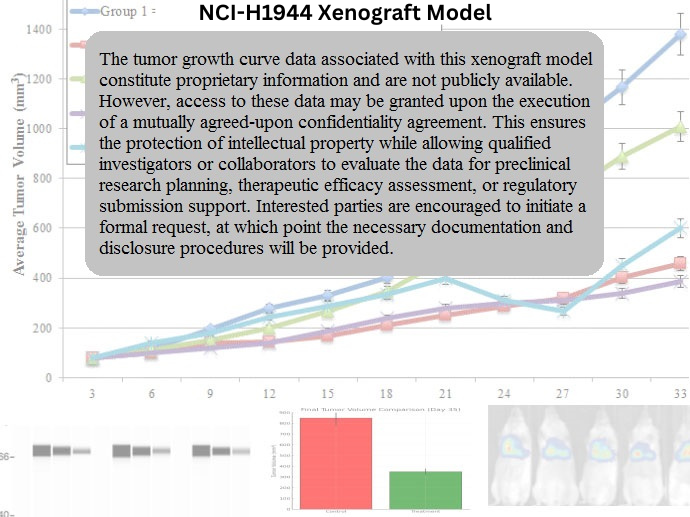
Subcutaneous xenografts established using NCI-H1944 cells in immunodeficient mice demonstrate efficient tumor engraftment and reproducible growth trajectories. Tumors become palpable within 10 to 12 days following implantation, typically reaching volumes of 400–600 mm³ by the fifth week. The model shows robust vascularization and histological consistency across replicates, allowing for standardized experimental timelines and clear endpoints. Its wild-type RAS/EGFR background enhances its utility in studies investigating alternative pathways, including DNA damage response, anti-mitotic mechanisms, and immune modulation. The model is compatible with repeated dosing regimens and is well-suited for evaluating drug exposure, biodistribution, and pharmacodynamic biomarkers in vivo. Due to its aggressive phenotype and rapid growth rate, it is also advantageous for screening novel compound libraries and identifying fast-acting therapeutic candidates.
Request a Custom Quote for NCI-H1944 Xenograft ModelHistopathology and Immunohistochemical Profile
Tumors derived from the NCI-H1944 xenograft model exhibit poorly differentiated histology consistent with large cell carcinoma. Hematoxylin and eosin staining reveals sheets of undifferentiated epithelial cells, minimal glandular architecture, and high nuclear-to-cytoplasmic ratios. Ki-67 staining indicates a proliferation index frequently exceeding 70%, confirming rapid cell turnover. Immunohistochemical markers reveal diffuse cytoplasmic cytokeratin expression and variable membranous PD-L1 staining, which may increase under inflammatory or drug-induced conditions. Mutant p53 protein accumulation is detectable, consistent with defective p53-mediated apoptotic pathways. Although neuroendocrine markers such as synaptophysin and chromogranin are absent, the model shows partial positivity for pan-cytokeratin, supporting its classification within the NSCLC spectrum. These histologic and molecular attributes make NCI-H1944 a viable option for evaluating agents that target proliferation, cell cycle progression, and immune evasion.
Preclinical Applications and Drug Response
The NCI-H1944 xenograft model serves as a critical platform for investigating therapeutic responses in NSCLC cases lacking KRAS or EGFR mutations. It is particularly suitable for evaluating cytotoxic agents, CDK inhibitors, and therapies targeting anti-apoptotic signaling networks. Owing to its p53 mutation status and elevated BCL-2/BCL-XL expression, the model has been employed in studies utilizing BH3 mimetics and DNA-damaging agents. Responses to platinum-based chemotherapy agents such as cisplatin and carboplatin have been characterized, with varying degrees of resistance that simulate clinical scenarios. Moderate PD-L1 expression has allowed for exploration of immune checkpoint inhibitors and their synergistic effects with conventional or targeted treatments. The model is also advantageous for pharmacokinetic profiling and drug delivery assessments due to its consistent tumor vascularization and reproducibility across cohorts.
Request This Model
To request the NCI-H1944 xenograft model for your preclinical studies, please use the form below. A customized quote and additional model specifications will be provided upon inquiry.
Request a Custom Quote for NCI-H1944 Xenograft Model