NCI-H1838 Xenograft Model Overview
The NCI-H1838 xenograft model is derived from a human non-small cell lung cancer (NSCLC) adenocarcinoma and offers a reliable preclinical platform for evaluating therapeutic interventions in tumors lacking classical oncogenic drivers. Isolated from the pleural effusion of a male patient, the NCI-H1838 cell line displays a moderately differentiated epithelial phenotype and forms solid, well-vascularized tumors when implanted subcutaneously into immunodeficient mice. This model is particularly valuable for testing agents that act independently of KRAS or EGFR mutations, as it lacks activating alterations in these commonly studied pathways. Its genomic and phenotypic stability make it suitable for pharmacological profiling, dose optimization studies, and assessments of novel therapeutic combinations in KRAS/EGFR wild-type NSCLC.
Request a Custom Quote for NCI-H1838 Xenograft ModelBiological and Molecular Characteristics
The NCI-H1838 cell line is characterized by a wild-type status for both KRAS and EGFR, providing a molecularly neutral background ideal for investigating therapies not reliant on pathway-specific addiction. The cell line expresses markers of epithelial lineage, including cytokeratin 7 and E-cadherin, and retains functional p53 protein, suggesting a relatively intact apoptotic signaling cascade. PD-L1 expression is generally low under basal conditions but may be upregulated following cytokine stimulation or treatment with immune modulators. This immunophenotype supports studies involving immune sensitization and the evaluation of checkpoint blockade combinations. The presence of moderate levels of pro-survival proteins such as survivin and BCL-XL offers additional opportunities to examine apoptosis-targeting therapies.
| Characteristic | Description |
|---|---|
| Tissue Origin | Human lung (adenocarcinoma, pleural effusion) |
| Key Genetic Features | KRAS wild-type, EGFR wild-type, TP53 functional |
| Cell Morphology | Epithelial, moderately differentiated |
| Immunomarkers | CK7+, E-cadherin+, PD-L1 low |
| Relevant Pathways | Apoptosis, immune modulation, DNA damage response |
In Vivo Model Development and Tumorigenicity
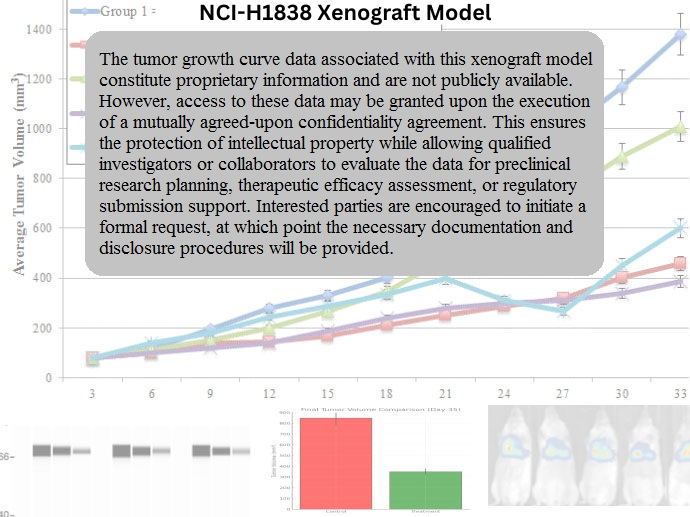
NCI-H1838 xenografts are established via subcutaneous injection into immunodeficient murine models such as nude or NOD/SCID mice. Tumors are typically palpable by day 14 post-injection and reach measurable volumes of 300–500 mm³ within five to six weeks. The model demonstrates high take rates and reproducible tumor growth kinetics, enabling well-controlled longitudinal efficacy and pharmacodynamic studies. Its moderate proliferation rate and consistent histological structure support detailed time-course analyses, including compound exposure, biomarker sampling, and therapeutic response evaluations. This xenograft system is also suitable for imaging-based studies when transduced with appropriate reporter genes, further expanding its utility in drug development workflows.
Request a Custom Quote for NCI-H1838 Xenograft ModelHistopathology and Immunohistochemical Profile
Histological examination of NCI-H1838 tumors reveals moderately differentiated adenocarcinoma with organized epithelial architecture and mild nuclear pleomorphism. Hematoxylin and eosin staining shows cohesive tumor nests with gland-like structures and a moderately fibrotic stroma. Ki-67 labeling indicates a proliferation index typically in the range of 40% to 55%, aligning with the model’s moderate growth rate. Immunohistochemical analysis confirms cytoplasmic cytokeratin 7 and membranous E-cadherin expression, along with low but inducible PD-L1 staining. The presence of intact p53 expression and absence of neuroendocrine differentiation markers further refine its classification as a well-suited model for testing therapies in non-oncogene-addicted NSCLC.
Preclinical Applications and Drug Response
The NCI-H1838 xenograft model is ideally positioned for evaluating therapies directed at non-mutated NSCLC, including DNA-damaging agents, apoptosis-inducing compounds, and immune checkpoint inhibitors. Its wild-type KRAS and EGFR background allows for the isolation of therapeutic effects unrelated to these pathways, enabling the assessment of treatment mechanisms in genomically neutral contexts. Studies using platinum-based chemotherapeutics and taxanes have shown predictable responses, while investigations involving CDK inhibitors and BCL-2 family antagonists have explored synergistic treatment strategies. Low PD-L1 expression makes the model useful in studies examining agents that enhance tumor immunogenicity or amplify checkpoint pathway engagement. Its tumor consistency and defined growth profile also support its use in pharmacokinetic and formulation studies, including nanoparticle and polymer-based delivery systems.
Request This Model
To request the NCI-H1838 xenograft model for your preclinical studies, please use the form below. A customized quote and additional model specifications will be provided upon inquiry.
Request a Custom Quote for NCI-H1838 Xenograft Model