NCI-H1781 Xenograft Model Overview
The NCI-H1781 xenograft model is derived from a human lung adenocarcinoma and is notable for its harboring of the rare ERBB2 (HER2) G776insV_G/C insertion mutation. This unique alteration renders the model particularly useful in the study of HER2-driven non-small cell lung cancer (NSCLC), a molecular subtype with limited effective therapeutic options. Established from a female patient, the NCI-H1781 cell line displays epithelial morphology and demonstrates reliable tumorigenicity in immunodeficient mice when implanted subcutaneously. The model serves as an indispensable tool for evaluating HER2-targeted agents, including tyrosine kinase inhibitors (TKIs), antibody–drug conjugates (ADCs), and combination regimens aimed at overcoming intrinsic resistance associated with this oncogenic driver.
Request a Custom Quote for NCI-H1781 Xenograft ModelBiological and Molecular Characteristics
The NCI-H1781 cell line carries an exon 20 insertion mutation in ERBB2 (HER2), a variant that results in constitutive kinase activation and downstream signaling through the PI3K/AKT and MAPK pathways. This mutation subtype, found in a minority of NSCLC cases, is associated with resistance to EGFR-targeted therapies and represents a distinct therapeutic challenge. The cells lack common driver alterations in EGFR and KRAS, making them suitable for isolated study of HER2-dependent oncogenesis. Immunophenotypically, the cell line expresses epithelial markers including cytokeratin 7 and E-cadherin, while PD-L1 expression is minimal. This molecular signature supports its use in preclinical evaluation of HER2 inhibitors and drug regimens designed to disrupt HER2-mediated oncogenic signaling.
| Characteristic | Description |
|---|---|
| Tissue Origin | Human lung adenocarcinoma |
| Dominant Alteration | HER2 (ERBB2) exon 20 insertion (G776insV_G/C) |
| Other Mutation Status | EGFR and KRAS wild-type |
| Cell Morphology | Epithelial, adherent |
| Immunomarkers | CK7+, E-cadherin+, PD-L1 (low) |
| Active Pathways | HER2–MAPK, HER2–PI3K/AKT |
In Vivo Model Development and Tumorigenicity
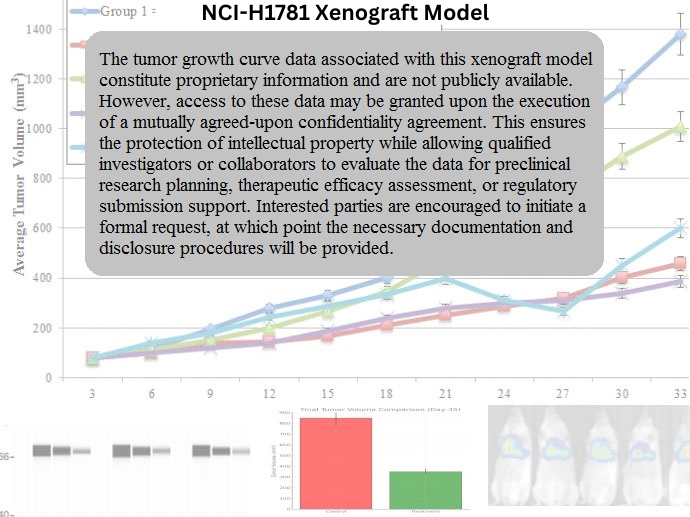
Subcutaneous implantation of NCI-H1781 cells into immunodeficient mice, including NOD/SCID or athymic nude strains, results in efficient and consistent tumor formation. Tumors typically become measurable within two weeks of injection and expand to treatment-relevant volumes between 300–500 mm³ over the course of four to six weeks. The model displays a stable growth curve and high tumor take rate, supporting its application in dosing, combination therapy, and long-term response studies. The NCI-H1781 xenograft model is especially suited for evaluating HER2-targeted agents, and its defined mutation allows for clean pharmacodynamic analyses and biomarker response correlation.
Request a Custom Quote for NCI-H1781 Xenograft ModelHistopathology and Immunohistochemical Profile
Tumors derived from the NCI-H1781 xenograft model present with histological features typical of moderately differentiated adenocarcinoma. Hematoxylin and eosin staining reveals glandular tumor architecture, nuclear pleomorphism, and mitotic activity. Immunohistochemistry demonstrates strong cytoplasmic expression of cytokeratin 7 and membranous E-cadherin, consistent with epithelial origin. HER2 overexpression can be confirmed through specific antibody staining or fluorescent in situ hybridization. Ki-67 proliferation index ranges between 50–70%, indicating moderate to high proliferative activity suitable for evaluating cell-cycle–dependent therapies. PD-L1 staining is typically low, supporting the use of this model in immune-sensitization studies or trials involving checkpoint blockade combinations.
Preclinical Applications and Drug Response
The NCI-H1781 xenograft model is a benchmark system for investigating HER2-targeted therapeutic agents in NSCLC. Its responsiveness to irreversible HER2 tyrosine kinase inhibitors, including afatinib and poziotinib, has been documented in preclinical settings. The model is also used in testing antibody–drug conjugates such as trastuzumab emtansine (T-DM1) and trastuzumab deruxtecan (T-DXd), which have demonstrated activity against HER2 exon 20 insertions. Combination strategies pairing HER2 inhibition with PI3K or MEK inhibitors have shown promise in overcoming resistance and enhancing antitumor efficacy. Additionally, the model is useful in evaluating nanoparticle-based delivery platforms and drug synergy analyses involving cytotoxic agents or immunomodulators. Its defined mutation and consistent tumor growth make it a key component in the translational research pipeline for HER2-altered lung cancer.
Request This Model
To request the NCI-H1781 xenograft model for your preclinical studies, please use the form below. A customized quote and additional model specifications will be provided upon inquiry.
Request a Custom Quote for NCI-H1781 Xenograft Model