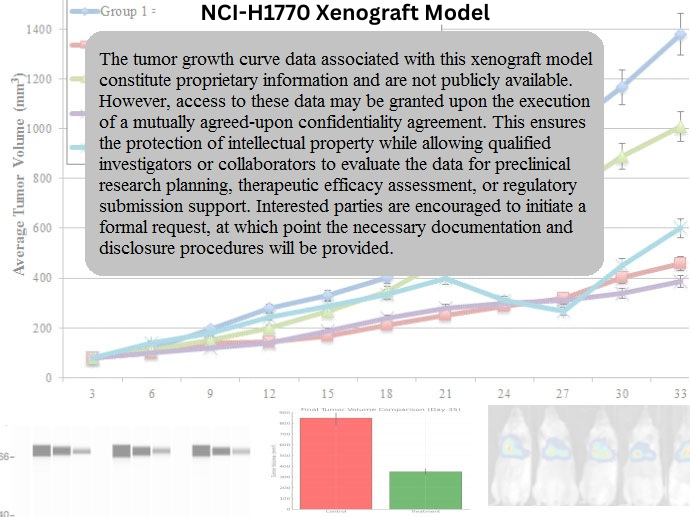
NCI-H1770 Xenograft Model Overview
The NCI-H1770 xenograft model is derived from a human large cell neuroendocrine carcinoma (LCNEC) of the lung and serves as a powerful system for studying high-grade neuroendocrine tumors with aggressive biology and limited therapeutic responsiveness. Established from a male patient, the NCI-H1770 cell line exhibits neuroendocrine morphology, rapid proliferation, and high tumorigenicity in immunodeficient mice following subcutaneous implantation. This model is particularly valuable for evaluating novel therapies targeting transcriptional addiction, DNA replication stress, and immune resistance mechanisms in LCNEC, a tumor type that shares molecular overlap with both small cell lung cancer (SCLC) and poorly differentiated non-small cell lung cancer (NSCLC).
Request a Custom Quote for NCI‑H1770 Xenograft ModelBiological and Molecular Characteristics
NCI-H1770 cells are defined by classical neuroendocrine marker expression—including synaptophysin, neuron-specific enolase (NSE), and chromogranin A—and exhibit transcriptional dependence on ASCL1. Genomic analysis reveals loss-of-function mutations in TP53 and RB1, common to high-grade neuroendocrine lung tumors. The model does not harbor activating mutations in EGFR, KRAS, or ALK, making it an ideal system for evaluating treatments independent of canonical NSCLC drivers. MYC family amplification and overexpression of cell cycle regulators such as CDK1 and E2F1 contribute to its proliferative phenotype. PD-L1 expression is minimal, and MHC class I molecules are downregulated, resulting in an immune-evasive tumor microenvironment suitable for immune-priming combination studies.
| Characteristic | Description |
|---|---|
| Tissue Origin | Human large cell neuroendocrine carcinoma |
| Key Alterations | TP53 and RB1 inactivation, MYC activation |
| Neuroendocrine Markers | Synaptophysin+, NSE+, Chromogranin A+, ASCL1+ |
| Mutation Status | EGFR, KRAS, ALK wild-type |
| Immunophenotype | PD-L1 (low), MHC I (low), Ki-67 > 80% |
In Vivo Model Development and Tumorigenicity
The NCI-H1770 xenograft model is generated by subcutaneous injection into immunodeficient mice such as NOD/SCID or athymic nude strains. Tumor formation occurs rapidly, with palpable nodules typically appearing within 7–10 days and expanding aggressively to volumes of 300–500 mm³ within three to four weeks. The model exhibits near-universal tumor take rates and highly reproducible growth, making it suitable for rigorous preclinical evaluation of monotherapies and rational drug combinations. NCI-H1770 is particularly useful in testing small-molecule inhibitors of transcriptional regulators (e.g., BET, CDK9), agents targeting the DNA damage response (e.g., PARP, CHK1 inhibitors), and compounds that reprogram immune tolerance.
Request a Custom Quote for NCI‑H1770 Xenograft ModelHistopathology and Immunohistochemical Profile
Histological examination of NCI-H1770 xenograft tumors reveals sheets of small to intermediate-sized cells with scant cytoplasm, granular chromatin, and inconspicuous nucleoli—typical features of high-grade neuroendocrine carcinoma. Hematoxylin and eosin staining shows abundant mitotic figures, frequent apoptosis, and minimal stromal infiltration. Immunohistochemistry confirms robust staining for synaptophysin, chromogranin A, and NSE. Nuclear ASCL1 expression is prominent and uniformly distributed. Ki-67 proliferation index commonly exceeds 80%, confirming the tumor’s rapid turnover and suitability for cytotoxic and cytostatic response studies. PD-L1 and MHC I expression remain low, supporting immune-modulation trials and immune checkpoint blockade sensitization strategies.
Preclinical Applications and Drug Response
The NCI-H1770 xenograft model is widely utilized in studies exploring new therapies for high-grade neuroendocrine tumors that are refractory to platinum-based regimens. It has been used to evaluate the antitumor efficacy of PARP inhibitors, CHK1/ATR inhibitors, and aurora kinase inhibitors in monotherapy and combination settings. Given its MYC activity and high transcriptional burden, it is particularly responsive to BET bromodomain inhibitors and CDK7/9 antagonists. The model is also suitable for immune-epigenetic drug development, STING agonist combinations, and strategies aimed at restoring MHC class I expression. Its reproducibility, aggressive biology, and neuroendocrine fidelity make NCI-H1770 an essential model for translational research in LCNEC and therapy-resistant lung cancer.
Request This Model
To request the NCI-H1770 xenograft model for your preclinical studies, please use the form below. A customized quote and additional model specifications will be provided upon inquiry.
Request a Custom Quote for NCI‑H1770 Xenograft Model