NCI-H1650 Xenograft Model Overview
The NCI-H1650 xenograft model is derived from a non-small cell lung carcinoma (NSCLC) adenocarcinoma cell line, originally isolated from the pleural effusion of a female patient. This model represents a clinically relevant subtype of lung adenocarcinoma characterized by mutations in the epidermal growth factor receptor (EGFR) gene and activation of downstream oncogenic signaling cascades. NCI-H1650 cells harbor an exon 19 deletion in EGFR, a feature frequently observed in NSCLC patients who initially respond to EGFR tyrosine kinase inhibitors (TKIs). The NCI-H1650 xenograft model is widely used in translational oncology to evaluate EGFR-targeted therapies, understand mechanisms of resistance, and explore combinatory treatment approaches.
Request a Custom Quote for NCI‑H1650 Xenograft ModelBiological and Molecular Characteristics
NCI-H1650 cells exhibit epithelial morphology and a molecular profile that includes an in-frame deletion in exon 19 of the EGFR gene (delE746-A750), which results in constitutive activation of the receptor. Unlike some other EGFR-mutant NSCLC lines, NCI-H1650 cells lack secondary T790M resistance mutations, making them suitable for modeling EGFR-TKI–sensitive tumors. The cell line is PTEN-null, leading to hyperactivation of the PI3K/AKT pathway and contributing to intrinsic resistance to certain TKIs. Expression of cytokeratins, E-cadherin, and surfactant proteins confirms its adenocarcinoma phenotype. These features make NCI-H1650 an important tool for studying oncogenic signaling, apoptotic regulation, and tumor progression in lung cancer.
| Characteristic | NCI-H1650 Cell Line Profile |
|---|---|
| Cancer Type | Non-small cell lung carcinoma (adenocarcinoma) |
| EGFR Mutation | Exon 19 deletion (E746-A750) |
| PTEN Status | Null |
| Histologic Features | Epithelial/adenocarcinoma phenotype |
| Key Pathways | EGFR, PI3K/AKT, MAPK |
| Marker Expression | Cytokeratin⁺, E-cadherin⁺, SP-A⁺ |
In Vivo Model Development and Tumorigenicity
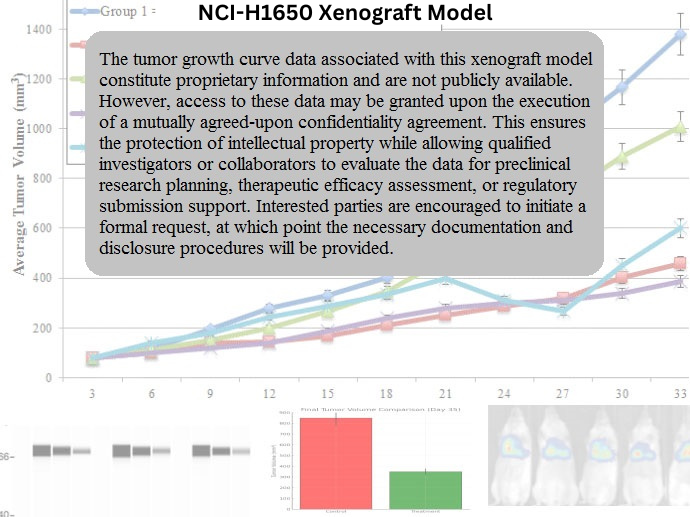
The NCI-H1650 xenograft model is established through subcutaneous injection of cultured cells into immunodeficient mice, including BALB/c nude or NSG strains. Tumor growth is robust, with engraftment occurring within 7–10 days and measurable tumor masses reaching 600–900 mm³ over a 4–6 week period. The model demonstrates consistent tumor take rates and homogenous growth kinetics, making it well-suited for longitudinal treatment studies. In select studies, orthotopic lung implantation may be performed to better replicate the pulmonary tumor microenvironment, although subcutaneous models remain preferred for drug screening due to ease of monitoring and tissue harvesting.
Request a Custom Quote for NCI‑H1650 Xenograft ModelHistopathology and Immunohistochemical Profile
Xenograft tumors formed from NCI-H1650 cells demonstrate histological features typical of moderately differentiated adenocarcinomas. Tumor cells grow in glandular and solid patterns with basophilic cytoplasm, large nuclei, and prominent nucleoli. Immunohistochemical staining reveals strong positivity for EGFR, cytokeratins CK7 and CK18, and epithelial adhesion markers such as E-cadherin. Ki-67 staining confirms high proliferative indices, while phospho-EGFR and phospho-AKT expression denote activation of the EGFR-PI3K axis. These features confirm the molecular fidelity of the in vivo tumors relative to their human NSCLC origin and support their application in mechanistic and therapeutic studies.
Preclinical Applications and Drug Response
The NCI-H1650 xenograft model plays a central role in evaluating the efficacy of EGFR inhibitors such as gefitinib and erlotinib, particularly in the context of primary sensitivity followed by adaptive resistance. Due to PTEN loss, this model provides insight into alternative resistance mechanisms and downstream signaling dependencies. It is also frequently used in studies of combination therapy targeting EGFR and PI3K/AKT/mTOR or MEK/ERK pathways. Furthermore, NCI-H1650 serves as a platform for testing investigational agents that restore PTEN function or modulate compensatory survival signals. The model supports biomarker discovery and pharmacodynamic analysis, particularly in tumors with EGFR-driven oncogenesis and impaired feedback regulation.
Request This Model
To access the NCI-H1650 xenograft model for your non-small cell lung cancer research, please contact our scientific team to receive validated protocols, tumor growth kinetics data, and comprehensive study support tailored to EGFR-mutant NSCLC investigations.
Request a Custom Quote for NCI‑H1650 Xenograft Model