NCI-H1581 Xenograft Model Overview
The NCI-H1581 xenograft model is derived from a human lung adenocarcinoma and is distinguished by high-level amplification of the fibroblast growth factor receptor 1 (FGFR1) gene. This model provides a unique and clinically relevant system for evaluating the preclinical efficacy of FGFR-targeted therapies in non-small cell lung cancer (NSCLC). Unlike many NSCLC models that harbor common mutations such as EGFR or KRAS, NCI-H1581 lacks these drivers, making it an essential model for isolating and interrogating FGFR-driven oncogenesis. Upon subcutaneous implantation into immunodeficient mice, NCI-H1581 cells generate tumors with reproducible growth kinetics, suitable for pharmacologic studies, resistance modeling, and biomarker discovery focused on FGFR signaling.
Request a Custom Quote for NCI-H1581 Xenograft ModelBiological and Molecular Characteristics
NCI-H1581 cells exhibit a distinctive genetic and phenotypic profile reflective of FGFR1-dependent lung cancer biology. FGFR1 amplification leads to enhanced downstream signaling through the MAPK and PI3K/AKT pathways, promoting tumor cell proliferation, angiogenesis, and survival. The cell line does not carry activating mutations in EGFR, KRAS, or ALK, providing a clean background for assessing selective FGFR inhibition without overlapping pathway interference. It expresses epithelial markers including cytokeratin 7 and E-cadherin, while displaying low levels of PD-L1, indicating minimal immune infiltration and low baseline immunogenicity. This molecular profile enables the use of NCI-H1581 as a pathway-specific model for developing precision oncology agents that target FGFR1 or its downstream effectors.
| Characteristic | Description |
|---|---|
| Tissue Origin | Human lung adenocarcinoma |
| Dominant Alteration | FGFR1 amplification |
| Other Mutation Status | Wild-type for EGFR, KRAS, ALK |
| Cell Morphology | Epithelial, adherent |
| Immunomarkers | CK7+, E-cadherin+, PD-L1 (low) |
| Active Pathways | FGFR1–MAPK, FGFR1–PI3K/AKT |
In Vivo Model Development and Tumorigenicity
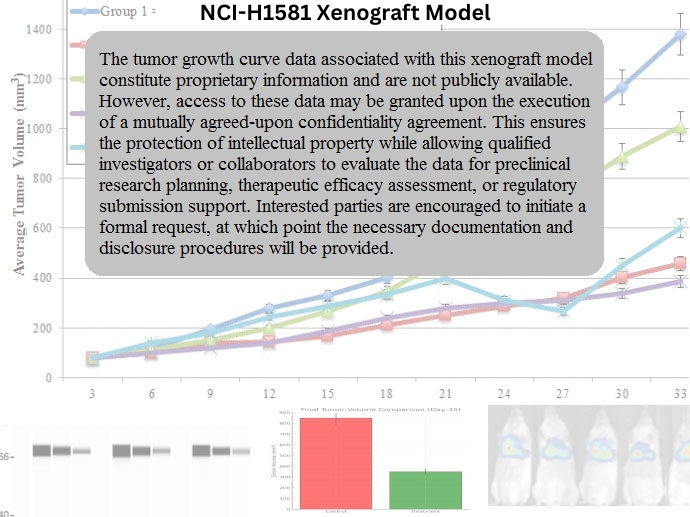
The NCI-H1581 xenograft model is generated by subcutaneous injection of cultured tumor cells into immunodeficient mouse strains, including athymic nude and NOD/SCID mice. Tumors typically become palpable within 10–14 days and progress steadily to 300–500 mm³ within 4–6 weeks, providing a consistent timeframe for therapeutic dosing studies. This model exhibits a high tumor take rate and uniform volumetric progression, supporting its use in both single-agent and combination therapy protocols. Due to its FGFR1 amplification, it is particularly valuable in assessing the antitumor effects of selective FGFR inhibitors, as well as evaluating pharmacokinetic/pharmacodynamic relationships, biomarker responses, and adaptive feedback mechanisms associated with FGFR blockade.
Request a Custom Quote for NCI-H1581 Xenograft ModelHistopathology and Immunohistochemical Profile
Tumors derived from the NCI-H1581 xenograft model display histological features consistent with moderately differentiated adenocarcinoma. Hematoxylin and eosin staining reveals glandular structures with high nuclear-to-cytoplasmic ratios, frequent mitotic figures, and uniform cellular architecture. Immunohistochemical staining confirms strong expression of epithelial lineage markers CK7 and E-cadherin. FGFR1 overexpression is detectable using receptor-specific antibodies and can be further confirmed through fluorescence in situ hybridization or qPCR. PD-L1 expression is typically low and nonuniform, consistent with the tumor’s non-immunogenic phenotype. Ki-67 proliferation indices exceed 60%, highlighting the model’s suitability for evaluating cell cycle–targeting agents and growth-inhibitory compounds.
Preclinical Applications and Drug Response
The NCI-H1581 xenograft model has been widely employed in preclinical studies of FGFR1-targeted therapies, including selective FGFR tyrosine kinase inhibitors, pan-FGFR inhibitors, and antibody-drug conjugates. The model has demonstrated sensitivity to FGFR1 blockade, with significant tumor growth inhibition observed in dose-dependent studies. Its FGFR1-driven oncogenic profile makes it ideal for studying resistance mechanisms, feedback loop activation, and compensatory signaling through mTOR or ERK. Combination strategies targeting FGFR1 and PI3K/AKT or MEK pathways have shown enhanced efficacy, as have therapeutic regimens incorporating anti-angiogenic agents. Its defined mutation profile and low immunogenicity allow researchers to isolate drug-specific effects and explore synergistic interactions without confounding signals from parallel oncogenic drivers.
Request This Model
To request the NCI-H1581 xenograft model for your preclinical studies, please use the form below. A customized quote and additional model specifications will be provided upon inquiry.
Request a Custom Quote for NCI-H1581 Xenograft Model