NCI-H146 Xenograft Model Overview
The NCI-H146 xenograft model is derived from a human small cell lung carcinoma (SCLC) and represents a well-established platform for evaluating novel therapeutics targeting high-grade neuroendocrine tumors. Originating from a male patient, the NCI-H146 cell line is defined by its classic SCLC morphology, rapid growth, and high tumorigenic potential in vivo. When implanted subcutaneously into immunodeficient mice, it forms aggressive tumors that accurately replicate the pathological and molecular features of treatment-refractory SCLC. This model is widely used for investigating DNA damage response inhibitors, mitotic checkpoint antagonists, and emerging immunotherapeutic strategies for neuroendocrine lung cancer.
Request a Custom Quote for NCI‑H146 Xenograft ModelBiological and Molecular Characteristics
NCI-H146 cells harbor the hallmark genetic alterations of classical SCLC, including inactivation of TP53 and RB1. These mutations drive unchecked proliferation, resistance to apoptosis, and increased sensitivity to replication stress. The cell line expresses neuroendocrine markers such as synaptophysin, chromogranin A, and neuron-specific enolase (NSE), confirming its lineage fidelity. Amplification of MYC family members and overexpression of BCL2 have also been observed, suggesting transcriptional addiction and apoptotic pathway dysregulation. The tumor cells are PD-L1 negative and exhibit reduced MHC class I expression, characteristics of immune-cold tumors that are often resistant to checkpoint blockade. These molecular features make NCI-H146 an ideal model for testing agents that exploit SCLC-specific vulnerabilities.
| Characteristic | Description |
|---|---|
| Tissue Origin | Human small cell lung carcinoma |
| Key Alterations | TP53 and RB1 inactivation; MYC amplification; BCL2↑ |
| Neuroendocrine Markers | Synaptophysin+, NSE+, Chromogranin A+ |
| Immunophenotype | PD-L1−, MHC I (low), high Ki-67 |
| Therapeutic Relevance | Classic SCLC biology, chemoresistance, transcriptional targeting |
In Vivo Model Development and Tumorigenicity
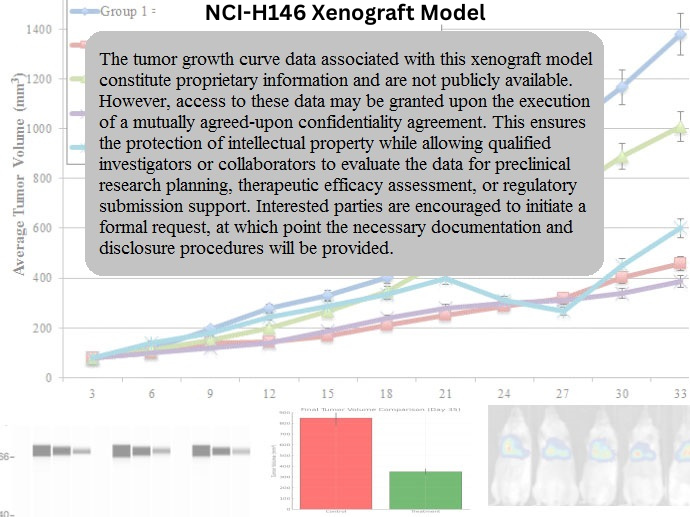
The NCI-H146 xenograft model is established via subcutaneous injection of tumor cells into immunocompromised mice, including NOD/SCID and athymic nude strains. Tumors form rapidly, typically becoming palpable within 7–10 days and expanding aggressively, reaching volumes of 300–500 mm³ in as little as three to four weeks. The model displays near-complete tumor take rates and highly reproducible growth kinetics, enabling reliable preclinical drug testing under well-controlled experimental timelines. NCI-H146 is especially effective for testing DNA-damaging agents, cell cycle regulators, and combinations that target oncogenic transcriptional programs or apoptotic imbalances common in MYC-driven SCLC.
Request a Custom Quote for NCI‑H146 Xenograft ModelHistopathology and Immunohistochemical Profile
Histologically, NCI-H146 xenografts exhibit features characteristic of poorly differentiated SCLC, including sheets of small, round to oval cells with scant cytoplasm, granular chromatin, and high nuclear-to-cytoplasmic ratios. H&E staining highlights dense cellularity, frequent mitotic figures, and apoptotic debris, with minimal stromal support. Immunohistochemistry reveals strong expression of synaptophysin and NSE, moderate to strong chromogranin A, and diffuse nuclear staining for ASCL1, a transcription factor critical for neuroendocrine identity. Ki-67 proliferation indices often exceed 80%, indicating a highly mitotic tumor. PD-L1 and MHC class I expression remain low, reinforcing the model’s immunologically inert phenotype.
Preclinical Applications and Drug Response
The NCI-H146 xenograft model has been extensively employed in studies of chemotherapy resistance, DNA repair pathway inhibition, and transcriptional dependency in SCLC. It is responsive to platinum-based chemotherapy agents (cisplatin, carboplatin) and topoisomerase inhibitors (etoposide, topotecan), which form the current clinical standard for SCLC, but rapidly develops resistance under prolonged treatment. As a result, the model is widely used to test second-line agents, including PARP inhibitors, CHK1/ATR inhibitors, BCL2 antagonists, and aurora kinase inhibitors. Due to its MYC-driven biology, the model supports evaluation of BET inhibitors and CDK9 antagonists. Its immune-cold profile also makes it suitable for testing epigenetic or STING-based priming strategies aimed at improving immunotherapy responsiveness.
Request This Model
To request the NCI-H146 xenograft model for your preclinical studies, please use the form below. A customized quote and additional model specifications will be provided upon inquiry.
Request a Custom Quote for NCI‑H146 Xenograft Model