NCI-H1395 Xenograft Model Overview
The NCI-H1395 xenograft model is derived from a human lung adenocarcinoma and is extensively utilized in preclinical studies investigating targeted therapies, DNA repair mechanisms, and immunotherapeutic strategies in non-small cell lung cancer (NSCLC). Originally established from a female patient, the NCI-H1395 cell line is defined by a high mutational burden and complex genomic landscape, including mutations in TP53, KEAP1, and STK11, which collectively contribute to impaired oxidative stress regulation, resistance to apoptosis, and diminished immune responsiveness. The model forms reproducible subcutaneous tumors in immunodeficient mice and is particularly suited for evaluating agents that exploit metabolic dysregulation, synthetic lethality, and resistance phenotypes in advanced-stage NSCLC.
Request a Custom Quote for NCI‑H1395 Xenograft ModelBiological and Molecular Characteristics
NCI-H1395 cells harbor inactivating mutations in TP53, KEAP1, and STK11, resulting in disrupted cell cycle regulation, redox imbalance, and metabolic reprogramming. Unlike EGFR- or KRAS-driven models, NCI-H1395 represents a mutation-rich, oncogene-negative lung adenocarcinoma, making it ideal for evaluating noncanonical tumorigenic pathways. The cell line demonstrates epithelial morphology with cytokeratin 7 and E-cadherin expression, although with regions of reduced adhesion and polarity. PD-L1 expression is low, and MHC class I molecules are variably expressed, reflecting an immune-cold tumor phenotype. These features enable the model to support studies on immune evasion, metabolic vulnerability, and redox-targeted therapeutic approaches.
| Characteristic | Description |
|---|---|
| Tissue Origin | Human lung adenocarcinoma |
| Key Mutations | TP53 (inactivated), KEAP1 (mutated), STK11 (mutated) |
| Other Mutation Status | EGFR and KRAS wild-type |
| Immunomarkers | CK7+, E-cadherin+, PD-L1 (low), MHC I (variable) |
| Therapeutic Relevance | High mutational burden, metabolic and oxidative stress targets |
In Vivo Model Development and Tumorigenicity
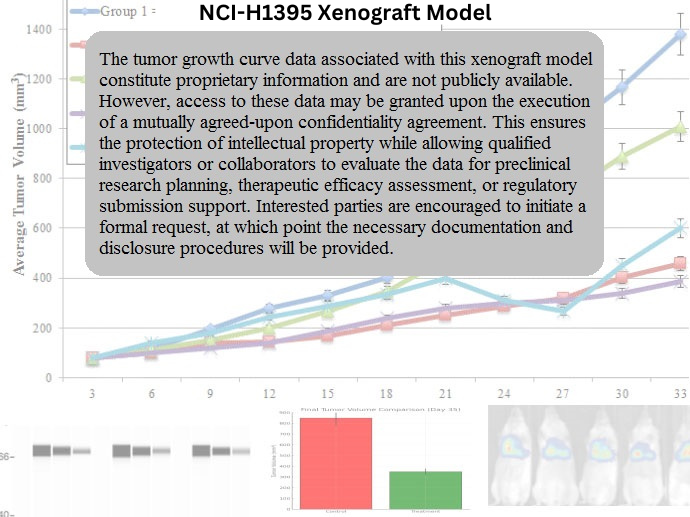
The NCI-H1395 xenograft model is established by subcutaneous injection into immunodeficient mice, including athymic nude or NOD/SCID strains. Tumors typically form within 10–14 days post-implantation and grow steadily to treatment-relevant volumes of 300–500 mm³ over four to six weeks. The model demonstrates a high tumor take rate and consistent growth kinetics, making it suitable for long-term efficacy studies and comparative analysis of monotherapies and combination treatments. The co-occurrence of KEAP1 and STK11 mutations confers resistance to conventional therapies and oxidative stress, offering a robust system for testing NRF2 pathway inhibitors, autophagy disruptors, and ferroptosis inducers.
Request a Custom Quote for NCI‑H1395 Xenograft ModelHistopathology and Immunohistochemical Profile
Histological analysis of NCI-H1395 xenografts reveals moderately differentiated adenocarcinoma with glandular architecture, nuclear pleomorphism, and regions of cytoplasmic clearing. Hematoxylin and eosin staining shows frequent mitotic activity and patchy areas of necrosis. Immunohistochemical profiling confirms strong cytokeratin 7 expression and focal E-cadherin positivity, indicating retained epithelial identity with partial loss of polarity. TP53 protein accumulation, consistent with inactivating mutation, is commonly observed. Ki-67 staining indicates a proliferation index exceeding 60%, while PD-L1 is typically undetectable, suggesting limited immune checkpoint responsiveness. MHC class I expression is heterogeneous, supporting the model’s relevance in immune-modulation studies.
Preclinical Applications and Drug Response
The NCI-H1395 xenograft model is valuable for testing experimental therapies targeting redox homeostasis, cell metabolism, and DNA damage response. Owing to KEAP1 and STK11 loss, the model exhibits altered glutathione metabolism and resistance to ROS-inducing agents, making it well suited for evaluating glutaminase inhibitors, ferroptosis sensitizers, and oxidative stress modulators. Additionally, it supports research on synthetic lethality involving DNA repair pathways, especially in combination with PARP or ATR inhibitors. The model’s immune-cold phenotype allows investigation of immune checkpoint blockade enhancers and adjuvants designed to increase tumor immunogenicity. NCI-H1395 is also appropriate for evaluating delivery vehicles and nanotherapies requiring stable tumor architecture and reproducible volumetrics.
Request This Model
To request the NCI-H1395 xenograft model for your preclinical studies, please use the form below. A customized quote and additional model specifications will be provided upon inquiry.
Request a Custom Quote for NCI‑H1395 Xenograft Model