NCI-H1373 Xenograft Model Overview
The NCI-H1373 xenograft model is derived from a human non-small cell lung cancer (NSCLC) adenocarcinoma and is widely utilized for preclinical investigations involving KRAS-mutant lung tumors. Established from a male patient’s primary tumor, the NCI-H1373 cell line harbors a KRAS^G13C mutation, placing it within the subset of NSCLC that exhibits resistance to EGFR-targeted therapies and poor clinical outcomes with conventional treatment. This model provides a platform for evaluating targeted therapies directed at RAS effector pathways, apoptotic regulators, and immune modulatory agents. When implanted subcutaneously into immunodeficient mice, NCI-H1373 cells form solid, moderately fast-growing tumors that recapitulate the histological and molecular complexity of KRAS-driven lung adenocarcinoma.
Request a Custom Quote for NCI-H1373 Xenograft ModelBiological and Molecular Characteristics
The NCI-H1373 cell line is characterized by a KRAS^G13C mutation, a rare but clinically relevant variant that drives constitutive activation of RAS-MAPK and PI3K signaling cascades. The line is wild-type for EGFR, and retains partial p53 functionality, although downstream apoptotic signaling remains compromised. NCI-H1373 exhibits epithelial morphology and expresses cytokeratin 7 and E-cadherin, consistent with lung adenocarcinoma lineage. Baseline expression of PD-L1 is low to moderate, and inducibility in response to immune stress or cytokine signaling allows exploration of checkpoint blockade combinations. Elevated levels of BCL-XL and survivin further contribute to its resistance phenotype and enable testing of pro-apoptotic and synthetic lethal therapeutic strategies.
| Characteristic | Description |
|---|---|
| Tissue Origin | Human lung adenocarcinoma (primary tumor) |
| Key Genetic Features | KRAS^G13C mutant, EGFR wild-type, partial p53 function |
| Cell Morphology | Epithelial, adherent |
| Immunomarkers | CK7+, E-cadherin+, PD-L1 (low-moderate) |
| Oncogenic Pathways | RAS-MAPK, PI3K/AKT, apoptosis resistance |
In Vivo Model Development and Tumorigenicity
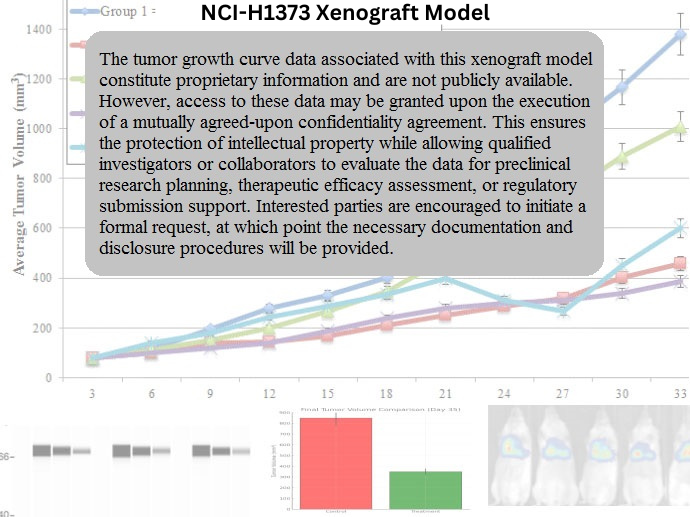
NCI-H1373 xenografts are established through subcutaneous injection into immunodeficient mice, typically athymic nude or NOD/SCID strains. Tumors are typically palpable by day 10–14 and reach measurable volumes of 400–600 mm³ within five to six weeks. The model demonstrates a high take rate and reliable growth kinetics, which support reproducibility in therapeutic response studies. Its moderately vascularized architecture enables efficient drug delivery and pharmacokinetic profiling. Due to the KRAS-driven growth mechanism, the model is appropriate for studies focused on downstream signaling inhibition, bypass pathway activation, and the evaluation of resistance mechanisms to monotherapy and dual-agent regimens.
Request a Custom Quote for NCI-H1373 Xenograft ModelHistopathology and Immunohistochemical Profile
Tumors generated from NCI-H1373 xenografts show moderately differentiated adenocarcinoma with glandular structures, hyperchromatic nuclei, and a fibrous stromal component. Hematoxylin and eosin staining reveals cohesive epithelial clusters and variable mitotic activity. The Ki-67 proliferation index typically ranges from 55% to 65%, reflecting moderate to rapid tumor growth. Immunohistochemistry confirms CK7 and E-cadherin expression, validating the epithelial origin. PD-L1 is expressed heterogeneously across tumor sections, with potential for upregulation under stress or inflammatory signaling. BCL-XL and survivin are expressed at moderate to high levels, offering multiple pharmacologic targets for apoptosis sensitization studies.
Preclinical Applications and Drug Response
The NCI-H1373 xenograft model is employed in the preclinical testing of agents that address the therapeutic challenges associated with KRAS-mutant NSCLC. It is resistant to EGFR inhibitors but responsive to MEK, ERK, and PI3K inhibitors, particularly when combined with agents that inhibit anti-apoptotic proteins such as BCL-2 or MCL-1. The model has also been used in synthetic lethality studies targeting vulnerabilities exposed by RAS pathway dependence, including DDR pathway inhibitors and metabolic disruptors. Immune checkpoint blockade in monotherapy is limited due to modest PD-L1 levels, but response can be enhanced when paired with chemotherapy, epigenetic modifiers, or cytokine-stimulating agents. Additionally, the model supports pharmacokinetic assessments and tumor-targeted drug delivery studies using liposomal, polymeric, or inhaled formulations.
Request This Model
To request the NCI-H1373 xenograft model for your preclinical studies, please use the form below. A customized quote and additional model specifications will be provided upon inquiry.
Request a Custom Quote for NCI-H1373 Xenograft Model