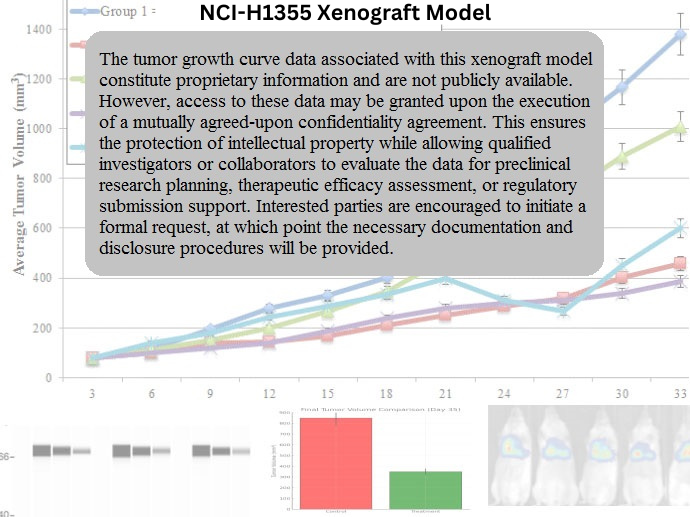
NCI-H1355 Xenograft Model Overview
The NCI-H1355 xenograft model is derived from a human non-small cell lung carcinoma (NSCLC) of the large cell subtype and serves as a reliable in vivo system for evaluating therapeutics targeting KRAS-mutant lung cancer. Established from a male patient, the NCI-H1355 cell line exhibits robust tumorigenic capacity when implanted subcutaneously into immunodeficient mice, forming rapidly growing and histologically consistent tumors. This model is particularly valuable for preclinical studies focused on KRAS-driven oncogenesis, resistance to EGFR-targeted therapies, and combinatorial strategies aimed at overcoming immune and metabolic escape mechanisms. Its aggressive growth profile and well-characterized mutation landscape support its broad utility in pharmacological screening and translational oncology.
Request a Custom Quote for NCI‑H1355 Xenograft ModelBiological and Molecular Characteristics
NCI-H1355 cells harbor an activating KRAS mutation (G13C), leading to constitutive activation of the RAS–RAF–MEK–ERK and PI3K–AKT signaling pathways. The cell line is wild-type for EGFR and ALK and typically exhibits inactivation of TP53, contributing to impaired DNA damage response and apoptotic resistance. Phenotypically, the cells display features consistent with epithelial lineage, including expression of cytokeratin 7 and focal E-cadherin. PD-L1 expression is low to moderate, while MHC class I expression is retained, making the model appropriate for immune-sensitization studies. The molecular profile supports its use in drug development programs evaluating KRAS-specific inhibitors, MAPK pathway modulators, and synthetic lethality strategies targeting co-mutational vulnerabilities.
| Characteristic | Description |
|---|---|
| Tissue Origin | Human large cell lung carcinoma |
| Key Alterations | KRAS G13C mutation, TP53 inactivation |
| Other Mutation Status | EGFR and ALK wild-type |
| Cell Morphology | Epithelial, adherent |
| Immunomarkers | CK7+, E-cadherin (focal), PD-L1 (low-moderate) |
| Active Pathways | RAS–MAPK, PI3K–AKT, apoptosis resistance |
In Vivo Model Development and Tumorigenicity
The NCI-H1355 xenograft model is established by subcutaneous injection into immunodeficient mouse strains, such as NOD/SCID or athymic nude mice. Tumor formation occurs within 10–12 days post-inoculation and expands rapidly to study-ready volumes (300–500 mm³) within four to five weeks. The model is characterized by high tumor take rates, uniform growth kinetics, and consistent histological architecture, allowing for reproducible therapeutic evaluation. It is particularly well suited for pharmacokinetic/pharmacodynamic studies of KRAS and MAPK pathway inhibitors, dose-ranging experiments, and long-term survival studies using combination treatment regimens.
Request a Custom Quote for NCI‑H1355 Xenograft ModelHistopathology and Immunohistochemical Profile
Histologically, NCI-H1355 xenografts exhibit poorly differentiated tumor architecture with solid growth patterns, pleomorphic nuclei, and high mitotic activity. Hematoxylin and eosin staining reveals compact tumor cell clusters with variable nuclear sizes and minimal glandular differentiation. Immunohistochemistry demonstrates strong cytoplasmic staining for cytokeratin 7 and patchy E-cadherin expression. TP53 protein accumulation is frequently observed, confirming mutation-driven dysregulation. Ki-67 proliferation index commonly exceeds 70%, supporting its use in efficacy studies targeting highly proliferative tumors. PD-L1 staining is variable but generally low, reinforcing the model’s potential for checkpoint blockade sensitization trials.
Preclinical Applications and Drug Response
The NCI-H1355 xenograft model has been widely employed in preclinical research targeting KRAS-mutant NSCLC. It is resistant to EGFR tyrosine kinase inhibitors, providing a relevant platform for evaluating KRAS G13C-specific inhibitors and MEK/ERK pathway antagonists. The model also supports investigation into apoptosis-enhancing agents such as BCL-2/BCL-XL inhibitors and synthetic lethality approaches targeting TP53 loss. Chemotherapy agents, including platinum doublets and taxanes, have demonstrated variable efficacy and are often used as comparators in combination therapy studies. The model’s immunophenotype allows for studies involving epigenetic priming, MHC upregulation, and immune co-targeting strategies. Overall, NCI-H1355 is a versatile model for addressing therapeutic challenges in KRAS-driven, immune-evasive NSCLC.
Request This Model
To request the NCI-H1355 xenograft model for your preclinical studies, please use the form below. A customized quote and additional model specifications will be provided upon inquiry.
Request a Custom Quote for NCI‑H1355 Xenograft Model