NCI-H1299 Xenograft Model Overview
The NCI-H1299 xenograft model is derived from a lymph node metastasis of a human non-small cell lung carcinoma (NSCLC) and is characterized by a complete deletion of the TP53 gene, making it one of the few p53-null lung cancer models available for in vivo research. This cell line, originally isolated from a 43-year-old male patient, exhibits an epithelial morphology and rapid proliferation rate. Due to the absence of functional p53 protein and wild-type status for EGFR and KRAS, the NCI-H1299 xenograft is uniquely suited for preclinical studies focused on p53-independent tumor biology, DNA damage response mechanisms, and agents targeting non-canonical growth pathways. Its aggressive growth kinetics and reproducibility have made it a cornerstone model in lung cancer pharmacology and mechanistic studies.
Request a Custom Quote for NCI‑H1299 Xenograft ModelBiological and Molecular Characteristics
NCI-H1299 cells display a fibroblast-like morphology and proliferate robustly in monolayer culture. They are p53-null due to homozygous partial deletion of chromosome 17p, eliminating TP53 expression completely. The cell line is wild-type for KRAS and EGFR, providing a clean genetic background for isolating the effects of novel compounds without interference from commonly mutated pathways. NCI-H1299 cells overexpress MYC and retain functional Rb protein, resulting in an altered cell cycle profile. They also demonstrate responsiveness to oxidative stress and DNA-damaging agents in a p53-independent manner, facilitating investigations into compensatory pathways such as ATR, CHK1, and BCL-2 signaling.
| Characteristic | NCI-H1299 Cell Line Profile |
|---|---|
| Cancer Type | Non-small cell lung cancer (metastatic carcinoma) |
| TP53 Status | Null (complete deletion) |
| KRAS/EGFR Status | Wild-type |
| MYC Status | Overexpressed |
| Marker Expression | Cytokeratin⁺, Vimentin⁺/−, E-cadherin⁺ |
| Growth Characteristics | Rapid proliferation, p53-independent survival |
In Vivo Model Development and Tumorigenicity
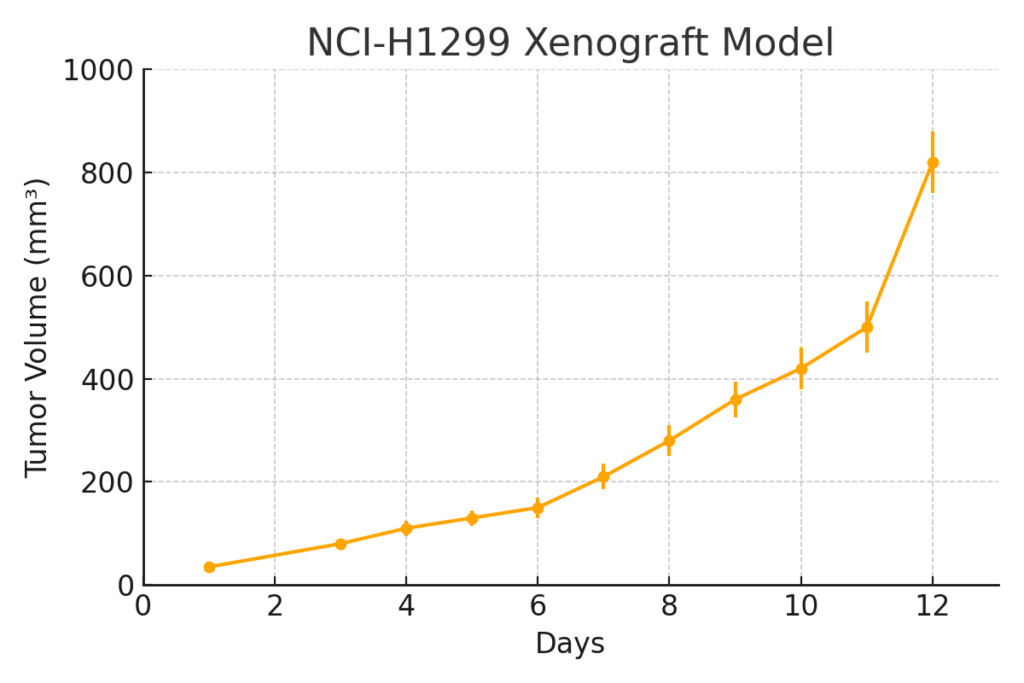
The NCI-H1299 xenograft model is developed via subcutaneous injection into immunodeficient mice, most commonly athymic nude or NOD/SCID strains. Tumors become palpable within 5–7 days and exhibit highly aggressive, linear growth, frequently reaching endpoint volumes (800–900 mm³) within three to four weeks. The model demonstrates a near-100% tumor take rate with minimal variability in engraftment, making it highly suitable for reproducible therapeutic efficacy studies. Due to its rapid kinetics, the NCI-H1299 xenograft is ideal for evaluating cytotoxic agents, testing short-duration drug regimens, and conducting dose-escalation studies with stringent timeframes.
Request a Custom Quote for NCI‑H1299 Xenograft ModelHistopathology and Immunohistochemical Profile
Histologically, NCI-H1299 xenograft tumors present as poorly differentiated carcinomas with solid sheets of atypical epithelial cells, high nuclear-to-cytoplasmic ratio, and prominent nucleoli. Areas of central necrosis are often observed in larger tumors due to hypoxia associated with rapid expansion. Immunohistochemical analysis reveals strong expression of pan-cytokeratin and E-cadherin, with variable vimentin positivity, indicating a hybrid epithelial-mesenchymal phenotype. The Ki-67 proliferation index is typically above 70%, consistent with the model’s aggressive in vivo behavior. Absence of p53 staining validates the model’s utility in studies aimed at exploring alternative tumor suppressor pathways.
Preclinical Applications and Drug Response
The NCI-H1299 xenograft model is widely employed in preclinical evaluation of therapies that act independently of p53-mediated apoptosis, including inhibitors targeting BCL-2 family proteins, PARP, CHK1, and ATR. It serves as a powerful model for studying synthetic lethality in the context of p53 loss and has been instrumental in testing drugs that enhance replication stress or induce mitotic catastrophe. Additionally, the model is applicable in radiation sensitization studies, immunotherapy investigations using humanized mouse systems, and in the evaluation of tumor microenvironmental responses to therapy. Its robust and consistent in vivo behavior enhances statistical power in drug development pipelines.
Request This Model
To utilize the NCI-H1299 xenograft model in your lung cancer research or preclinical testing program, contact our team for growth kinetics data, p53-null validation, and customizable in vivo study protocols tailored to your therapeutic development goals.
Request a Custom Quote for NCI‑H1299 Xenograft Model