NCI-H1048 Xenograft Model Overview
The NCI-H1048 xenograft model originates from a human lung carcinoma with combined small cell lung cancer (SCLC) and large cell neuroendocrine carcinoma features. Derived from a male patient, this cell line is uniquely positioned within the neuroendocrine spectrum of lung malignancies, characterized by high-grade transformation, rapid proliferation, and poor differentiation. In vivo, NCI-H1048 cells form aggressive subcutaneous tumors in immunodeficient mice, making the model particularly well suited for evaluating chemoresistant phenotypes and neuroendocrine-specific therapeutic strategies. Its molecular profile includes amplification of MYC family members and alterations in cell cycle regulatory genes, consistent with a transcriptionally active, proliferative tumor biology. The NCI-H1048 model is an indispensable tool in the preclinical study of neuroendocrine lung cancers, including both monotherapies and rational drug combinations targeting cell cycle regulators, DNA damage response pathways, and neuroendocrine signaling axes.
Request a Custom Quote for NCI-H1048 Xenograft ModelBiological and Molecular Characteristics
NCI-H1048 cells display hallmark features of neuroendocrine lung tumors, including elevated expression of transcription factors ASCL1 and NEUROD1, which are involved in lineage-specific gene regulation. Molecular profiling reveals co-alterations in RB1 and TP53, a genetic signature that defines the majority of high-grade neuroendocrine lung cancers. These cells exhibit minimal expression of epithelial markers and instead express neural cell adhesion molecule (NCAM), synaptophysin, and chromogranin A, confirming their neuroendocrine differentiation. Amplification or overexpression of MYCL and MYCN is also observed, supporting a transcriptionally driven oncogenic program. The NCI-H1048 cell line lacks activating EGFR or KRAS mutations, making it particularly suitable for testing agents that act independently of classical NSCLC pathways.
| Characteristic | Description |
|---|---|
| Tissue Origin | Human lung (neuroendocrine carcinoma) |
| Key Alterations | RB1 loss, TP53 mutation, MYCL/N amplification |
| Lineage Markers | ASCL1+, NCAM+, synaptophysin+, chromogranin A+ |
| Growth Pattern | Rapidly proliferative, adherent neuroendocrine morphology |
| Signaling Pathways | Cell cycle, MYC-regulated transcription, DNA repair |
In Vivo Model Development and Tumorigenicity
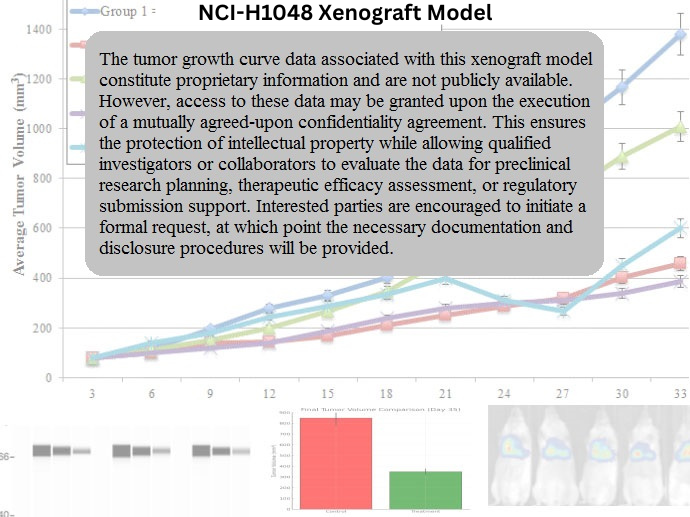
The NCI-H1048 xenograft model is typically established through subcutaneous injection into immunodeficient mouse strains such as NOD/SCID or nude mice. Tumor take rates are high, with detectable growth commonly appearing within 7–10 days and exponential volume increase thereafter. Tumors grow rapidly, often necessitating short treatment windows and close monitoring of endpoint volume thresholds. The model is particularly effective for evaluating agents targeting mitotic checkpoints, cell cycle regulators, and transcriptional dependencies such as CDK7/9 inhibitors. Due to the aggressive and poorly differentiated nature of the tumors, this system provides a valuable representation of therapy-refractory, high-grade neuroendocrine lung cancers. Its rapid kinetics and reproducibility also facilitate time-sensitive pharmacodynamic and mechanistic evaluations.
Request a Custom Quote for NCI-H1048 Xenograft ModelHistopathology and Immunohistochemical Profile
Histological examination of NCI-H1048-derived tumors reveals dense sheets of small to intermediate-sized cells with high nuclear-to-cytoplasmic ratios, finely granular chromatin, and minimal cytoplasm. Hematoxylin and eosin staining confirms a high mitotic index and apoptotic body presence, features consistent with poorly differentiated neuroendocrine malignancies. Immunohistochemical analysis supports this classification, with strong staining for synaptophysin, chromogranin A, and NCAM. ASCL1 expression is nuclear and diffuse, indicating maintenance of neuroendocrine lineage identity. Ki-67 proliferation indices exceed 80%, reinforcing the model’s high growth rate. The absence of epithelial marker expression, including cytokeratin and E-cadherin, distinguishes this model from typical adenocarcinoma or squamous NSCLC xenografts.
Preclinical Applications and Drug Response
The NCI-H1048 xenograft model is widely used for testing investigational compounds in the context of high-grade neuroendocrine lung cancer. Due to its RB1 and TP53 co-inactivation, the model is inherently resistant to checkpoint blockade and classical EGFR-targeted agents, providing a stringent platform for evaluating novel drug candidates. Compounds targeting DNA damage repair, such as PARP inhibitors and CHK1/ATR inhibitors, have demonstrated activity in preclinical studies. The model is also sensitive to transcriptional disruption through CDK7/9 inhibitors, MYC suppressors, and BET bromodomain inhibitors. Given its rapid growth and high mitotic rate, it is a strong candidate for testing microtubule-targeting agents and mitotic poisons, as well as evaluating tumor evolution under treatment pressure. Its neuroendocrine profile enables differentiation-specific studies and mechanistic exploration of lineage plasticity in lung cancer.
Request This Model
To request the NCI-H1048 xenograft model for your preclinical studies, please use the form below. A customized quote and additional model specifications will be provided upon inquiry.
Request a Custom Quote for NCI-H1048 Xenograft Model