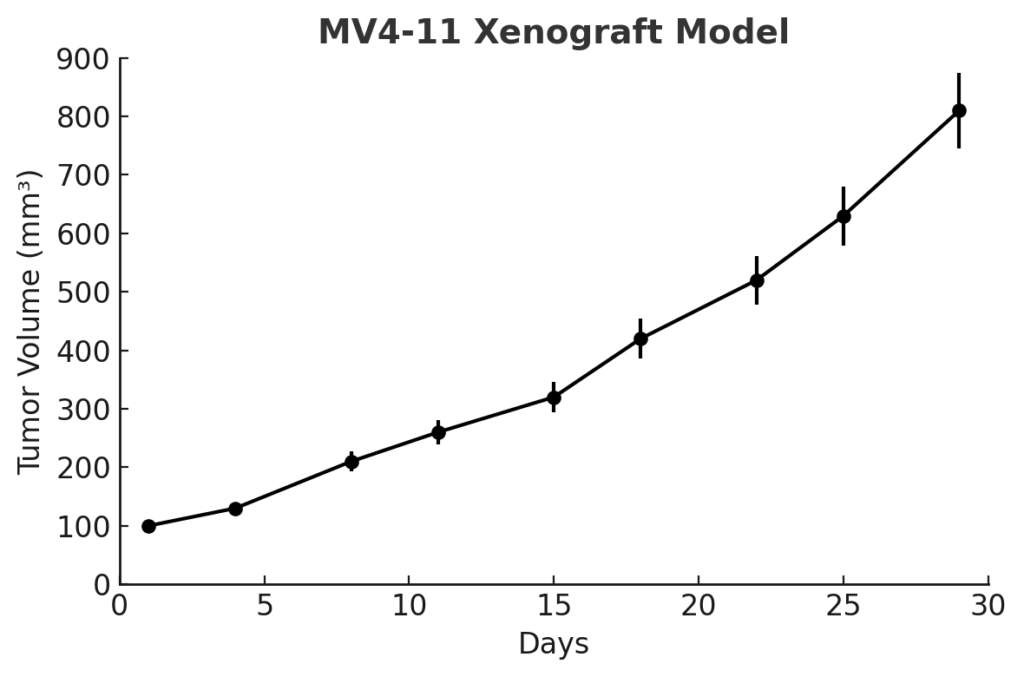
MV4-11 Xenograft Model Overview
The MV4-11 xenograft model is derived from a biphenotypic human myelomonocytic leukemia originally isolated from the peripheral blood of a 10-year-old male patient with acute myeloid leukemia (AML). This model harbors the internal tandem duplication (ITD) mutation in the FLT3 gene and expresses the MLL-AF4 fusion oncogene, providing a clinically relevant platform for high-risk AML subtypes characterized by poor prognosis and rapid disease progression. MV4-11 xenografts are widely used in preclinical research for evaluating FLT3-targeted agents, kinase inhibitors, and epigenetic modulators. The model exhibits consistent tumor engraftment, rapid leukemic expansion, and a molecular profile that mirrors relapsed/refractory AML with FLT3-ITD mutation, making it essential for translational hematologic malignancy studies.
Request a Custom Quote for MV4-11 Xenograft ModelBiological and Molecular Characteristics
MV4-11 cells display a round, suspension phenotype and express markers typical of immature myeloid progenitors, including CD33, CD34, CD45, and HLA-DR, along with low levels of CD14 and CD15. A defining molecular feature is the FLT3-ITD mutation, which leads to constitutive activation of the FLT3 receptor tyrosine kinase and downstream effectors such as STAT5, ERK1/2, and AKT. Additionally, MV4-11 cells express the MLL-AF4 fusion transcript resulting from a t(4;11)(q21;q23) chromosomal translocation, contributing to deregulated HOX gene expression and impaired differentiation. The model is wild-type for p53 and KRAS, and exhibits high sensitivity to FLT3 inhibitors while demonstrating resistance to conventional monotherapies due to survival pathway activation.
| Characteristic | MV4-11 Cell Line Profile |
|---|---|
| Disease Origin | Biphenotypic myelomonocytic leukemia (AML) |
| FLT3 Status | ITD mutation (constitutively active) |
| Fusion Oncogene | MLL-AF4 (t(4;11)(q21;q23)) |
| Surface Markers | CD33, CD34, CD45, HLA-DR |
| p53 Status | Wild-type |
| Signaling Pathways | FLT3-STAT5, PI3K/AKT, MAPK |
In Vivo Model Development and Tumorigenicity
MV4-11 xenografts are typically developed using immunodeficient mouse strains such as NSG or NOD/SCID mice via subcutaneous or intravenous injection. Subcutaneous implantation results in the formation of solid tumor nodules that reach measurable volumes of 700–900 mm³ within 3–5 weeks, while intravenous administration leads to systemic disease with infiltration of the bone marrow, liver, and spleen. The model exhibits a high engraftment rate, reproducible tumor burden, and aggressive expansion consistent with the clinical behavior of FLT3-ITD-positive AML. Its reliable tumor growth kinetics and defined genetic alterations make MV4-11 ideal for evaluating kinase inhibitors, combination chemotherapy, and molecularly guided therapeutic interventions.
Request a Custom Quote for MV4-11 Xenograft ModelHistopathology and Immunohistochemical Profile
Histological examination of subcutaneous MV4-11 xenografts reveals dense sheets of undifferentiated blast cells with a high nuclear-to-cytoplasmic ratio, prominent nucleoli, and frequent mitotic figures. Hematoxylin and eosin (H&E) staining highlights uniform cellular morphology with minimal stromal involvement. In disseminated models, leukemic infiltration of the spleen, liver, and bone marrow closely mimics human AML. Immunohistochemically, the xenograft expresses high levels of CD33, CD34, and phosphorylated FLT3, as well as nuclear staining for MLL fusion protein targets. STAT5 phosphorylation is consistently observed, validating pathway activation. There is an absence of differentiation markers such as CD14 or myeloperoxidase, confirming a block in maturation.
Preclinical Applications and Drug Response
The MV4-11 xenograft model is widely utilized in drug discovery programs focused on FLT3-ITD-positive AML. It has demonstrated strong responsiveness to FLT3 tyrosine kinase inhibitors including quizartinib, gilteritinib, and midostaurin, and is often used to investigate resistance mechanisms to these agents. The model supports combination therapy studies involving BCL-2 inhibitors, HDAC inhibitors, and DNA methylation modulators to overcome compensatory survival pathways. It also enables exploration of immunotherapeutic strategies such as bispecific antibodies and CAR-T constructs targeting myeloid antigens. MV4-11’s genetically defined nature and translational relevance position it as a key platform in the development of next-generation treatments for high-risk AML.
Request This Model
To incorporate the MV4-11 xenograft model into your hematologic malignancy research or FLT3-targeted drug development pipeline, please reach out for complete model specifications and expert support in designing customized in vivo efficacy studies for high-risk AML.
Request a Custom Quote for MV4-11 Xenograft Model