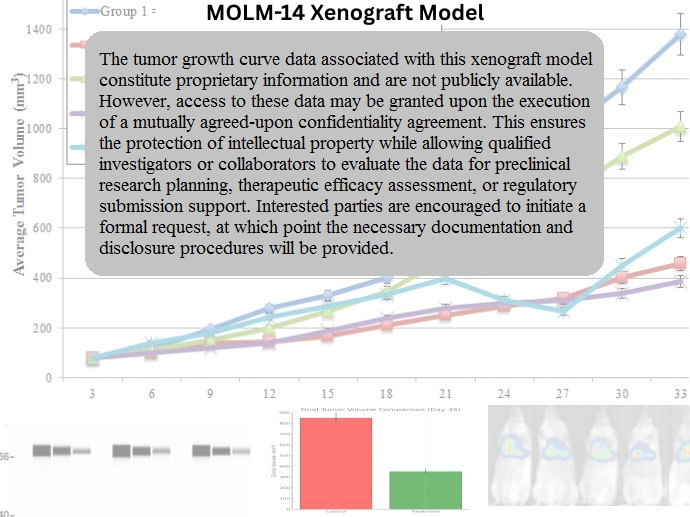
MOLM-14 Xenograft Model Overview
The MOLM-14 xenograft model is derived from a human acute myeloid leukemia (AML) cell line established from the peripheral blood of a 20-year-old male patient with relapsed AML. This cell line harbors the internal tandem duplication (ITD) mutation in the FLT3 gene (FLT3-ITD), which drives constitutive tyrosine kinase activity and aggressive leukemic proliferation. Additionally, MOLM-14 cells contain a partial tandem duplication (PTD) of MLL, contributing to their leukemogenic phenotype. As one of the most widely used models for FLT3-mutant AML, the MOLM-14 xenograft provides a clinically relevant and mechanistically faithful system for evaluating FLT3 inhibitors, combination regimens, and investigational therapies targeting AML with adverse genetic risk profiles.
Request a Custom Quote for MOLM‑14 Xenograft ModelBiological and Molecular Characteristics
MOLM-14 cells grow in suspension and exhibit a classic myeloblast morphology with high nuclear-to-cytoplasmic ratio, open chromatin, and prominent nucleoli. They express myeloid markers including CD33, CD13, CD117 (c-Kit), and HLA-DR, while lacking lymphoid-associated antigens. The FLT3-ITD mutation results in constitutive phosphorylation of FLT3 and downstream activation of STAT5, AKT, and ERK signaling pathways, promoting survival and resistance to apoptosis. The co-occurrence of MLL-PTD supports enhanced transcription of HOXA cluster genes, MEIS1, and other regulators of hematopoietic stem cell self-renewal. These molecular features make MOLM-14 ideal for dissecting oncogenic signaling and therapeutic vulnerabilities in high-risk AML.
| Characteristic | MOLM-14 Cell Line Profile |
|---|---|
| Disease Origin | Acute myeloid leukemia (relapsed) |
| Key Genetic Alterations | FLT3-ITD, MLL-PTD |
| Immunophenotype | CD13⁺, CD33⁺, CD117⁺, HLA-DR⁺ |
| Key Activated Pathways | FLT3-STAT5, PI3K/AKT, RAS/MAPK |
| Differentiation Status | Myeloid blasts |
| Therapeutic Sensitivities | FLT3 inhibitors (quizartinib, gilteritinib), BCL2 inhibitors |
In Vivo Model Development and Tumorigenicity
The MOLM-14 xenograft model is typically established by intravenous injection into immunodeficient mice such as NSG or NOD/SCID strains, resulting in systemic leukemia that localizes to the bone marrow, spleen, and liver. Engraftment occurs rapidly, with detectable leukemic burden within 2–3 weeks and fulminant disease progression shortly thereafter. This model is ideal for evaluating systemic drug efficacy, survival outcomes, and disease recurrence. Subcutaneous models can also be generated for localized tumor growth and tumor volume assessments, though they are less physiologically relevant for hematologic malignancies. Bioluminescent MOLM-14 variants are commonly used in studies requiring real-time monitoring of disease burden and drug response.
Request a Custom Quote for MOLM‑14 Xenograft ModelHistopathology and Immunohistochemical Profile
Histological analysis of MOLM-14-engrafted tissues reveals widespread infiltration of medium-sized myeloblasts with round nuclei, fine chromatin, and scant cytoplasm. In systemic models, bone marrow cellularity is replaced by leukemic blasts, and splenic white pulp is typically effaced. Immunohistochemistry confirms expression of myeloid markers such as CD33 and CD117, and phosphorylated FLT3 is readily detectable in untreated tumors. High Ki-67 staining reflects the proliferative capacity of the model. Treated tissues often show reduced p-FLT3 and STAT5 expression, providing a quantitative pharmacodynamic measure of target engagement and therapeutic effect.
Preclinical Applications and Drug Response
The MOLM-14 xenograft is a gold-standard preclinical model for evaluating FLT3-targeted therapeutics, including quizartinib, gilteritinib, crenolanib, and midostaurin. It is also used extensively in studies assessing BCL2 inhibition (e.g., venetoclax) and agents targeting co-activated pathways such as JAK/STAT, PI3K, or MEK. Combination strategies that pair FLT3 inhibitors with chemotherapy or epigenetic modifiers (e.g., hypomethylating agents or DOT1L inhibitors) have shown synergistic efficacy in this model. Additionally, MOLM-14 supports investigations into mechanisms of resistance, clonal evolution, and the impact of minimal residual disease following therapy. Its reproducibility, aggressive growth, and clinically relevant genotype make it a critical tool for AML translational research.
Request This Model
To initiate studies with the MOLM-14 xenograft model and evaluate its application in your AML drug development program, contact our scientific support team to obtain detailed model parameters, validated protocols, and in vivo study design assistance.
Request a Custom Quote for MOLM‑14 Xenograft Model