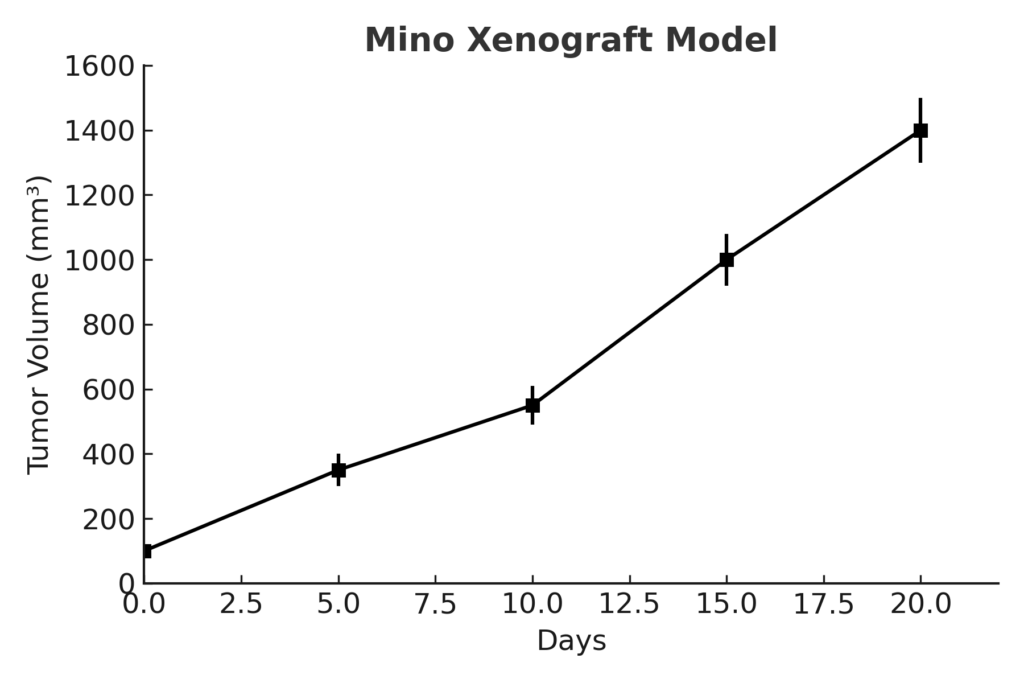
Mino Xenograft Model Overview
The Mino xenograft model is derived from a human mantle cell lymphoma (MCL) cell line and represents the classical subtype of MCL, characterized by overexpression of cyclin D1 and a mature B-cell immunophenotype. Established from the peripheral blood of a patient with relapsed MCL, the Mino cell line retains the t(11;14)(q13;q32) translocation, which drives CCND1 activation and deregulated cell cycle progression. The model offers a clinically relevant platform for evaluating novel therapeutics targeting cell cycle regulators, B-cell receptor (BCR) signaling, and apoptotic pathways. When xenografted into immunodeficient mice, Mino cells form tumors that mirror the pathological and molecular landscape of relapsed MCL, making it an essential tool in translational lymphoma research.
Request a Custom Quote for Mino Xenograft ModelBiological and Molecular Characteristics
Mino cells exhibit hallmark features of mantle cell lymphoma, including the t(11;14) chromosomal translocation leading to CCND1 overexpression. The cells express CD19, CD20, CD5, and surface immunoglobulin, consistent with a mature B-cell phenotype. Unlike some other MCL lines, Mino cells have wild-type TP53 but display heightened BCR pathway activation and elevated anti-apoptotic protein expression such as BCL2. MHC class II expression is present, and PD-L1 levels are low under basal conditions, allowing the model to serve as a valuable platform for immunotherapy studies and checkpoint modulation. Genetically, Mino also harbors mutations in ATM and TRAF2, which are implicated in genomic instability and NF-κB signaling, respectively.
| Characteristic | Description |
|---|---|
| Tissue Origin | Human mantle cell lymphoma (relapsed) |
| Key Alterations | t(11;14) translocation, CCND1 overexpression, ATM mutation |
| Mutation Status | TP53 wild-type, TRAF2 mutated |
| Immunophenotype | CD19+, CD20+, CD5+, sIg+, MHC II+, PD-L1 (low) |
| Therapeutic Relevance | CDK4/6 inhibition, BCR-targeted therapies, apoptosis modulation |
In Vivo Model Development and Tumorigenicity
The Mino xenograft model is established by subcutaneous implantation of cells into immunocompromised mice, typically NOD/SCID or NSG strains. Tumor formation occurs within 3 to 4 weeks post-injection, reaching measurable volumes suitable for pharmacological intervention between weeks 5 and 7. The model demonstrates consistent take rates and reproducible tumor kinetics, enabling therapeutic evaluation of small molecules and biologics. Mino xenografts are particularly well-suited for studying resistance mechanisms in relapsed MCL and for testing rational combination regimens that target the cell cycle, NF-κB pathway, and apoptotic signaling cascades.
Request a Custom Quote for Mino Xenograft ModelHistopathology and Immunohistochemical Profile
Histologically, Mino xenograft tumors are composed of monomorphic small- to medium-sized lymphoid cells with irregular nuclear contours and scant cytoplasm. Hematoxylin and eosin staining reveals diffuse infiltration with occasional mitoses and minimal stromal support. Immunohistochemistry shows strong nuclear cyclin D1 expression, confirming CCND1 overexpression, and membranous CD20 positivity. Ki-67 proliferation indices typically range between 40% and 60%, indicating moderate mitotic activity. Additional markers, including BCL2 and MHC class II, are uniformly expressed. These features mirror the histopathological presentation of classical MCL and validate the model’s use for translational lymphoma studies.
Preclinical Applications and Drug Response
The Mino xenograft model has proven instrumental in evaluating MCL-targeted agents including CDK4/6 inhibitors (e.g., palbociclib), BTK inhibitors (e.g., ibrutinib), and BCL2 antagonists (e.g., venetoclax). The model supports investigation into combination therapies that modulate BCR signaling, apoptosis, and immune responses. It has also been used to test experimental inhibitors of the NF-κB pathway, given the presence of TRAF2 mutation. Due to its immunophenotype and preserved MHC II expression, Mino is suitable for antibody-based therapies and early-stage immuno-oncology applications. Its reliability and clinical relevance make it an essential tool for advancing MCL therapeutics.
Request This Model
To request the Mino xenograft model for your preclinical studies, please use the form below. A customized quote and additional model specifications will be provided upon inquiry.
Request a Custom Quote for Mino Xenograft Model