ME180 Xenograft Model Overview
The ME180 xenograft model is derived from a human cervical carcinoma originally classified as an epidermoid (squamous cell) tumor. The parental ME180 cell line was established from a biopsy of a 66-year-old female patient with moderately differentiated cervical carcinoma. Notably, this model contains integrated human papillomavirus type 68 (HPV68), an uncommon but high-risk HPV subtype associated with invasive cervical cancers. ME180 xenografts are an excellent tool for modeling HPV-associated squamous cell carcinoma in vivo and have demonstrated consistent tumor formation, moderate growth kinetics, and immune-relevant HPV oncogene expression.
This model is particularly well-suited for studying HPV-driven oncogenesis, evaluating immunotherapy strategies, and testing radiosensitizers and chemotherapy regimens. ME180 tumors retain squamous morphology and are appropriate for investigating tumor cell differentiation, epithelial signaling, and therapeutic responses to DNA-damaging agents, EGFR inhibitors, and immune checkpoint blockade.
Request a Custom Quote for ME180 Xenograft ModelBiological and Molecular Characteristics
ME180 cells express HPV68 E6 and E7 oncoproteins, which inactivate p53 and Rb, promoting oncogenic transformation. These cells also display moderate EGFR expression, elevated cyclin D1, and stable epithelial markers such as E-cadherin. ME180 does not express hormone receptors and does not undergo epithelial-mesenchymal transition (EMT) under standard conditions, maintaining a basal squamous phenotype.
| Characteristic | ME180 Profile |
|---|---|
| Tissue of Origin | Cervix (epidermoid carcinoma) |
| HPV Status | HPV68-positive (integrated) |
| Oncogene Expression | E6⁺, E7⁺ |
| p53 / Rb Status | Functionally inactivated by HPV oncogenes |
| EGFR Status | Moderate expression |
| EMT Markers | Low |
| Epithelial Markers | High (E-cadherin, cytokeratins) |
| Proliferation Index | Moderate to high (Ki-67 ~50–60%) |
| Tumor Differentiation | Moderately differentiated squamous morphology |
| Immune-Relevant Antigens | HPV68 E6/E7, MHC class I |
This molecular profile makes ME180 an informative model for both targeted therapy and immuno-oncology research.
In Vivo Model Development and Tumorigenicity
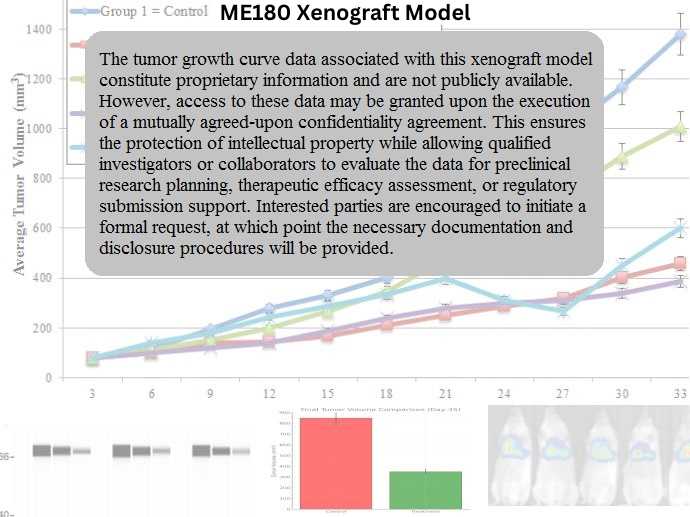
ME180 xenografts are typically established by injecting 5–10 × 10⁶ cells subcutaneously into the flanks of athymic nude or NOD/SCID mice. Tumor take rates exceed 85%, and xenografts are usually palpable within 10–14 days. Growth is moderate and consistent, with tumor volumes reaching 1,000–1,200 mm³ in approximately 5–6 weeks post-injection. ME180 tumors grow as well-vascularized, well-demarcated masses with low ulceration incidence.
The model is compatible with both subcutaneous and orthotopic implantation strategies. Orthotopic engraftment into the cervicovaginal mucosa allows for more physiologically relevant drug delivery and immune profiling, particularly useful in studies of viral antigen presentation and mucosal immune cell infiltration.
This model supports non-invasive imaging, tumor resection studies, and molecular endpoint analyses in longitudinal experiments.
Request a Custom Quote for ME180 Xenograft ModelHistopathology and Immunohistochemical Profile
ME180 xenografts exhibit moderately differentiated squamous histology, characterized by polygonal epithelial cells arranged in solid nests with frequent intercellular bridges and eosinophilic cytoplasm. Occasional keratin pearl formation and mitotic figures are observed, indicating active proliferation and partial keratinization.
Immunohistochemical staining reveals strong expression of cytokeratins (CK5/6), pan-keratin, and E-cadherin. Nuclear Ki-67 staining indicates a proliferation index of 50–60%. p53 staining is absent due to proteasomal degradation driven by HPV E6, and Rb expression is diminished. EGFR shows membranous to cytoplasmic localization, while HPV E6/E7 oncoproteins are consistently expressed in tumor tissue. CD31-positive endothelial structures outline the tumor vasculature.
These histologic features underscore the model’s value in therapy testing, especially for agents that rely on intact epithelial architecture or DNA damage signaling.
Preclinical Applications and Drug Response
The ME180 xenograft model has demonstrated broad utility in cervical cancer research, particularly in the context of HPV-targeted therapeutics and immune-oncology. Its applications include:
- Radiation and radiosensitizer studies, due to its intermediate DNA repair capacity
- EGFR-targeted therapies, including tyrosine kinase inhibitors (e.g., erlotinib)
- DNA-damaging agents such as cisplatin and carboplatin
- HPV-directed immunotherapy, including peptide-based vaccines and adoptive T cell therapy
- Checkpoint blockade studies, evaluating PD-1/PD-L1 or CTLA-4 inhibitors in HPV-positive tumors
- RNA interference or gene-editing studies, targeting E6/E7 to restore p53 and Rb functions
The model supports a range of combination therapy experiments and serves as a comparative benchmark alongside other HPV-driven xenografts such as Ca Ski or SiHa.
Request This Model
To integrate the ME180 xenograft model into your cervical cancer research or therapeutic development program, request a customized xenograft services package below. Available options include tumor implantation, therapeutic dosing studies, immunohistochemistry, and antigen-specific immune profiling.
Request a Custom Quote for ME180 Xenograft Model