LCLC-97TM1 Xenograft Model Overview
The LCLC-97TM1 xenograft model is derived from a human large cell lung carcinoma (LCLC) and serves as a specialized system for studying poorly differentiated non-small cell lung cancer (NSCLC) with neuroendocrine and mesenchymal features. The LCLC-97TM1 cell line was established from a primary resected tumor in a male patient and is representative of high-grade LCLC with aggressive clinical behavior and limited therapeutic responsiveness. When engrafted subcutaneously into immunodeficient mice, LCLC-97TM1 cells form rapidly proliferating tumors with a high degree of histological uniformity and stromal organization, enabling controlled evaluation of drug response kinetics and biomarker modulation. This model is especially relevant for translational studies exploring cytotoxic chemotherapy resistance, apoptosis-inducing agents, EMT-targeting compounds, and immunomodulatory strategies in non-adenocarcinoma NSCLC subtypes.
Request a Custom Quote for LCLC-97TM1 Xenograft ModelBiological and Molecular Characteristics
The LCLC-97TM1 cell line lacks mutations in canonical oncogenic drivers such as KRAS and EGFR, aligning with the genomic landscape of many large cell carcinomas. Instead, it features inactivation of TP53 and loss of RB1, resulting in cell cycle dysregulation and apoptotic resistance. The cell line demonstrates mesenchymal characteristics, including strong vimentin expression, low E-cadherin levels, and variable cytokeratin expression, indicating partial epithelial-mesenchymal transition (EMT). It expresses low baseline levels of PD-L1, though the PD-L1 axis is inducible under inflammatory stimulation. Elevated expression of anti-apoptotic proteins including BCL-2, BCL-XL, and survivin supports its use in studies targeting intrinsic apoptosis resistance. These molecular traits make LCLC-97TM1 an effective model for evaluating agents directed at non-oncogene-addicted tumor subtypes with mesenchymal and neuroendocrine features.
| Characteristic | Description |
|---|---|
| Tissue Origin | Human lung (large cell carcinoma, primary tumor) |
| Key Genetic Features | TP53 mutant, RB1 loss, KRAS/EGFR wild-type |
| Phenotype Markers | Vimentin+, low E-cadherin, CK (variable), EMT+ |
| Anti-apoptotic Proteins | BCL-2+, BCL-XL+, survivin+ |
| Immunophenotype | Low PD-L1, inducible; MHC class I positive |
In Vivo Model Development and Tumorigenicity
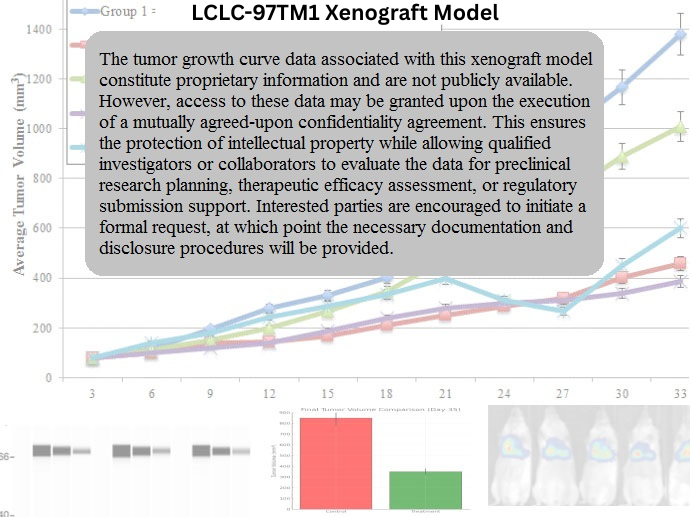
The LCLC-97TM1 xenograft model is established via subcutaneous implantation into immunodeficient murine strains such as athymic nude or NOD/SCID mice. Tumor formation occurs within 10–14 days post-inoculation, and tumors typically reach 400–600 mm³ within four to five weeks. The model demonstrates a high take rate, uniform histology, and reproducible growth kinetics, making it highly suitable for longitudinal studies involving therapeutic dosing, pharmacodynamic biomarker analysis, and resistance development. The tumor microenvironment exhibits moderate vascularization, supporting compound penetration and distribution studies. The aggressive nature of the LCLC-97TM1 model also allows for time-sensitive efficacy evaluation of novel compound libraries and dose-fractionated regimens in preclinical development.
Request a Custom Quote for LCLC-97TM1 Xenograft ModelHistopathology and Immunohistochemical Profile
Histological examination of LCLC-97TM1 xenografts reveals undifferentiated large cell carcinoma morphology, with sheets of polygonal tumor cells, prominent nucleoli, and abundant cytoplasm. Hematoxylin and eosin staining indicates nuclear pleomorphism and occasional mitotic activity. Immunohistochemistry shows strong cytoplasmic vimentin staining, weak and patchy expression of cytokeratins, and reduced membranous E-cadherin, consistent with a mesenchymal phenotype. Ki-67 proliferation indices typically exceed 70%, highlighting the model’s aggressive tumor kinetics. BCL-2 and BCL-XL expression is diffuse and high, while PD-L1 staining is minimal in untreated tumors. This histological and molecular profile supports the model’s application in drug resistance modeling, cell cycle checkpoint inhibition, and apoptosis-sensitizing combination therapy research.
Preclinical Applications and Drug Response
The LCLC-97TM1 xenograft model is primarily used in studies targeting aggressive, treatment-refractory NSCLC subtypes. It demonstrates limited sensitivity to EGFR and ALK inhibitors due to its wild-type genotype but responds variably to cytotoxic agents such as cisplatin, paclitaxel, and topoisomerase inhibitors. Its mesenchymal features and apoptotic resistance profile make it well-suited for evaluating BCL-2 family inhibitors, CHK1/ATR axis modulators, and EMT-reversing compounds. The model has also been employed in immunotherapy research to examine the impact of PD-L1 induction and immune-priming agents in combination with chemotherapy. Additionally, its stable tumor progression and predictable histology facilitate the testing of targeted drug delivery platforms and formulation technologies, including liposomal carriers and biodegradable nanoparticles for localized or sustained therapeutic exposure.
Request This Model
To request the LCLC-97TM1 xenograft model for your preclinical studies, please use the form below. A customized quote and additional model specifications will be provided upon inquiry.
Request a Custom Quote for LCLC-97TM1 Xenograft Model