KG-1 Xenograft Model Overview
The KG-1 xenograft model is derived from a human acute myelogenous leukemia (AML) cell line originally established from the bone marrow aspirate of a 59-year-old male patient diagnosed with erythroleukemia. As a representative model of early myeloid progenitor malignancies, KG-1 retains features of primitive hematopoietic precursors and has become a foundational tool in studying leukemogenesis, drug resistance, and hematopoietic differentiation. KG-1 xenografts are used extensively in preclinical studies evaluating the efficacy of chemotherapeutics, small molecule inhibitors, and immunomodulatory agents in myeloid malignancies, particularly in AML subtypes with immature blast phenotypes.
Request a Custom Quote for KG-1 Xenograft ModelBiological and Molecular Characteristics
KG-1 cells exhibit a loosely adherent, cluster-forming morphology in culture and are immunophenotypically consistent with early myeloid progenitor cells. The line expresses CD34, HLA-DR, CD13, and CD33, but lacks lineage-specific markers such as CD14 and CD15, reflecting a differentiation block. KG-1 cells do not express terminal myeloid enzymes such as myeloperoxidase, and they possess low clonogenic capacity in methylcellulose assays unless treated with differentiating agents like PMA or ATRA. Genetically, the model is p53 wild-type but exhibits abnormalities on chromosomes 8 and 9 and carries a constitutively active STAT5 signaling axis. The cells are resistant to glucocorticoids and demonstrate moderate responsiveness to DNA hypomethylating agents and FLT3 inhibitors, despite lacking FLT3-ITD mutations.
| Characteristic | KG-1 Cell Line Profile |
|---|---|
| Disease Origin | Acute myelogenous leukemia (erythroleukemia) |
| Immunophenotype | CD34⁺, CD13⁺, CD33⁺, HLA-DR⁺ |
| Differentiation Status | Immature, blocked progenitor |
| FLT3 Status | Wild-type |
| p53 Status | Wild-type |
| Key Pathways | STAT5, JAK-STAT, cell cycle regulation |
In Vivo Model Development and Tumorigenicity
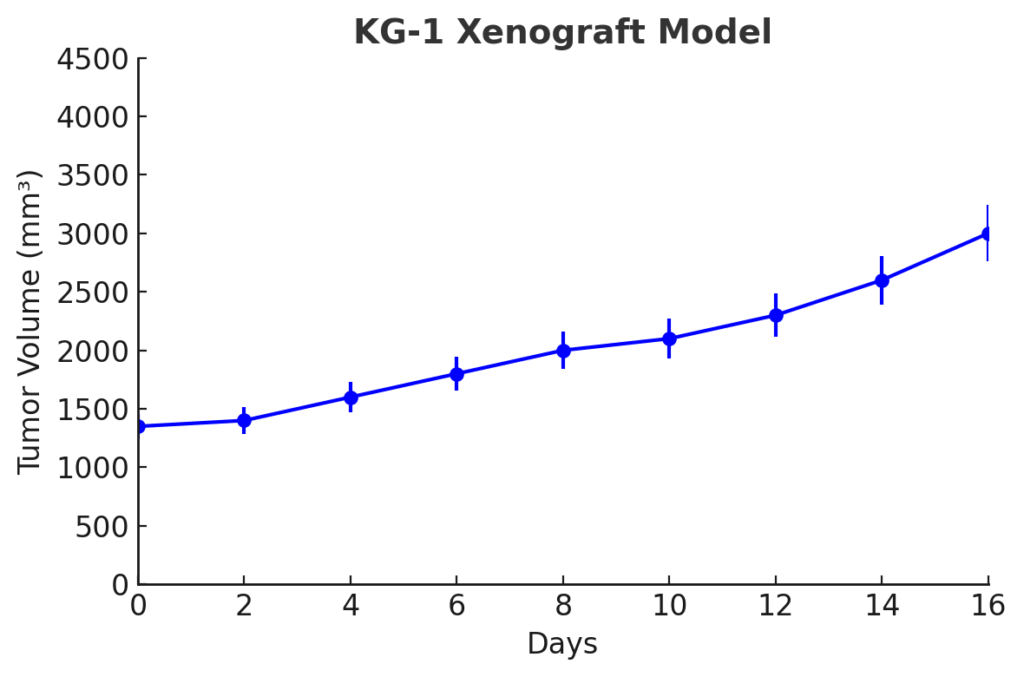
KG-1 xenograft models are generated through subcutaneous or intravenous injection of tumor cells into immunocompromised murine hosts, most commonly NSG or NOD/SCID mice. Subcutaneous tumors exhibit slower growth kinetics compared to more aggressive AML models, typically requiring 5–6 weeks to reach target volumes of 700–900 mm³. Disseminated models show limited infiltration into bone marrow and spleen but are useful for studying early leukemic engraftment and myeloid progenitor persistence. The take rate is moderate and can be enhanced by co-administration with Matrigel or by preconditioning the host with sublethal irradiation. KG-1 xenografts are especially suitable for evaluating therapies targeting immature blast populations or promoting terminal differentiation.
Request a Custom Quote for KG-1 Xenograft ModelHistopathology and Immunohistochemical Profile
Histologically, KG-1 xenografts are composed of loosely packed, medium-sized blast cells with round nuclei, inconspicuous nucleoli, and scant cytoplasm. H&E staining reveals minimal stromal involvement and limited necrosis, consistent with the slower proliferation rate of this model. Immunohistochemical analysis confirms positivity for CD34, CD33, and HLA-DR, with negative staining for lineage-specific antigens such as CD14 and myeloperoxidase. Phosphorylated STAT5 and Ki-67 markers are present, albeit at moderate levels, consistent with activated but non-aggressive cellular proliferation. These features render KG-1 useful for evaluating drugs that target leukemia-initiating cells and early myeloid progenitors.
Preclinical Applications and Drug Response
The KG-1 xenograft model has proven valuable in assessing the activity of epigenetic modulators, such as azacitidine and decitabine, and in evaluating the pro-differentiation potential of retinoids, HDAC inhibitors, and JAK/STAT pathway antagonists. Its relative resistance to standard chemotherapy highlights its relevance for modeling minimal residual disease and studying therapeutic resistance mechanisms in AML. KG-1 is also used to assess immune evasion and host–tumor interaction given its low immunogenicity and stable growth kinetics. Although less aggressive than other AML models, its primitive phenotype makes it a uniquely suited tool for evaluating drugs targeting leukemic stem cell populations and hematopoietic differentiation pathways.
Request This Model
To incorporate the KG-1 xenograft model into your AML-focused preclinical studies or therapeutic development programs, reach out to our team for complete model specifications and support in designing custom efficacy, differentiation, or resistance evaluation protocols for early myeloid leukemias.
Request a Custom Quote for KG-1 Xenograft Model