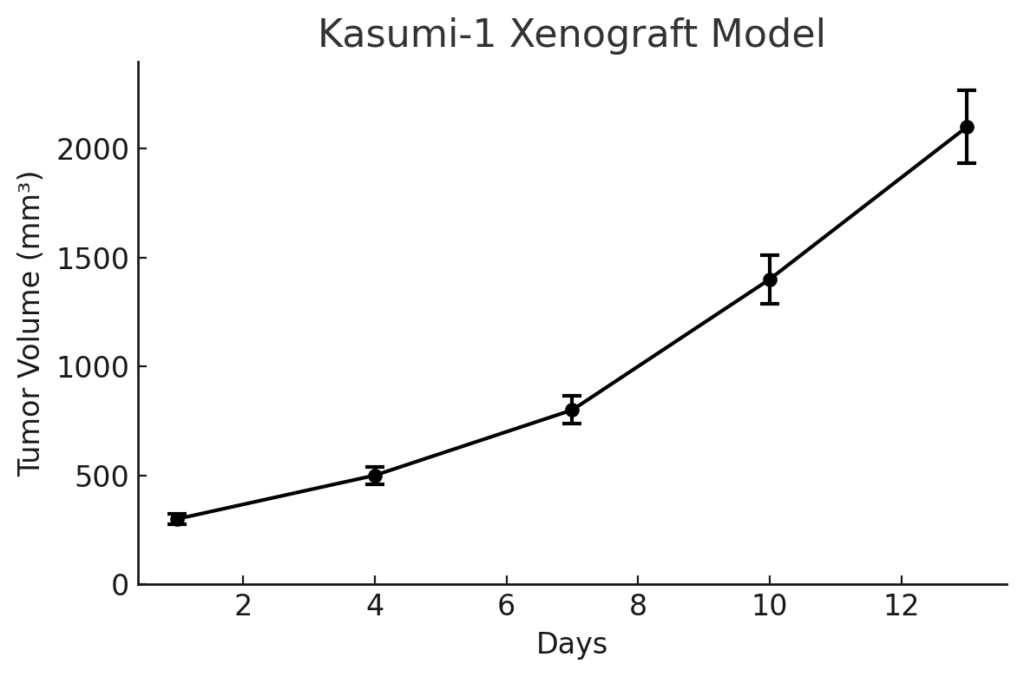
Kasumi-1 Xenograft Model Overview
The Kasumi-1 xenograft model is derived from a human acute myeloid leukemia (AML) cell line established from the peripheral blood of a 7-year-old Japanese boy with AML M2 (according to the FAB classification). This model is distinguished by the presence of the t(8;21)(q22;q22) translocation, resulting in the AML1-ETO (RUNX1-RUNX1T1) fusion gene, a hallmark of core-binding factor (CBF) leukemia. Additionally, Kasumi-1 harbors a KIT N822K mutation, a recurrent secondary lesion in t(8;21)-positive AML. These defining genetic alterations contribute to leukemogenesis through impaired hematopoietic differentiation and enhanced survival signaling. The Kasumi-1 xenograft model is a well-validated preclinical platform for evaluating therapies targeting CBF leukemias, epigenetic modulators, tyrosine kinase inhibitors, and pro-differentiation agents.
Request a Custom Quote for Kasumi-1 Xenograft ModelBiological and Molecular Characteristics
Kasumi-1 cells display a suspension morphology with occasional clustering and a high mitotic index in vitro. They are positive for markers of early myeloid commitment, including CD34, CD13, CD33, HLA-DR, and CD117 (c-KIT). The cells are negative for monocytic and lymphoid markers, consistent with a granulocytic lineage block. The t(8;21) translocation leads to constitutive repression of RUNX1 target genes, impairing myeloid differentiation. Co-occurrence of the KIT N822K mutation activates downstream pathways such as PI3K/AKT and MAPK/ERK, contributing to enhanced proliferation and chemotherapy resistance. Kasumi-1 cells are also characterized by expression of CD56, which has been associated with poor prognosis in t(8;21) AML cases.
| Characteristic | Kasumi-1 Cell Line Profile |
|---|---|
| Disease Origin | Acute myeloid leukemia (AML M2) |
| Chromosomal Abnormalities | t(8;21)(q22;q22), KIT N822K mutation |
| Fusion Gene | AML1-ETO (RUNX1-RUNX1T1) |
| Immunophenotype | CD34⁺, CD13⁺, CD33⁺, HLA-DR⁺, CD117⁺ |
| Signaling Pathways | PI3K/AKT, MAPK/ERK, epigenetic repression |
| Differentiation Status | Blocked granulocytic maturation |
In Vivo Model Development and Tumorigenicity
Kasumi-1 xenografts are typically established via subcutaneous or intravenous injection into immunodeficient mice, such as NOD/SCID or NSG strains. Subcutaneous models produce solid tumors that grow in a reproducible manner, reaching 700–900 mm³ in 4–5 weeks, while systemic dissemination models mimic leukemic infiltration of the spleen, bone marrow, and liver. The presence of the AML1-ETO fusion and KIT mutation confers moderate tumorigenicity and allows evaluation of agents targeting leukemic stem cell persistence, chromatin remodeling, and tyrosine kinase signaling. Pretreatment with busulfan or irradiation enhances bone marrow engraftment in intravenous models, facilitating leukemia burden assessments and survival endpoints.
Request a Custom Quote for Kasumi-1 Xenograft ModelHistopathology and Immunohistochemical Profile
Histopathological analysis of Kasumi-1 xenografts reveals dense accumulations of medium-sized blasts with finely dispersed chromatin, indistinct nucleoli, and scant cytoplasm. Hematoxylin and eosin staining shows diffuse infiltration with limited stromal response. Immunohistochemically, Kasumi-1 xenografts are positive for CD34, CD33, CD13, and CD117, with nuclear expression of AML1-ETO target proteins and cytoplasmic phosphorylated KIT. The absence of myeloperoxidase and monocytic markers reinforces the granulocytic immaturity of the model. Ki-67 staining reveals high proliferative activity, consistent with its clinical representation of proliferative yet differentiation-blocked AML.
Preclinical Applications and Drug Response
The Kasumi-1 xenograft model is a critical tool for preclinical evaluation of therapeutic agents in CBF AML, particularly those targeting AML1-ETO-mediated transcriptional repression or KIT-driven signaling. The model has shown responsiveness to tyrosine kinase inhibitors such as dasatinib and midostaurin, as well as HDAC inhibitors, DNMT inhibitors, and menin-MLL interaction inhibitors. It is also employed in testing agents that reverse the differentiation block, such as retinoids and other epigenetic therapies. The dual presence of AML1-ETO and KIT mutations allows investigators to evaluate synergistic drug combinations aimed at eradicating leukemic stem cells and overcoming resistance in t(8;21)-positive AML.
Request This Model
To integrate the Kasumi-1 xenograft model into your translational AML research or CBF leukemia drug development program, contact our scientific team for detailed specifications, support with model selection, and customized study designs for in vivo efficacy, resistance profiling, and biomarker validation.
Request a Custom Quote for Kasumi-1 Xenograft Model